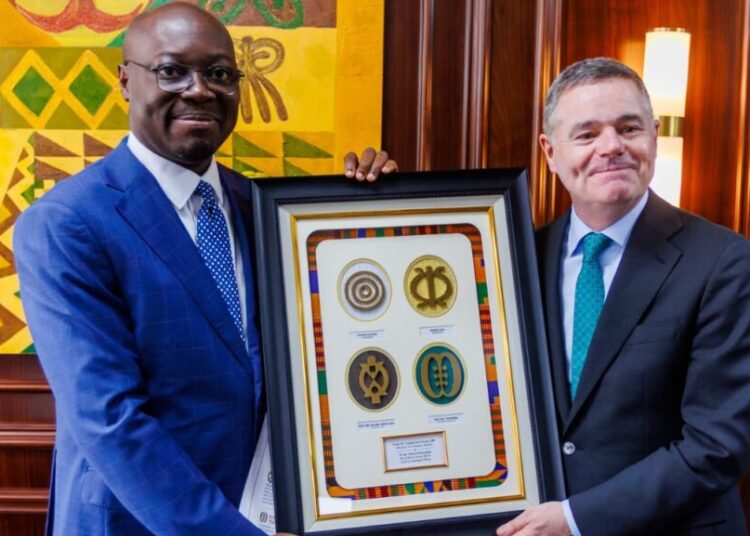
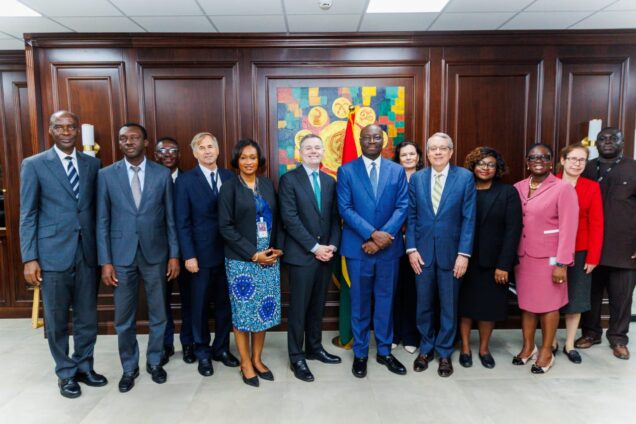
The Managing Director and Chief Knowledge Officer of the World Bank Group, Paschal Donohoe, has concluded a three day official visit to Ghana with a strong message of support for the country’s economic recovery, job creation agenda, and long term development priorities.
The visit marked Mr. Donohoe’s first official mission to Africa since assuming office in November 2025. It brought together top level government officials, private sector leaders, civil society actors, development partners, and academia in a series of high level engagements focused on advancing reforms that promote inclusive and sustainable growth.
Meetings were held with President John Mahama, Finance Minister Cassiel Ato Forson, and Education Minister Haruna Iddrisu, alongside senior policymakers and business leaders. Discussions centered on strengthening macroeconomic stability, expanding employment opportunities, improving education outcomes, and accelerating private sector led growth.
Mr. Donohoe reaffirmed the institution’s commitment to Ghana’s reform agenda, stressing that sustained collaboration would be essential to delivering tangible results for citizens. “The priority now is to work together to implement reforms at scale and ensure that growth translates into real opportunities for all Ghanaians,” he said.
Youth Employment Takes Center Stage
A key focus of the visit was Ghana’s pressing youth unemployment challenge. The Finance Minister acknowledged recent economic gains but emphasized that the employment gap among young people remains a major national concern.
He noted that public sector hiring alone cannot absorb the rapidly expanding youth population and called for deliberate policies that empower the private sector to generate sustainable jobs.
In response, the World Bank confirmed plans to undertake a comprehensive Jobs and Growth Analysis. The study will identify priority sectors with high employment potential and guide future policy direction and investment decisions.
The emphasis on data driven policymaking reflects a broader shift toward targeted interventions that align economic expansion with job creation.
Record Investment to Transform Secondary Education
One of the most significant outcomes of the visit was the confirmation of a 300 million dollar commitment to Ghana’s secondary education sector under the STARR-J Programme. The Secondary Education Transformation for Access, Relevance and Results for Jobs initiative represents the largest single World Bank allocation to Ghana’s education sector.
The announcement was made during a joint visit to the Armed Forces Senior High Technical School in Burma Camp, Accra. The new commitment nearly doubles the 180 million dollars initially discussed during the 2025 IMF and World Bank Spring Meetings and is expected to commence within the current fiscal year.
The programme will fund the rehabilitation and expansion of senior high schools and Technical and Vocational Education and Training institutions, with a strong emphasis on practical and job relevant skills.
Education Minister Haruna Iddrisu pledged a major overhaul of the instructional model within the TVET system. He committed to reversing the current structure from 90 percent theory and 10 percent practical training to a system anchored on 70 percent practical instruction.
He explained that investments in workshops and laboratory infrastructure would be critical to delivering this transformation and ensuring students graduate with employable competencies.
Tackling Skills Mismatch Through Industry Collaboration
At the University of Ghana, Mr. Donohoe delivered the institution’s first Vice Chancellor’s Occasional Lecture of 2026, where he highlighted the urgent need to bridge the gap between education and industry.
He described the persistent skills mismatch as a structural coordination failure and urged employers to play a more active role in shaping curricula and training systems.
“The data is clear on what works. The question is not what to do, but whether there are the political will and institutional capacity to do it on a scale,” Mr. Donohoe said.
He cited figures showing that 1.34 million young Ghanaians between ages 15 and 24, representing 21.5 percent of that population group, are not in employment, education, or training. The scale of the challenge, he stressed, requires urgent and coordinated national action.
The STARR-J programme builds on earlier gains from the Ghana Accountability for Learning Outcomes Project, which has trained more than 70,000 teachers and directly benefited over 3.1 million students, exceeding its original target.
Clean Energy and Industrial Expansion
The delegation also toured a landmark renewable energy project at LMI Holdings’ Tema Free Zones enclave. The site hosts a 16.82 megawatt rooftop solar installation, the largest in Africa and the third largest globally of its kind. The project was co financed by the International Finance Corporation.
Mr. Donohoe called for stronger collaboration between government and private investors to expand clean energy capacity, strengthen energy security, and power industrial growth.
LMI Holdings Chairman Kojo Aduhene used the occasion to advocate regulatory reforms to remove structural bottlenecks limiting private investment in solar energy. He pointed to gaps in power wheeling regulations and the absence of standardized power purchase agreement frameworks as key constraints.
The IFC reaffirmed its readiness to mobilize private capital for sustainable infrastructure and climate aligned investments in Ghana.
Private Sector as Engine of Growth
Mr. Donohoe also participated in a high level IFC Business Council meeting with private sector leaders. Conversations focused on removing barriers to business expansion, boosting productivity, and scaling job creation.
Particular attention was given to youth and women entrepreneurs, who own about 44 percent of Ghana’s micro, small, and medium enterprises. The World Bank Group emphasized that private sector led development remains central to Ghana’s long term growth and employment strategy.
The visit underscored an integrated partnership framework that links macroeconomic stability, human capital development, private enterprise expansion, and clean energy investment into a unified growth strategy.
By aligning financial support with structural reforms, the World Bank Group aims to help Ghana build a more resilient and inclusive economy.
Mr. Donohoe reiterated the institution’s long standing commitment to the country and its readiness to support reforms that strengthen institutions and expand opportunity.
READ ALSO: NAIMOS: 94 Excavators Seized, 237 People Arrested in Anti-Galamsey Operations