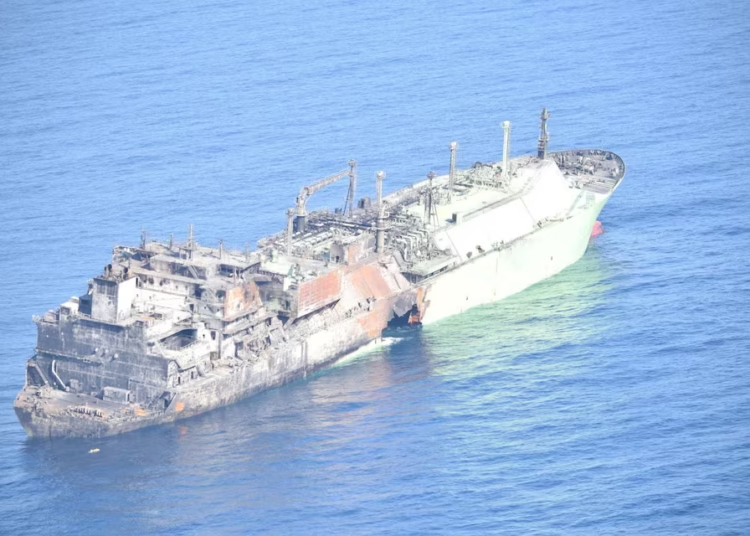
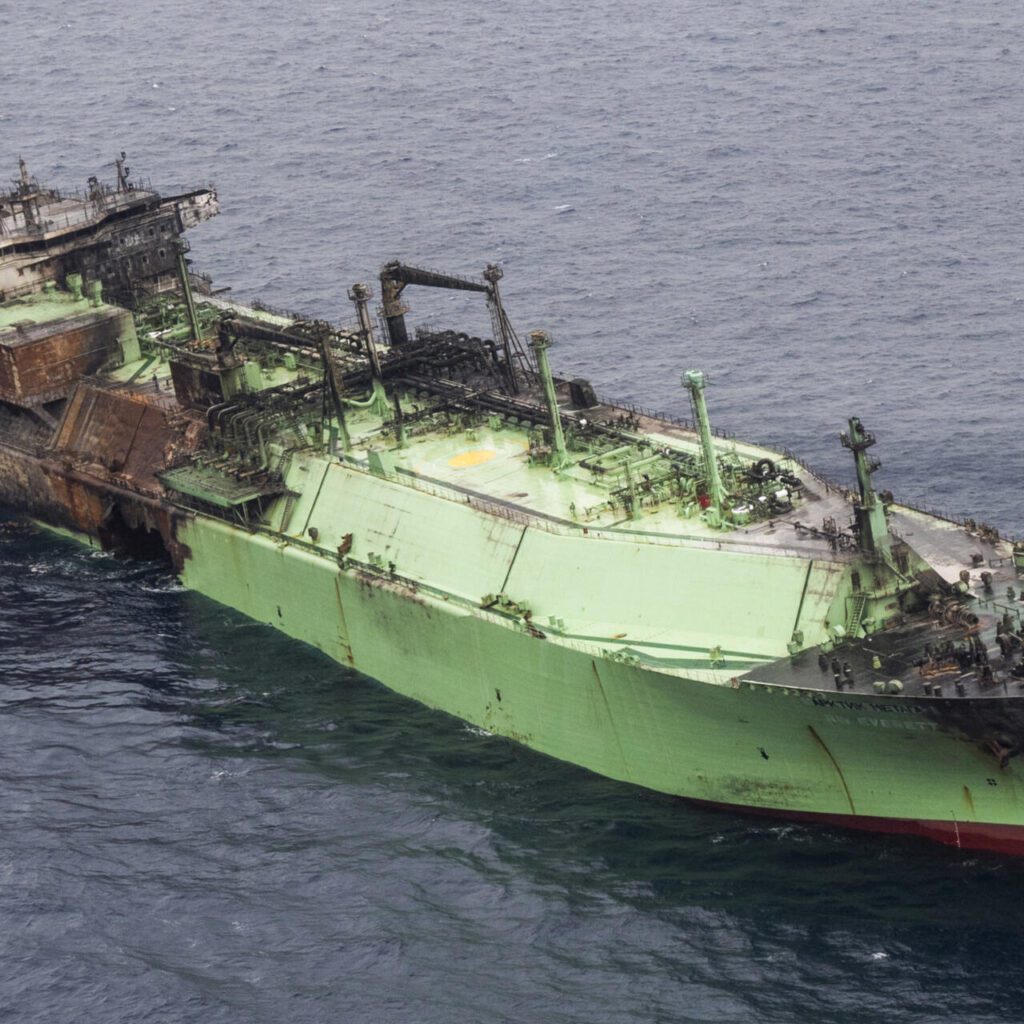
The Libyan Coast Guard has removed a severely damaged Russian Liquefied Natural Gas (LNG) tanker, identified as the “Arctic Metagaz,” after the unmanned vessel drifted dangerously close to the western coast near Zuwara following weeks of uncontrolled movement across the central Mediterranean.
The intervention comes amid growing regional alarm over what several European states described as a potential “major ecological disaster” due to the vessel’s compromised structural integrity and onboard LNG cargo.
The Commander of Operations for the central sector of the Coast Guard and Ports Security, Omar Mohamed Omar Al-Tuwair, indicated that the abandoned tanker has been towed away from Zuwara’s shores and assured the people of Libya in general, and the western coastal areas in particular, especially Zuwara and Sabratha, “that the relevant authorities are making every effort to deal with the situation,”
The tanker, reportedly linked to Russia’s so-called “shadow fleet” used in circumventing Western sanctions on energy exports, had been drifting without crew after sustaining severe damage in an explosion earlier this month.
The incident triggered coordinated concern across southern Europe, with governments including Italy, France, Spain, and several other European Union member states warning that the drifting ship posed an imminent environmental hazard, particularly as it moved unpredictably under the influence of winds and sea currents.
The vessel’s condition worsened after it reportedly suffered an onboard explosion, which Russian authorities attributed to a Ukrainian naval drone strike. The blast left the ship unmanned and structurally compromised, with aerial assessments indicating a large rupture in its hull.
The tanker, carrying liquefied natural gas at the time, raised fears of both gas leakage and potential fuel contamination across sensitive marine ecosystems in the central Mediterranean corridor.
In response, Libya’s National Oil Corporation (NOC) called on a specialist international firm to manage the threat posed by the damaged Russian Liquefied Natural Gas tanker.
Swift action is necessary to neutralise environmental threats within Libyan territorial waters and safeguard the coastline from pollution risks, and all Libyan oil installations, including platforms, terminals, and ports, remain secure and face no pollution hazard from the incident.
National Oil Corporation
Also, a high-level emergency response was immediately activated under the supervision of the Government of National Unity to address the challenge.
By the time the tanker approached Libyan waters, maritime monitoring indicated it had already drifted over 150 nautical miles from the southeastern vicinity of Malta, raising fears that shifting currents could push it directly toward densely populated coastal zones.
Libyan coast guard units eventually intervened, initiating towing operations to redirect the vessel away from the shoreline and toward a designated port under controlled conditions.
Maritime Risk, Energy Security, and Environmental Threats in the Central Mediterranean
The central Mediterranean is widely regarded as one of the world’s most strategically important maritime corridors, serving as a critical conduit between the Atlantic Ocean via the Strait of Gibraltar and the eastern Mediterranean routes that extend through the Suez Canal toward Asia.
This narrow, heavily trafficked sea lane is essential to global trade and energy flows, but it also represents a politically sensitive, geographically complex maritime space bordered by North Atlantic Treaty Organization (NATO) member states and North African countries with uneven levels of maritime surveillance and enforcement capacity.
The “Arctic Metagaz” drifting on the coasts shows that maritime risk in the region is no longer limited to conventional hazards such as severe weather, mechanical failure, or navigational error. Instead, shipping operations now increasingly operate within what analysts describe as a “hybrid environmental threat”, where geopolitical tensions and irregular maritime activity intersect with traditional safety risks.
At the same time, the Mediterranean Sea’s status as a semi-enclosed basin with restricted water exchange with the Atlantic significantly heightens its environmental vulnerability. Contaminants introduced into this system tend to persist longer and disperse more slowly than in open-ocean conditions, increasing the likelihood of prolonged and cumulative ecological impacts.
The region is also among the most diverse and economically significant marine environments globally. It supports extensive fisheries, a robust tourism sector, and coastal communities whose livelihoods are directly tied to the health and stability of marine ecosystems.
Within this context, any major spill involving fuel oil, liquefied natural gas (LNG) derivatives, or related hazardous materials would have consequences extending far beyond immediate pollution. Such an incident could cause long-term degradation of fragile marine ecosystems.
Against this backdrop, industry experts have characterized the presence of a damaged, drifting LNG carrier as creating an “environmental uncertainty risk.”
READ ALSO : AU Marks International Day of Remembrance of the Victims of Slavery and the Transatlantic Slave Trade