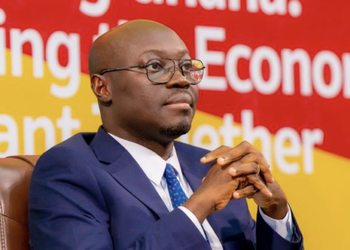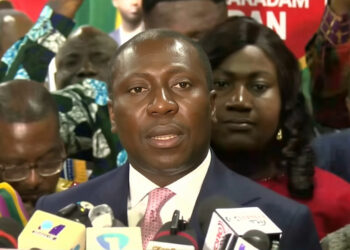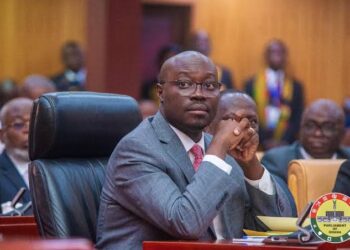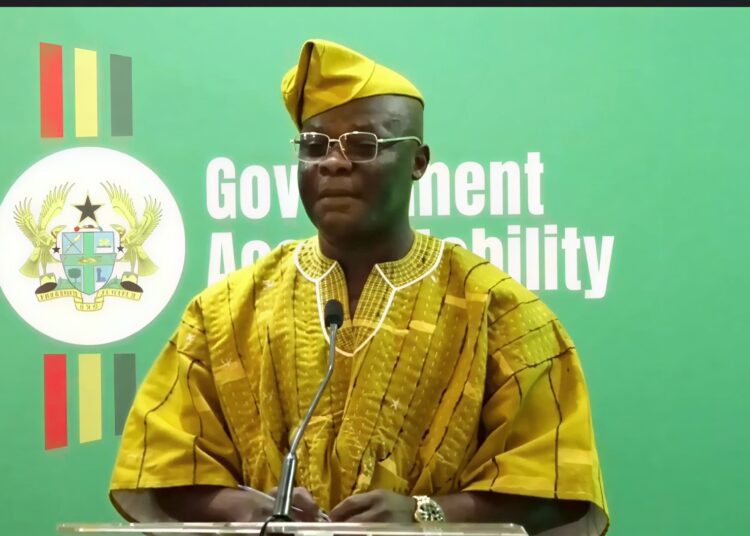
The Minister for Local Government, Chieftaincy and Religious Affairs, Honourable Ahmed Ibrahim, addressed stakeholders and media houses during the Government Accountability Series, presenting a detailed account of the decentralisation sector. He acknowledged his deputy, Honourable Rita Naa Odoley Sowah, chief directors, traditional leaders, assembly members, and media personnel for their roles in governance.
He indicated that the government inherited a weakened decentralisation structure in 2025, influenced by persistent financial and administrative challenges. Metropolitan, Municipal and District Assemblies, he explained, faced serious constraints in discharging their statutory responsibilities due to irregular resource flows.
According to the Minister, funding to the assemblies had remained inconsistent over several years under the previous administration. Less than half of the District Assemblies Common Fund reached the assemblies, limiting their capacity to deliver services effectively.
He further explained that statutory guidelines required under the Local Governance Act were not issued consistently, affecting financial discipline. Only the initial year, he said, received formal direction, leaving subsequent years without clear operational guidance.
Referencing the constitutional provision mandating a fixed percentage of national revenue for local assemblies, he observed that the expected allocation was not fully released and was instead applied to other national priorities.
He attributed this as a central issue in assessing the previous government’s approach to decentralisation, linking it to what he described as an inability to prioritise local government, while referencing a direct quote from former administrator Naa Toshie, who stated that “the NPP under Nana Akufo-Addo, deputized by Alhaji Mahmoud Bawumia, did not take decentralisation seriously.”
He added that the pattern of irregular disbursement weakened planning at the district level, making it difficult for assemblies to execute development projects and maintain essential services.
The Minister also pointed out that the absence of regular financial releases disrupted accountability mechanisms, as assemblies could not fully account for funds that were not received as expected.
These challenges, he said, created a gap between policy intentions and implementation outcomes across the country, causing decentralisation to lose momentum.
He then outlined the policy direction under the current administration, describing it as a structured effort to restore functionality. The reforms, he said, were guided by a clear objective to strengthen local governance institutions.
He cited the merger of local government, chieftaincy, religious affairs and sanitation as a strategic decision, explaining that the integration improved coordination and strengthened institutional alignment across sectors.
According to the Minister, the reforms had restored operational capacity within the assemblies, with the reset agenda focused on improving service delivery and ensuring balanced development nationwide.

Government Advances Reforms to Strengthen Local Governance System
The Minister pointed out that President John Mahama’s experience in local governance had influenced the direction of reforms within the sector. His background as a former assembly member, he explained, informed decisions aimed at strengthening decentralised administration.
He said the restructuring of the ministry created a unified system for governance and service delivery, improving coordination and clarifying institutional responsibilities.
The reform agenda, he described, was a deliberate process to restore systems that had weakened over time. “A practitioner ascended to leadership and reset the system to deliver results,” he remarked.
He explained that the ministry’s current mandate covered decentralisation, traditional authority and religious coexistence, with sanitation and environmental management forming part of its responsibilities within local governance.
These functions, he added, were aligned with national development priorities and constitutional provisions, ensuring governance structures operated within established legal frameworks.
Pointing to Article 35 of the Constitution as a guide for equitable development, he explained that policies were designed to promote balanced socio-economic growth within a decentralised framework.
He added that the ministry coordinated programmes to support assemblies in delivering services to their communities, while monitoring and evaluation systems had been strengthened to improve accountability.
Assemblies, he noted, were now better positioned to respond to local needs, with improved administrative clarity and funding flows enhancing their operational effectiveness.
The Minister indicated that the reforms were already producing measurable improvements in governance at the district level, with communities beginning to experience more responsive service delivery.
He emphasised that the ministry would continue to strengthen decentralisation through sustained policy implementation, maintaining that the objective remained the creation of an efficient and accountable local governance system across the country.
READ ALSO: Vice President Opoku Agyemang Addresses Ghanaian Diaspora In Spain