
Fresh polling data released by Global InfoAnalytics has revealed a sharp decline in support for the New Patriotic Party in Ashanti Region, raising serious questions about the party’s grip on one of its most dependable political strongholds.
The analysis, presented by its Executive Director, Mussa Dankwa, compares voter affiliation data collected in October 2024 with findings published in March 2026. When placed side by side, the figures reveal what political analysts are describing as one of the most significant regional political shifts since Ghana’s last general election.
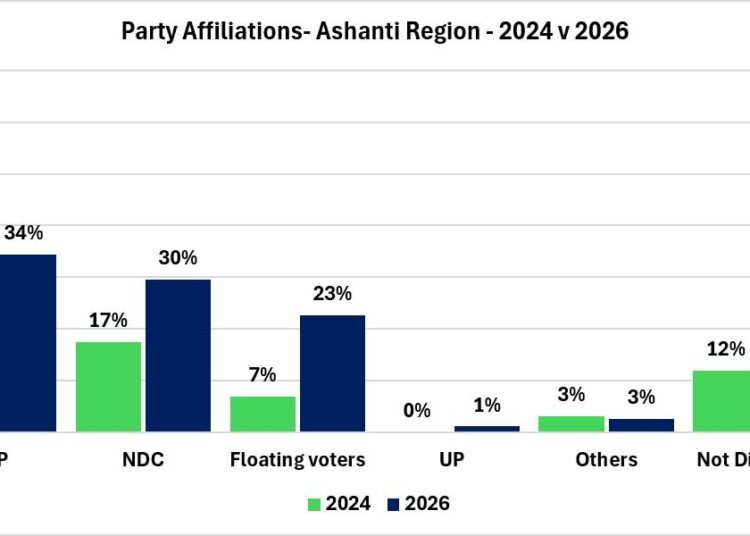
According to the data, voters in the Ashanti Region who identified with the New Patriotic Party stood at 61 percent in October 2024. By March 2026, that figure had dropped sharply to 34 percent, representing a decline of 27 percentage points within just over a year.
The scale of the decline is significantly higher than the party’s national trend over the same period. Nationally, support for the NPP moved from 37 percent in 2024 to 25 percent in 2026, a drop of 12 percentage points.
The sharper decline in the Ashanti Region, long regarded as the electoral backbone of the party, has sparked concern among party insiders, political strategists, and independent analysts.

Mr. Dankwa warned against attempts to minimise the significance of the figures, arguing that any political strategist who focuses only on supporters who may have stayed away from recent voting exercises while ignoring the broader changes in party affiliation is missing the larger political reality.
He explained that the trend unfolding in the Ashanti Region is more severe than what the party is experiencing nationally, describing it as a development that should command immediate strategic attention.
NDC Gains Ground in NPP Territory
While the opposition New Patriotic Party’s numbers have declined sharply, the polling data shows the ruling National Democratic Congress making notable gains in the same region.
According to the survey, support for the NDC in the Ashanti Region rose from 17 percent in October 2024 to 30 percent in March 2026, representing a 13 percentage point increase.
The data suggests that the NDC, together with floating voters, were the only voter groups that recorded growth during the period under review. According to Mr. Dankwa’s analysis, this indicates that many of the gains being recorded by the NDC may be coming from voters who changed political allegiance after the 2024 election.

The renowned pollster noted that the shift is particularly significant because the Ashanti Region has historically been viewed as one of the most difficult electoral terrains for the NDC. Any measurable gains in such a region could have important implications for future electoral strategies and national political calculations.
Mr. Dankwa noted that when voter movement is examined in context, the emerging pattern suggests that support is not simply becoming fragmented but is actively shifting toward competing political alternatives.
Akan Voter Trends Deepen Concerns
The polling data also points to a major change among Akan voters, a demographic group widely considered central to the electoral fortunes of the New Patriotic Party.
According to the analysis, 67 percent of Akan voters identified with the NPP in 2024. By March 2026, that number had fallen to 41 percent, representing a 26 percentage point decline.
At the same time, support for the National Democratic Congress among Akan voters increased from 14 percent to 24 percent, representing a 10 percentage point rise.
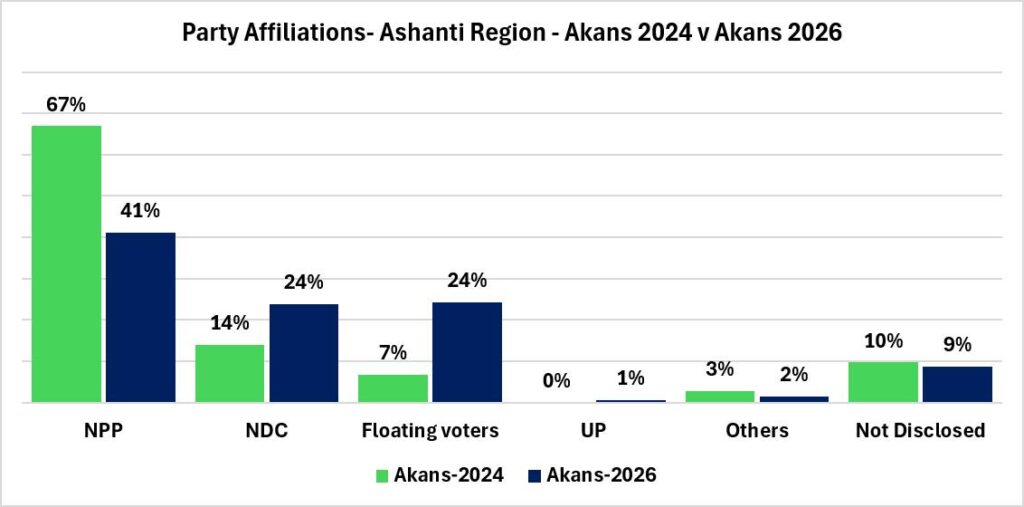
Mr. Dankwa observed that the decline among Akan voters closely mirrors the broader regional trend, suggesting that the political changes taking place in the Ashanti Region are not isolated but may reflect deeper shifts within key demographic blocs that have traditionally supported the NPP.
The national picture also presents an interesting contrast. According to the latest polling data, 40 percent of Akan voters nationwide now identify with the NDC, while 30 percent align with the NPP.
Analysts say these figures suggest that competition for one of Ghana’s most politically influential voter groups is becoming increasingly intense.
Strategic Questions for the Opposition
The latest numbers are expected to trigger serious internal reflection within the opposition New Patriotic Party as the party looks toward future electoral contests.
For decades, the Ashanti Region has served as one of the party’s strongest political bases, delivering substantial electoral margins during national elections.
Any sustained erosion of support in the region could significantly alter the party’s electoral calculations and force a reassessment of campaign strategy, grassroots mobilisation, and voter engagement.
Mr. Dankwa stressed that when the October 2024 and March 2026 data are viewed together, the scale of the political movement becomes difficult to ignore. He said the numbers reveal a seismic shift in party affiliations within a region that has historically formed the backbone of the main opposition.
While he acknowledged that such figures may encourage optimism within the NDC, he cautioned against drawing premature conclusions, insisting that political data must always be understood within a broader electoral context.

A Changing Political Landscape
The findings from Global InfoAnalytics are likely to intensify political calculations across Ghana’s major parties. For the NPP, the challenge now appears to be rebuilding trust within traditional support bases while addressing the factors driving voter defections.
For the NDC, the data may provide fresh encouragement that strategic gains made after the 2024 election are beginning to translate into measurable support in regions once considered politically inaccessible.
As Ghana’s political landscape continues to evolve, the latest polling figures may offer one of the clearest signs yet that voter loyalty, even in the country’s most established political strongholds, can no longer be taken for granted.
READ ALSO: Bank of Ghana Bets Big on Fintech Future