
Fresh polling data from Ghana’s politically strategic Volta Region is raising new questions about voter alignment in one of the most reliable electoral strongholds of the governing National Democratic Congress,
The new survey figures suggest that the party’s support base has weakened over the past eighteen months, even as the main opposition struggles to convert those losses into political gains.
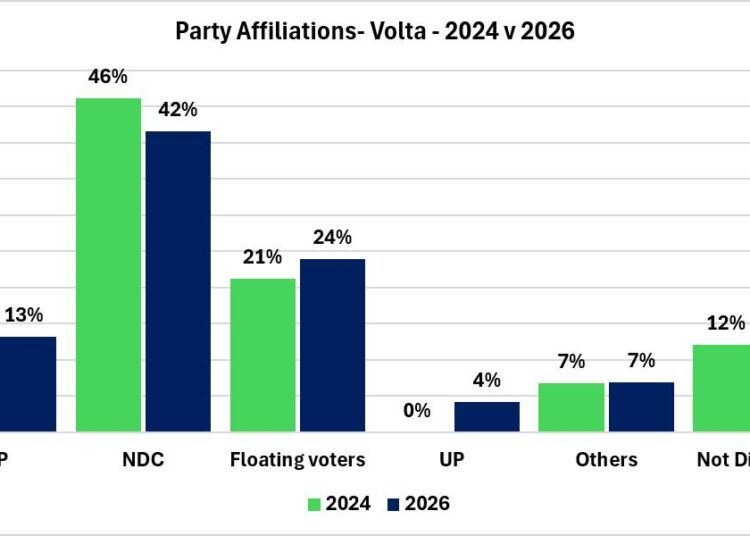
The latest analysis, presented by Mussa Dankwa, compares party affiliation data gathered in October 2024 with fresh polling conducted in March 2026. The findings reveal what the pollster describes as an early warning signal emerging from the Volta Region, long regarded as the electoral heartbeat of the NDC.
According to Mr Dankwa, while the NDC continues to command the largest share of party affiliation in the region, its support has declined in a manner that deserves serious strategic attention. “Volta Region fires warning shots but NPP fails to capitalize,” Mr Dankwa observed as he unveiled the comparative figures.
The data shows that in October 2024, the NDC accounted for 46 percent of voters in the region. By March 2026, that figure had dropped to 42 percent, representing a four percentage point decline within a traditionally loyal political base.
Though the fall may appear modest on the surface, analysts say any measurable erosion within the Volta Region carries significant political implications given the region’s historic role in delivering substantial electoral margins for the governing party.
NPP Records Minimal Gains Despite NDC Decline
Despite the apparent weakening of the ruling National Democratic Congress’s dominance, the opposition New Patriotic Party has shown little evidence of capitalizing on the shift.
According to the survey data, the NPP’s regional support also declined, moving from 14 percent in 2024 to 13 percent in 2026. The one percentage point drop suggests that dissatisfaction among some NDC aligned voters is not necessarily translating into direct gains for the opposition.
For political observers, that may be one of the most revealing aspects of the latest numbers. Rather than defecting to the NPP, a growing number of voters appear to be moving toward political independence or exploring alternatives outside the traditional two-party system.

This trend becomes clearer in the category of floating voters, which rose from 21 percent in 2024 to 24 percent in 2026. The emergence of the United Party also adds a fresh dynamic to the regional political landscape.
The party, which previously registered no measurable affiliation in the region, now commands four percent of voter identification according to the latest survey.
Political strategists say this could indicate growing appetite for alternatives, particularly among younger voters and citizens frustrated by conventional party politics.
Ewe Voter Shift Raises Strategic Questions
Perhaps even more striking is the change in political affiliation among the region’s dominant ethnic voting bloc. Among Ewe voters, who have historically formed the backbone of NDC electoral strength in the Volta Region, support for the governing party has fallen more sharply.
According to Mr Dankwa’s analysis, NDC affiliation among Ewe voters dropped from 51 percent in October 2024 to 43 percent in March 2026, representing an eight percentage point decline. The numbers suggest that the shift is not merely demographic but may be occurring within the party’s most dependable support constituency.
At the same time, the NPP made only marginal gains among Ewe voters, moving from 10 percent to 12 percent, a two percentage point increase that remains insufficient to alter the broader political balance in the region.

The United Party also gained visibility among Ewe voters, registering three percent support where previously it had no measurable presence. For election analysts, these figures may signal the beginning of a more fluid voter environment in a region that has historically produced predictable political outcomes.
Regional Exception in National Political Trends
Mr Dankwa noted that the Volta Region stands out as a notable exception within Ghana’s broader political landscape. According to his nationwide analysis, the NDC has improved its party affiliation figures in nearly every other region since 2024, while the NPP has recorded declines across multiple regional strongholds.
The Volta Region therefore appears to be the only major area where the governing party is losing ground while simultaneously facing limited competitive pressure from its principal rival.
“This is where the major parties are seeing changes in voter alignment,” Mr Dankwa explained, suggesting that the regional numbers should be interpreted as a strategic signal rather than a temporary statistical fluctuation.
Political analysts say such shifts could influence campaign planning, resource allocation, and voter engagement strategies ahead of future national elections.
What the Numbers Could Mean
Although the NDC remains the dominant political force in the Volta Region, the decline in affiliation among both the general voting population and the Ewe majority may force party strategists to reassess grassroots engagement, policy communication, and regional mobilization.

At the same time, the NPP’s inability to significantly benefit from this erosion raises questions about its regional strategy and long term penetration in one of Ghana’s most politically symbolic regions.
The rise in floating voters and the appearance of smaller political alternatives may indicate that the real contest in Volta is no longer simply between the two traditional political giants.
Instead, the region may be entering a new phase where voter loyalty becomes less automatic and more performance-driven. For now, the warning signs are clear. The NDC may still hold the Volta Region, but the numbers suggest its grip is no longer as unquestioned as it once was.
READ ALSO: Ghana Economist Breaks Global Research Ranking Barriers