Authored by Evans Senior Owu (Columnist, Policy & M&E Professional)
There is a scene now playing out in Ghana’s courts that ought to concern every citizen who cares about accountable governance. The Attorney General’s Department, the republic’s lead prosecution arm, is actively pursuing the Mahama 2.0 government’s flagship accountability agenda dubbed the Operation Recover All Loot (ORAL).
It has already initiated charges against former government officials, including Adu Boahene (Former head of the National Signal Bureau), the controversial Sky Train project principals, NPP financier Chairman Wontumi, and Abdul Hannan, the former CEO of the National Buffer Stock Company.
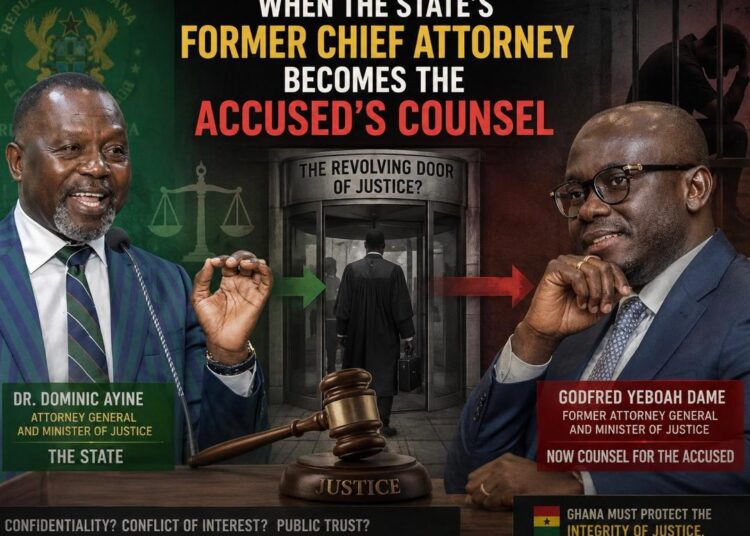
Sitting on the other side of that courtroom in the Abdul Wahab Hannan matter, as defense counsel, is none other than Godfred Yeboah Dame, the immediate past Attorney General of Ghana, the very man who, until January 2025, was the constitutional head of the institution now prosecuting his client. This is not, strictly speaking, illegal. And that is precisely the problem.
This Is Not About Godfred Dame, the Man
Let us be clear from the outset: this perspective is not a personal indictment of Godfred Dame. He is a lawyer, trained and qualified, and he has every right to earn his livelihood in private practice now that he has left public office. Neither is he the first to walk this road.
The current Attorney General, Dr. Dominic Ayine, himself served as Deputy Attorney General during President Mahama’s first term between 2013 and 2017 and thereafter returned to private legal practice, representing various clients with interests touching the state.
The revolving door between Ghana’s Attorney General’s Department and private legal practice is a well-worn path; what it lacks is the restraints. The legitimate concern here is not the mere return to private practice. It is the choice of the client and the case.
When a former Attorney General, an official who held supervisory authority over the Economic and Organized Crime Office (EOCO), the BNI, and the FIC, and maintained daily working relationships with the Ghana Police Service and the courts, returns within months of leaving office to represent a person being criminally prosecuted by the very apparatus he once led, the integrity of that prosecution is placed under strain.
Think about it plainly: career public servants in those agencies do not change when governments change. The investigators, prosecutors, and registry clerks who worked under Dame yesterday are the same professionals building the case file against his client today. The institutional familiarity runs deep and in both directions.
This op-ed is not alleging wrongdoing. We are asking a harder question: can those career officers exercise their professional independence fully and fearlessly when the former boss of their department is on the opposite bench?
Does that dynamic subtly, even unconsciously, shape how evidence is gathered, how disclosures are made across the bar table, how witnesses are prepared? Democracy is weakened not only by actual wrongdoing but by the reasonable appearance of compromise.
What the World Has Learned
Ghana is not navigating uncharted waters. Some democracies have grappled with this exact dilemma and arrived at codified answers. In the United States, the framework is comprehensive and carries criminal teeth.
Federal law places a lifetime prohibition on former government lawyers communicating with or appearing before an agency or court regarding a matter in which they personally and substantially participated while in government service.
For high-ranking executive branch officials, an absolute cooling-off period bars any representational communication with their former agency for up to two years after departure, regardless of whether the specific matter overlaps with their prior work.
A notable rule of the American Bar Association also prohibits a former government lawyer from representing a private client in any matter in which the lawyer participated personally and substantially as a public officer, unless the relevant government agency gives informed written consent.
Willful violations of the federal revolving door statute can attract up to five years in prison. Closer to home, Kenya, whose governance journey has many parallels with Ghana’s, has just enacted its Conflict-of-Interest Act, 2025, which came into force in August 2025.
The law directly addresses the revolving door: a former public officer is expressly prohibited, for a period of two years following departure from office, from representing or defending any person, whether for remuneration or otherwise, before any government entity with which the former official had direct and significant official dealings.
This is not a soft guideline. Violations attract criminal sanctions, including fines and potential imprisonment. The principle across these jurisdictions is the same: you may leave public service, and you may practice law, but the public trust you carried in office does not belong to you; it belongs to the republic, and you must not leverage it against the very institutions you once led.
The Ghanaian Gap
The 1992 Constitution’s Article 284 prohibits public officers from putting themselves in positions of conflict of interest while in office, but it says nothing about what happens the day after they resign or exit office. The Public Officers (Disqualification and Assets Declaration) Act of 1998 governs financial disclosures.
The Legal Profession (Professional Conduct and Etiquette) Rules of 2020 (L.I. 2423) address conflicts of interest between a lawyer and former private clients, and Rule 21 prohibits a lawyer who has previously represented a client from representing an adverse party in the same or substantially the same matter.
But none of these provisions squarely addresses the unique conflict created when the former constitutional head of state’s prosecution takes private instructions in a criminal matter before the department he once commanded.
Ghana has, in short, a significant legislative gap, and it is a gap that is currently being exploited, without any malice necessarily intended, simply because the law permits it.
What the CRC Recognized
The Constitution Review Committee, chaired by the distinguished Professor H. Kwasi Prempeh, which presented its final report on December 22, 2025, identified the revolving door phenomenon as a live governance concern.
The Committee recommended post-service restrictions on specific high-level public officials, particularly in institutions like the Electoral Commission, by proposing “post-service political bans” to prevent the immediate monetization of public office through private sector transitions.
The broader thrust of the CRC report, in addressing “state capture” and “party-first ideologies,” affirms that the problem the Committee was confronting is precisely the pattern we are discussing: the blurring of the line between state power and private interest.
As Ghana moves to implement these recommendations, it must extend the same logic emphatically to the legal profession’s most sensitive public office.
A Narrow but Necessary Remedy
The solution being proposed here is proportionate and targeted. Ghana does not need to bar former Attorneys General or Deputy Attorneys General from private practice. That would be neither fair nor practical.
What Ghana urgently needs is legislation or a binding regulatory instrument establishing clear post-service restrictions on what cases these former officials may handle.
Concretely: a former Attorney General or Deputy Attorney General should be prohibited, for a period of not less than four years following departure from office, from representing any private person or entity in any criminal matter being investigated or prosecuted by the Attorney General’s Department, EOCO, or any other state investigative body that fell under their supervisory authority while in office.
The restriction should be tied to the institutional overlap and the proximity in time, not to the political identity of the accused or the accuser. This is how Kenya has framed it. This is how the United States has framed it.
The principle is not partisan; it protects accused persons under either of the two political parties because the question is not whether the accused deserves representation. Everyone deserves competent legal defense. The question is whether the state’s former chief lawyer should be providing it.
The Deeper Stakes
Ghana is a democracy that is still strengthening its institutions. The Attorney General’s Department, the courts, EOCO, and the BNI are bodies whose independence is regularly questioned by citizens across the political spectrum.
Every action that reinforces public trust in these institutions matters enormously; every action that undermines it even in appearance exacts a cost that is paid not by politicians, but by ordinary citizens who need those institutions to function.
When a former Attorney General appears as defense counsel in a prosecution led by his former department within months of leaving office, it sends a signal to investors, to civil society, to the international community watching our anti-corruption commitments that the line between public power and private advantage in Ghana remains blurry.
We can and must do better. The CRC has given us a constitutional reform moment. Parliament has a governance reform agenda. The General Legal Council, which regulates the legal profession, has both the authority and the professional obligation to address this.
The time to act is not after another such appointment that has attracted controversy. The time is now before this practice becomes a fixture in the political-legal culture of the Fourth Republic. Ghana’s institutions are not yet fully fortified. But they can be, and it starts by closing this door.
READ ALSO: Government to Finish 35 Agenda 111 Hospitals, President Mahama Confirms