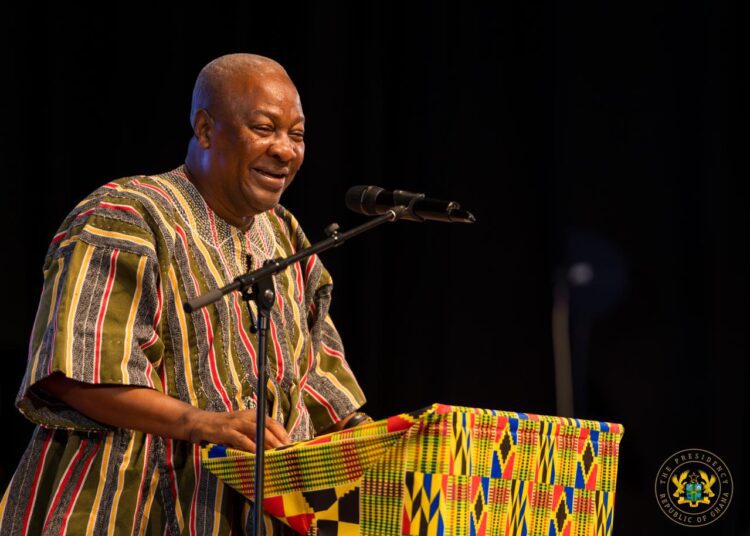
President John Dramani Mahama has declared Ghana’s energy sector stable, announcing a comprehensive overhaul of the national electricity distribution network to eliminate persistent power surges and brownouts.
Speaking during an interactive townhall meeting with members of the Ghanaian diaspora community in London, United Kingdom, the president outlined a decisive strategy aimed at retrofitting heavily overloaded power infrastructure across the country.
By aligning systemic capacity with contemporary urban demand, the administration intends to solidify grid reliability while directly confronting the legacy distribution bottlenecks that threaten commercial and residential power consumers alike.
“The energy sector, too is critical, and I’m happy to announce that it’s stable. We have begun undertaking a total revamp of the electricity distribution sector. We inherited a debt in the energy sector of about $1.5 billion, and the Minister of Energy and the Minister of Finance have both been working together to pay down that debt.”
President John Dramani Maham

The President clarified that the prevalent distribution inconsistencies do not stem from a generation deficit, but rather from severely outdated, overstressed transformer units.
Many of these localization systems were engineered and installed over two decades ago to service sparse neighborhoods that have since expanded exponentially into dense urban settlements.
This rapid urban migration and demographic growth have strained the legacy equipment to its breaking point, resulting in severe supply fluctuations.
To systematically resolve this imbalance, the government has embarked on an expansive nationwide replacement campaign to substitute obsolete grid assets with higher-capacity hardware, a move backed by synchronized efforts between the nation’s fiscal and energy ministries to liquidate a legacy sector debt of approximately $1.5 billion.
Overcoming Legacy Overload in Urban Networks
The core technical hurdle hindering the distribution architecture remains the sheer disproportion between historical design parameters and modern power consumption.
“There are some areas where the transformers were installed 22 years ago,” President Mahama observed, emphasizing that an asset originally deployed to support an isolated group of 100 homes is frequently tasked with routing voltage to over 500 households today.
As these units undergo severe operational overloading, their thermal limits are breached, inducing localized low-voltage anomalies known across the domestic sector as brownouts.

By moving away from patch-and-repair maintenance schedules and executing a comprehensive “overhauling of all the transformers all over the country,” the administration aims to stabilize terminal voltage levels.
Retooling the medium-voltage lines prevents systemic power surges that destroy sensitive industrial electronics and domestic appliances.
For the Ghanaian diaspora looking to invest back home, this structural transition acts as a guarantee that their capital investments and residential properties will be anchored by a predictable, reliable, and uniform power supply.
Retooling Infrastructure to Drive Economic Acceleration
A macro-level asset modernization program yields technical and socio-economic advantages that can accelerate Ghana’s industrial growth.
Upgrading the physical distribution apparatus with automated, high-capacity transformers minimizes technical distribution losses the energy dissipated as heat during transmission which historically drains substantial revenue from the state utilities.

This capital optimization allows utility providers to balance their books, ensuring the self-sustainability of the electricity pool without relying on continuous central government bailouts.
Restoring Fiscal Credibility and Investor Trust
Resolving the physical bottleneck requires a matching effort to clear the financial structural vulnerabilities that have historically weighed down the power sector.
The administration’s focus on paying down the inherited “$1.5 billion energy sector debt” is a strategic move to restore liquidity across the entire energy value chain.

This fiscal cleanup ensures that bulk power producers, transmission entities, and fuel suppliers can operate with predictable cash flows, reducing the risk of circular debt build-ups.
This coordinated effort by the Ministry of Energy and the Ministry of Finance signals a major shift toward structural transparency.
By clearing these liabilities, Ghana re-establishes its creditworthiness with international development finance institutions and private energy investors.
This fiscal openness paves the way for clean energy capital injections, positioning the nation to transition toward an integrated, efficient, and investor-friendly power network capable of supporting long-term economic growth.
READ ALSO: Silverbird Launches Epic Summer Movie Magic Marathon in Accra