The United Arab Emirates (UAE) has signaled a profound intent to back Ghana’s monumental Petroleum Hub project, a transformative enterprise engineered to fundamentally restructure the energy matrix of West Africa by establishing Ghana as the preeminent regional center for refining, manufacturing, and petrochemical production.
This strategic development marks a major milestone for the Petroleum Hub Development Corporation (PHDC) as it seeks to attract top-tier global partners to accelerate the realization of this massive industrial ecosystem.
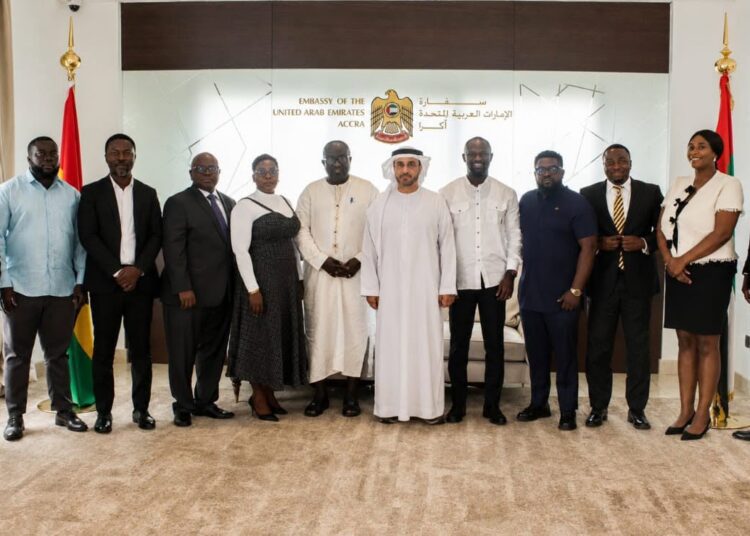
This renewed interest was formally conveyed by the UAE Ambassador to Ghana, H.E. Dr Abdulla Al Mandoos, during a critical courtesy call paid by a high-powered delegation from the PHDC, led by its Chief Executive Officer, Dr Toni Aubynn.
During their high-level deliberations, the two parties underscored the long-term economic dividends of the initiative, noting that the cross-border alignment between Accra and Abu Dhabi could serve as an essential catalyst for industrialization, regional infrastructure reinforcement, and energy independence across the sub-region.
“The Petroleum Hub project aligns with the UAE’s broader interest in supporting strategic initiatives that promote energy security, industrial development, and sustainable economic growth across emerging markets. The scale and long-term impact of the project, coupled with its projected creation of more than 780,000 direct and indirect jobs, position it as a significant undertaking with the potential to strengthen regional energy infrastructure and drive economic transformation.”
Petroleum Hub Development Corporation (PHDC)
Expanding the Ghana-UAE Strategic Energy Partnership
The high-level meeting concluded with both sides reaffirming their unwavering commitment to continued dialogue and closer engagement in support of Ghana’s long-term development objectives and regional energy ambitions.

Representing the PHDC alongside Dr Aubynn were key executives including Onasis Rosely, Deputy Chief Executive Officer for Operations and Technical; Enoch Aboagye Larbi, Director of Legal; Favour E. Nunoo, Senior Manager for Communications and Public Relations; Abigail Abrokwa, Senior Manager for Business Development; and Business Development Managers George Asante and Augustine Amporful.
This collective presence underscored the readiness of Ghana to engage in granular technical and commercial discussions with Gulf partners.
Presenting the strategic vision behind the project, PHDC Chief Executive Officer Dr Toni Aubynn described the Petroleum Hub as a “transformational initiative designed to strengthen Ghana’s role within the global petroleum value chain while accelerating industrialisation and economic growth.”
He extended a strategic invitation to the Gulf nation, encouraging the UAE to regard the project as a “natural extension of the longstanding friendship and growing economic partnership between Ghana and the United Arab Emirates.”

Dr Aubynn highlighted the extensive investment opportunities embedded within the mega-project, which includes the planned development of three state-of-the-art refineries, five major petroleum storage terminals, diverse petrochemical industries, robust port infrastructure, and a dedicated jetty.
Together, these components will create an integrated energy ecosystem capable of efficiently serving both regional and international markets.
Ghana as West Africa’s Ultimate Investment Destination
According to Dr Aubynn, Ghana’s strategic location on the Gulf of Guinea, stable democratic governance, investor-friendly policies, and attractive incentive framework continue to position the country as “one of Africa’s most attractive destinations for long-term investment.”
The geographic positioning provides immediate, cost-effective maritime access to the landlocked countries of the Sahel and the wider Economic Community of West African States (ECOWAS) market, making it a perfect launchpad for a multi-billion-dollar energy network.

Furthermore, evolving geopolitical and energy market dynamics have intensified international interest in the Petroleum Hub project, attracting growing attention from governments, institutions, and private-sector investors around the world.
Dr Aubynn expressed total confidence that the project would successfully catalyze localized industrialization, massive value addition, rapid employment generation, and macro-economic transformation while permanently enhancing Ghana’s position as a “gateway for energy trade and investment in West Africa.”
How UAE’s Capital and Technical Might Can Benefit the Project
From an expert energy blogger’s perspective, the UAE’s interest is a massive validation that could completely unlock the financing architecture of the PHDC.
The United Arab Emirates hosts some of the world’s most liquid sovereign wealth funds, such as the Abu Dhabi Investment Authority (ADIA), alongside global downstream giants like the Abu Dhabi National Oil Company (ADNOC).
Securing financial commitments from such entities provides the immense capital injection required to construct heavy industrial infrastructure, reducing Ghana’s reliance on debt and accelerating construction timelines.
Beyond liquidity, the UAE possesses world-class technical expertise in operating integrated downstream zones, exemplified by the massive Ruwais industrial refining complex.

By collaborating with the UAE, Ghana stands to benefit from invaluable technology transfers, operational best practices, and advanced human resource training.
Gulf expertise will optimize refinery efficiencies and ensure that the petrochemical plants conform to top-tier global environmental and safety standards.
Finally, the UAE’s unparalleled experience in global logistics and maritime trade hubs, like Jebel Ali, can assist Ghana in establishing its planned port infrastructure and dedicated jetty.
This partnership can introduce sophisticated bunkering, shipping, and supply chain management techniques to the Gulf of Guinea.
Consequently, UAE involvement will not only fund the project but will seamlessly integrate Ghana’s Petroleum Hub into global trade routes, transforming the West African state into a dominant force in international energy commerce.
READ ALSO: GHS, Ghana Red Cross Deploy 2,300 Health Workers Under REACH Initiative