Sub-Saharan Africa recorded the strongest improvement in energy transition performance globally in 2026, according to the latest Energy Transition Index (ETI), even as financing constraints, underinvestment and structural barriers continue to slow progress across much of the continent.
The ranking, published by the World Economic Forum (WEF) in collaboration with consulting firm Accenture, identified Namibia, Tunisia and Gabon as Africa’s leading performers in energy transition this year.
The report assessed 120 countries using indicators that measure energy security, sustainability and equity, alongside broader factors such as regulation, investment, innovation, infrastructure and human capital development.
While Africa’s overall performance improved, the findings suggest that progress remains uneven and that many countries still face significant obstacles in building cleaner, more resilient energy systems.
Namibia leads Africa
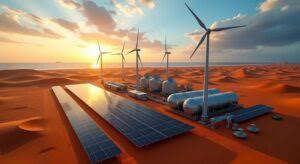
Namibia emerged as Africa’s highest-ranked country, placing 61st globally with an overall score of 56.2.
According to the report, the southern African country benefited from greater renewable energy deployment, targeted regulatory reforms and increasing investment in clean energy projects.
The country has also positioned itself as a major player in the emerging green hydrogen sector, attracting international attention and investment.
Tunisia followed closely behind in second place in Africa and 62nd globally, while Gabon ranked third on the continent and 66th worldwide.
South Africa, Morocco and Mauritius completed the continent’s top six performers.
The report ranked Ghana 85th globally and 10th in Africa, behind countries including Namibia, Tunisia, Gabon, South Africa, Morocco, Mauritius, Cameroon, Nigeria and Egypt.
Kenya ranked 87th globally, while Botswana and the Democratic Republic of Congo occupied the bottom positions among African countries included in the index.
Fastest regional improvement worldwide
One of the most significant findings of the report was Sub-Saharan Africa’s overall improvement compared to other regions.
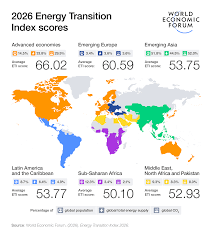
Sub-Saharan Africa recorded the strongest improvement, with an average score of 50.10 this year, up 1.2% from a year earlier.
According to the report, gains were recorded across both energy system performance and transition readiness indicators.
The improvement was driven largely by stronger regulatory frameworks, greater investment activity, advances in innovation and progress in education and human capital development.
However, the report cautioned that Africa’s transition remains uneven and continues to face serious structural constraints.
Limited investment, weak infrastructure and financing challenges continue to affect the pace of progress in many countries.
Global transition becoming more fragmented
Beyond Africa, the report highlighted growing disparities in the global energy transition landscape.
While clean energy investment continues to expand worldwide, most funding remains concentrated in a relatively small number of economies.

Seventy-five percent of clean energy investment continues to flow to a small number of economies, while countries projected to account for 80% of future growth in electricity demand face financing costs that are two to three times higher.
The report noted that although 56 percent of countries improved their overall scores this year, only 24 percent managed to make progress simultaneously in energy security, sustainability and equity.
This suggests that many countries continue to face trade-offs as they attempt to balance affordability, reliability and decarbonisation objectives.
Financing concerns emerge
A particularly notable finding was the reversal in long-term energy transition readiness trends.

For the first time in more than a decade, the report found a decline in readiness indicators that measure countries’ ability to sustain future transition progress.
Financing and investment performance fell by 1.8 percent compared with 2025, while indicators relating to regulation, political commitment and innovation also weakened.
These developments come at a time when many emerging economies face higher borrowing costs, tighter financial conditions and growing competition for international capital.
The report also pointed to grid congestion, permitting delays, trade restrictions and geopolitical conflicts as additional challenges affecting energy transition efforts globally.
What it means for Ghana
For Ghana, the ranking presents a mixed picture.
The country remains among Africa’s top ten performers but continues to trail regional leaders such as Namibia, Tunisia, Gabon, South Africa and Morocco.
The result comes as Ghana pursues an ambitious energy transition agenda that includes expanding renewable energy generation, increasing solar deployment and promoting cleaner energy technologies under its broader energy transition framework.

The country’s position in the index suggests that while progress has been made, significant work remains in areas such as infrastructure development, investment mobilisation and accelerating renewable energy deployment.
The report’s findings may also reinforce ongoing discussions around energy financing, grid modernisation and the need to attract greater private-sector investment into Ghana’s clean energy sector.
A transition moving at different speeds
The broader message from the 2026 Energy Transition Index is that the global shift toward cleaner energy continues, but not at the same pace everywhere.
Africa is improving faster than many regions, yet the continent still faces significant financing and infrastructure gaps that could limit future progress.
For policymakers, investors and energy sector stakeholders, the challenge will be ensuring that recent gains translate into long-term improvements capable of supporting economic growth, energy security and sustainable development.
As the report makes clear, the transition is advancing, but increasingly along different paths and at different speeds across the world.
READ ALSO: ECOWAS Court Dismisses Torkornoo’s Suit Against Ghana