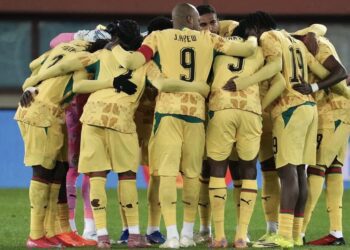

England midfielder Jude Bellingham has found himself at the centre of a growing debate over FIFA’s controversial mouth-covering regulation after television cameras captured him shielding his mouth while speaking to Ghana captain Jordan Ayew during Tuesday’s World Cup clash.
The incident occurred during England’s goalless draw with Ghana in Boston and quickly generated discussion among supporters and pundits, particularly because FIFA recently introduced a rule that allows players to be sent off for concealing their mouths while speaking to opponents in confrontational situations.
With the law already producing its first World Cup dismissal earlier in the tournament, many questioned why Bellingham avoided punishment despite footage clearly showing him covering his mouth during an exchange with Ayew.
However, FIFA’s interpretation of the regulation suggests the England star was never in danger of receiving a red card.
The key factor, according to football’s governing body, was not the act of covering his mouth itself but the nature of the conversation taking place.
Friendly Exchange Versus Confrontation
Ahead of the tournament, FIFA officials stressed that the new law was designed to target misconduct rather than ordinary conversations between players.
The regulation was introduced following UEFA’s decision to hand Benfica winger Gianluca Prestianni a six-match suspension for homophobic abuse directed at Real Madrid forward Vinicius Junior during a Champions League encounter earlier this year.

FIFA president Gianni Infantino subsequently pushed for stronger measures to prevent offensive language from being hidden from match officials and television cameras.
As a result, referees at the 2026 World Cup were given authority to dismiss players who deliberately conceal their mouths while engaging in hostile or confrontational interactions.
Yet FIFA’s refereeing department made it clear before the tournament that players would still be permitted to cover their mouths during normal conversations.
Referees’ chief Pierluigi Collina explained that footballers regularly speak privately with teammates, opponents and officials throughout matches and that such behaviour would not automatically result in disciplinary action.
The distinction, therefore, lies in whether the exchange is considered friendly or aggressive.
Observers noted that Bellingham and Ayew appeared relaxed during their discussion, with no signs of tension or conflict between the pair. That assessment is believed to be the main reason no review was initiated by video assistant referees.
Why Almiron’s Red Card Was Different
The contrast between Bellingham’s situation and the dismissal of Paraguay’s Miguel Almiron highlights how FIFA intends to enforce the law.
Almiron became the first player to receive a red card under the regulation during Paraguay’s match against Turkey. The incident occurred after Paraguayan forward Isidro Pitta went down following a challenge, triggering a heated confrontation involving players from both teams.

Amid the chaos, cameras caught Almiron covering his mouth while speaking to Turkish defender Mert Muldur.
Although neither player was directly involved in the pushing and shoving, officials deemed the interaction part of a volatile situation and VAR recommended a red card.
Almiron was subsequently dismissed and later handed a one-match suspension, ruling him out of Paraguay’s decisive final group fixture against Australia.
FIFA viewed the context surrounding the exchange as significantly different from the calm discussion involving Bellingham and Ayew.
Questions Remain Over Enforcement
Despite FIFA’s efforts to clarify the rule, debate continues over how consistently it can be applied.
Critics argue that determining whether a conversation is friendly or confrontational remains highly subjective and could lead to varying interpretations from officials.
Some have also raised concerns that players may attempt to exploit the regulation by drawing referees’ attention to opponents who cover their mouths during conversations.
That possibility was highlighted during the Almiron incident when Muldur immediately alerted nearby officials after the exchange.
Speaking earlier this week, FIFA President Gianni Infantino defended the rule and insisted players had been fully informed of its purpose before the tournament began.

He described the regulation as an important step in promoting respect and transparency on the pitch, arguing that football should set a positive example for supporters around the world.
Nevertheless, the controversy surrounding Bellingham’s conversation with Ayew has shown that questions remain over the practical application of the law.
For now, FIFA’s position is clear that covering the mouth is not an offence on its own. Only when it occurs during a confrontational exchange does it become a red-card matter.
That interpretation spared Bellingham against Ghana, but the discussion surrounding the rule is unlikely to disappear anytime soon.
READ ALSO: ECOWAS Court Dismisses Torkornoo’s Suit Against Ghana