
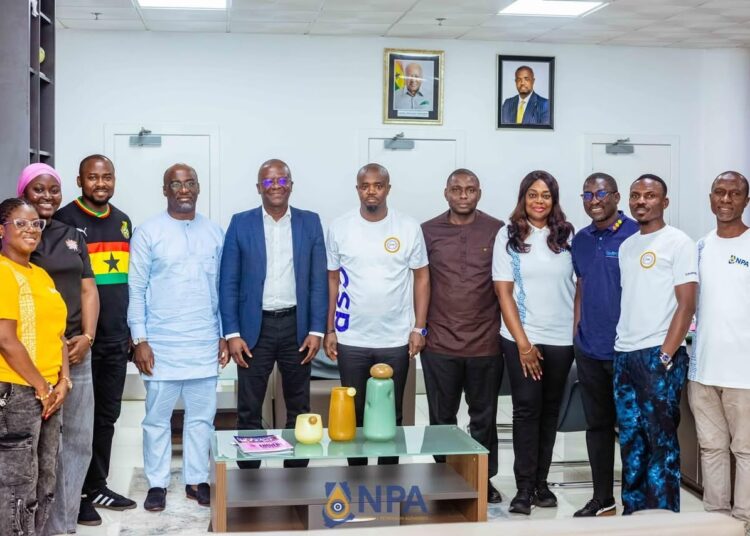
Ghana is seeking to strengthen confidence in its downstream petroleum sector by assuring investors of a stable and predictable regulatory environment, as the National Petroleum Authority (NPA) reaffirmed its commitment to supporting private sector participation in the country’s fuel distribution and marketing industry.
The assurance came during a courtesy visit by the Head of Puma Energy Africa, Mr. Ben Ouattara, to the Chief Executive of the NPA, Mr. Godwin Kudzo Tameklo, in Accra.
The engagement reflects government’s broader effort to position the private sector as a key driver of economic growth while ensuring that investments in the downstream petroleum industry continue to support fuel security, infrastructure development and employment.
For Ghana, where the downstream sector remains almost entirely private-sector driven, maintaining investor confidence is increasingly important as government pursues reforms aimed at improving efficiency, strengthening regulation and expanding energy infrastructure.
Investment Confidence Remains Central to Downstream Growth
According to the NPA, Mr. Ouattara’s visit formed part of his working trip to Ghana and provided an opportunity for both parties to discuss the operating environment for petroleum businesses in the country.
Puma Energy is among the international companies operating within Ghana’s downstream petroleum sector, which encompasses fuel importation, storage, transportation, distribution and retail marketing.

During the meeting, Mr. Ouattara expressed appreciation to the Authority for what he described as its continued cooperation with the company.
I thank the National Petroleum Authority for its support and cooperation with Puma Energy, which has enabled the company to thrive in Ghana.
Ben Ouattara, Head of Puma Energy Africa
His remarks underscore the importance international operators attach to regulatory certainty, particularly in a sector where investments in fuel infrastructure, logistics and retail networks require long-term planning and significant capital commitments.
NPA Links Regulatory Stability to Economic Growth
Responding to the delegation, NPA Chief Executive Mr. Godwin Kudzo Tameklo said the Authority remains committed to creating an enabling business environment that allows petroleum service providers to operate successfully while supporting national economic development.
He explained that the Authority’s approach aligns with President John Dramani Mahama’s vision of positioning the private sector as the engine of economic growth.

The National Petroleum Authority is committed to advancing the President’s vision by creating a conducive environment for companies in the downstream petroleum industry to operate successfully and recoup their investments.
NPA Chief Executive Mr. Godwin Kudzo Tameklo
The statement reinforces government’s recent messaging that regulatory institutions must facilitate investment while maintaining oversight to ensure fair competition, consumer protection and compliance with industry standards.
Why the Meeting Matters
Although the meeting was largely symbolic, it comes at a time when Ghana’s downstream petroleum industry is receiving increased policy attention.
In recent weeks, the NPA has intensified stakeholder engagement across the sector, including workshops with petroleum service providers and bulk road vehicle drivers aimed at strengthening regulatory compliance and combating illicit petroleum activities.

Separately, the Ghana Audit Service’s recent performance audit of the NPA highlighted weaknesses in petroleum transportation, product monitoring and retail outlet oversight, prompting recommendations to strengthen compliance systems and improve accountability across the downstream value chain.
Against this backdrop, continued engagement with major industry operators demonstrates the Authority’s effort to balance stricter regulatory enforcement with maintaining an investment climate capable of attracting and retaining private capital.
Industry analysts generally agree that both objectives are necessary if Ghana is to ensure reliable fuel supply while supporting continued investment in storage facilities, transportation networks and modern retail infrastructure.
Private Sector Remains Critical to Energy Security
The downstream petroleum industry occupies a strategic position within Ghana’s broader energy sector.
Unlike the upstream industry, where production is dominated by international oil companies operating offshore, the downstream sector depends heavily on private investment to import, store and distribute refined petroleum products nationwide.

Companies operating within the sector therefore play an essential role in ensuring uninterrupted fuel availability for transport, manufacturing, agriculture, mining and electricity generation.
A predictable regulatory environment can encourage additional investment in fuel depots, storage terminals and logistics infrastructure, ultimately improving supply reliability and reducing operational risks.
For consumers, this can contribute to greater fuel availability and a more resilient petroleum distribution system, although retail fuel prices remain largely influenced by international crude oil prices, exchange rate movements and applicable taxes.
Building Confidence Through Regulatory Engagement
The meeting also illustrates the increasingly collaborative relationship between regulators and industry participants.
While the NPA’s statutory responsibility includes licensing, monitoring and enforcing compliance, regular engagement with operators allows both sides to discuss operational challenges, regulatory expectations and opportunities for improving industry performance.

Such dialogue has become particularly important as Ghana continues to pursue broader reforms across the energy sector, including efforts to strengthen domestic refining, expand natural gas utilisation and improve efficiency throughout the petroleum value chain.
By reaffirming support for responsible private investment while maintaining regulatory oversight, the NPA appears to be signalling that attracting long-term capital into Ghana’s downstream petroleum sector remains an important component of the country’s wider energy and economic strategy.
READ ALSO: GH¢1.2bn Claims disbursed to Health Care Providers Nationwide – NHIA