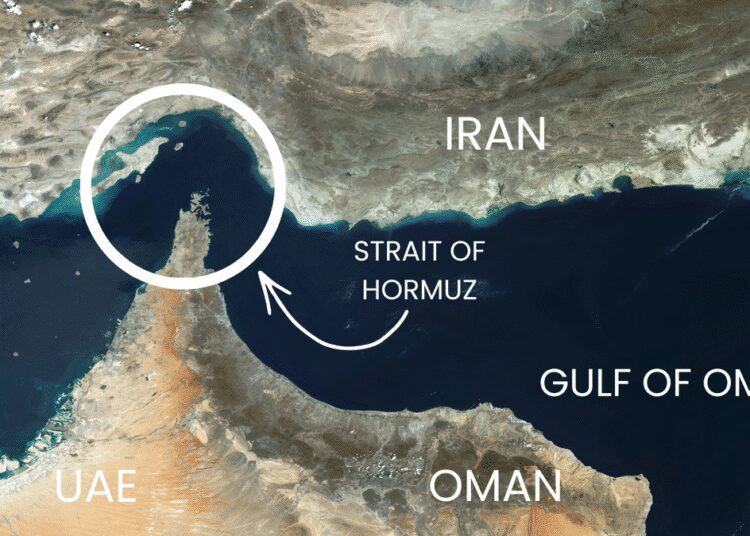
US and Iran continue to exchange fire amid their escalating standoff over control of the Strait of Hormuz.
Iran and the US are nearly at the midway point of the 60-day period of the Memorandum of Understanding that was supposed to set up talks for a permanent end to the war. Instead, it has devolved into a series of attacks over the strait and its future, worrying world leaders the Iran war fully could resume.
Iran believes that Article 5 of the MoU states it has full control over international maritime traffic in the Strait of Hormuz. Iran described the strait as being closed, while the US military and President Donald Trump asserted that the strait remained open.
Iran’s chokehold on the strait, however, has loosened as the US military provided support to vessels moving along a southern route along the coastline of Oman. That new route has angered Iran, which launched repeated attacks on ships using it. Iran’s grip on the strait led to a global energy crisis, though oil prices have sharply dropped since wartime highs of $120 a barrel.
The US Central Command (CENTCOM) announced today that it has “completed a new wave of offensive strikes against Iran.” The US attacks on Iran come amid an intensifying standoff over the Strait of Hormuz, with explosions reported in the port cities of Bandar Abbas, Sirik and Jask, as well as Qeshm Island.
CENTCOM said that it hit “dozens of targets at multiple locations with precision munitions to degrade Iran’s ability to continue attacking international shipping flowing through the Strait of Hormuz.” These targets include “Iranian military air-defense systems, coastal radar sites, missile and drone capabilities, and small boats.” CENTCOM said that it deployed “US fighter aircraft, naval vessels, one-way attack aerial drones, and one-way attack sea drones for the first time.”

Iran also claimed attacks on Bahrain, Kuwait, Oman and Jordan, saying it hit US military sites, in retaliation for Washington’s renewed bombardment of its southern coast.
Missile alert sirens sounded three times today in Bahrain, home to the US Navy’s 5th Fleet, and Kuwait said it was intercepting hostile fire. In Jordan, the kingdom’s military said it shot down four Iranian missiles in an incident that “resulted in zero casualties or material damage.” Jordan also hosts US military forces and aircraft.
The Islamic Revolutionary Guard Corps stated that it targeted the Prince Hassan airbase in Jordan with missiles and drones, setting fire to several fuel depots and ammunition storage facilities.
The IRGC also disclosed that it targeted several facilities at the Sheikh Isa airbase in Bahrain. In a statement, the IRGC said its aerospace forces struck helicopter maintenance facilities, a hangar housing a P-8 aircraft and a US military drone command-and-control centre.
The IRGC added that it has “completely destroyed” fuel tanks and Patriot air defence systems at the Ali Al-Salem airbase, as well as a strategic FPS radar system at the Ahmed Al-Jaber airbase. In a statement, the IRGC said the attacks were carried out by its aerospace forces during the third phase of its “eye-for-an-eye” operation in response to US military action against Iran.
The US Central Command said that the Strait of Hormuz is a vital maritime corridor for global trade and “Iran does not control it.” However, Iran’s paramilitary Revolutionary Guard sharply rejected the statement, saying, “The Strait of Hormuz is our territory, and we will not allow a rogue and child-killing army from the other side of the world to continue its illegal interference in it.”
Iran Not Ready To Relinquish Control Of Strait Of Hormuz
Alan Eyre, a distinguished diplomatic fellow at the Middle East Institute, opined thar Iran views control of the Strait of Hormuz as its primary strategic deterrent and is not yet prepared to relinquish it but “this is something that the US is not yet willing to accept.”
Speaking to a news agency, he added that the US’s ongoing strikes would not “sufficiently degrade” Iran’s ability to threaten shipping through the strait.
“The US is, again, doing what it does best: attacking Iran militarily, because we do have military supremacy. But the unfortunate reality is that no matter how much we strike the coastal areas, we cannot sufficiently degrade Iran’s potential to threaten shipping through this strait.”
Alan Eyre
He added that’s “because Iran has so many missiles, so many drones, so many smaller attack craft that can threaten vessels.”
READ ALSO: Black Volta Project Under Major Boost as Azumah Resources Grabs $47.4m from EBID