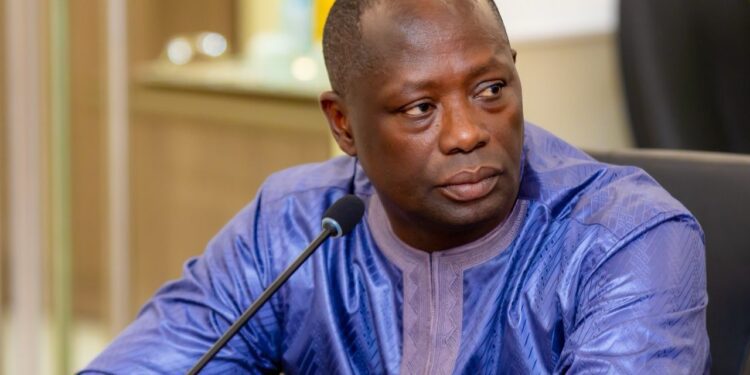
Minister for Lands and Natural Resources, Hon. Emmanuel Armah Kofi Buah, has announced that the government reclaimed 1,335 acres of degraded land in 2025 through a partnership with the private sector, with plans to push for an additional 1,500 acres this year.
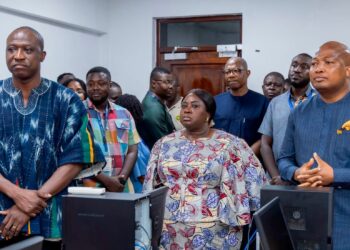
He made the disclosure during the Government Accountability Series at the Presidency, Jubilee House. Hon. Armah Kofi-Buah framed the achievement as part of a broader responsibility the government committed to at a previous session, when the scale of Ghana’s land reclamation needs was first discussed in detail.
“The last time we were here, we talked about how huge that responsibility is in terms of how much we have to reclaim on land. In partnership with the private sector, I can tell you that just last year we reclaimed 1,335 acres of degraded land”.
Ghana’s Minister for Lands and Natural Resources, Hon. Emmanuel Armah Kofi Buah
The Minister specified that the reclaimed acreage was concentrated in the Ashanti region, an area that has borne significant environmental degradation from mining and other land use activities in recent years.
The scale of this reclamation reflects the government’s continued focus on restoring land damaged by illegal mining and other extractive practices within the region. “And this was done in the Ashanti region,” he said.

Private Sector Commitment Drives Expanded Targets
Building on the momentum from 2025, Hon. Armah Kofi-Buah revealed that the government has secured fresh commitments from private sector partners to undertake further reclamation work, with a new target set for the current year. “We are targeting another 1,500 reclamations this year,” he said.
This private sector collaboration forms a central pillar of government’s land restoration strategy, allowing the Ministry to combine its own resources with external investment to accelerate the pace of reclamation across affected areas.
Government’s Own Reclamation Effort Adds to the Total
Beyond the private sector partnership, Hon. Armah Kofi-Buah disclosed that the government has separately undertaken its own reclamation initiatives, targeting 960 acres in selected areas as part of a complementary effort to restore degraded land.
Hon. Armah Kofi-Buah also touched briefly on efforts to reclaim degraded minor mining areas, describing an aggressive strategy pursued in partnership with the private sector to convert these sites into functional ecological zones.
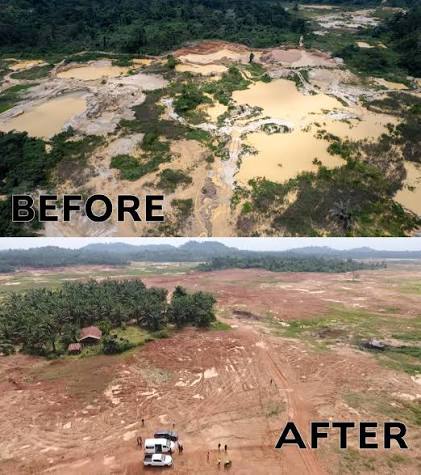
Combined, these figures suggest a multi-pronged approach to land restoration, one that draws on both public investment and private sector partnership to address the scale of degradation affecting various parts of the country.
Ecotourism as a Revenue Diversification Strategy
Shifting focus to ecotourism, Hon. Armah Kofi-Buah outlined the government’s ambitions to generate greater revenue from forest and wildlife resources, describing this as one of the Ministry’s key priorities for the year ahead.
“On ecotourism promotion and revenue diversification, one of the key priorities of the government is to maximise revenue from forest and wildlife resources. To achieve this, the ministry, through the forestry commission, is improving ecotourism facilities within our national parks and resource reserves.”
Ghana’s Minister for Lands and Natural Resources, Hon. Emmanuel Armah Kofi Buah
Hon. Armah Kofi-Buah detailed specific infrastructure projects planned for completion this year, aimed at enhancing the visitor experience at key reserves. He said the Ministry’s focus would include completing a 120-seater picnic area alongside 10 accommodation units at a resource reserve.
Additionally, he confirmed that a 20-room tourist accommodation facility and restaurant at the Mole Park would be completed within the same period, further expanding the range of amenities available to visitors at the site.

An Open Door for Private Sector Partnership
Hon. Armah Kofi-Buah used the opportunity to extend an invitation to private investors interested in collaborating with the Forestry Commission on ecotourism development, describing the sector as a significant opportunity for partnership.
“Let me say that this is a huge opportunity for private sector partnership with the forestry commission. And our doors are open for those discussions. We want Ghanaians to visit our reserve and travel with families”.
Ghana’s Minister for Lands and Natural Resources, Hon. Emmanuel Armah Kofi Buah
His remarks suggest that government views ecotourism not only as a revenue generation tool but also as a means of encouraging greater public engagement with Ghana’s natural reserves, positioning these sites as accessible destinations for families rather than purely conservation zones.
New Regulations to Strengthen Wildlife Conservation
Turning to policy developments, Hon. Armah Kofi-Buah announced that the Ministry, in collaboration with the Forestry Commission, is developing a legislative instrument to give effect to the Wildlife Resource Management Act, Act 1115.
“The legislative instrument, when approved, will provide legal backing and operational guidelines for community resource management areas, which we call CREMA, which has now become a model for engaging communities and landowners in sustainable forest management”.
Ghana’s Minister for Lands and Natural Resources, Hon. Emmanuel Armah Kofi Buah
This regulatory development reflects a growing emphasis on formalising community involvement in conservation efforts, recognising the role local landowners and residents play in sustaining forest and wildlife resources over the long term.
A Broader Vision for Land and Resource Management
Taken together, Hon. Armah Kofi-Buah’s remarks point to a Ministry pursuing land restoration, ecotourism development, and regulatory reform simultaneously, with private sector partnership serving as a recurring theme across each initiative.
Whether these targets translate into completed projects and measurable environmental gains will likely form the basis of future accountability sessions, as government continues to track progress against the figures presented.
For now, the reported reclamation of 1,335 acres, alongside plans for a further 1,500 acres this year, signals a continued commitment to addressing Ghana’s land degradation challenges, even as the Ministry expands its focus toward generating sustainable revenue from the country’s forest and wildlife resources.