
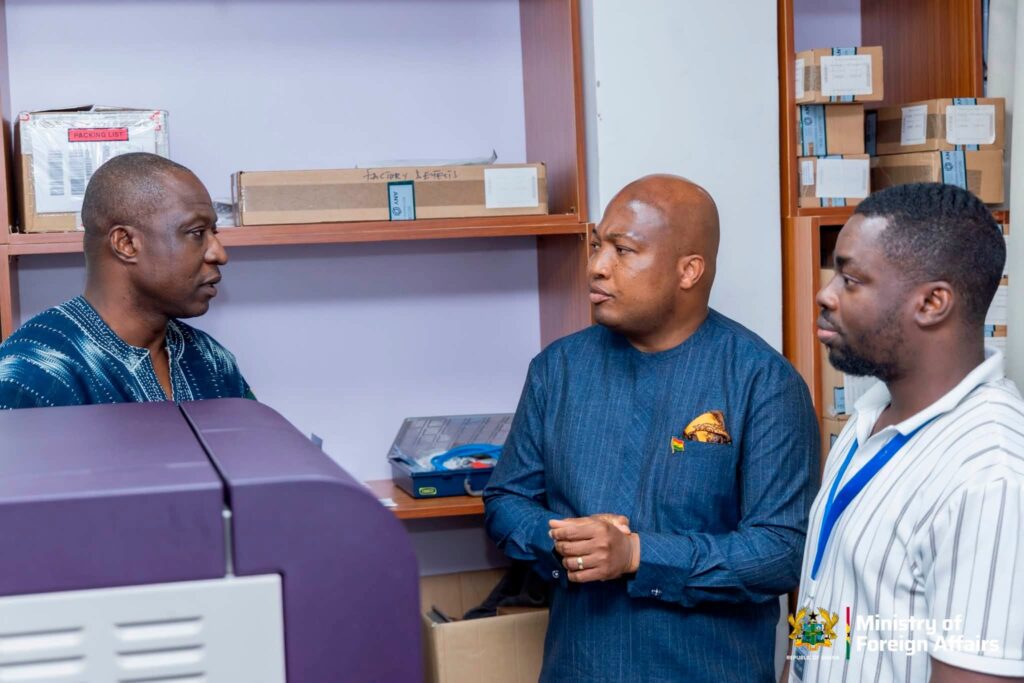
Foreign Affairs Minister Samuel Okudzeto Ablakwa has announced that all passport administration staff will receive a special bonus next week, saying the Passport Office emerged as the most transformed and least corrupt public institution in a recent Ghana Statistical Service report.
He announced during a working visit to the Passport Head Office. The Ghana Statistical Service data for the third wave of its survey, covering July to December 2025, places the Passport Office ninth on a list of the ten institutions where citizens most often report paying bribes, with 11.1 percent of people who interacted with the office reporting a payment.
That figure sits far below the 54.6 percent recorded for the Police Motor Traffic and Transport Division at the top of the table, but it describes an institution still among the ten most cited rather than the cleanest in the public service.
A bonus tied to the survey
The Minister framed the visit as recognition of work already done. “I paid a working visit to the Passport Head Office yesterday to congratulate management and staff for emerging as the most transformed and least corrupt public institution according to the recent Ghana Statistical Service report,” he said.

He then set out what follows. “I announced that all passport administration staff will receive a special bonus next week for their impressive output as highlighted by the GSS Survey,” he said. He did not state the value of the bonus, the number of staff receiving it, or the budget line funding it.
The survey’s third wave ranks the police at the head of the table, with the Motor Traffic and Transport Division at 54.6 percent, General Duties at 37.4 percent and the Criminal Investigation Department at 29.5 percent.
Ghana Ports and Harbours Authority officials follow at 26.2 percent, then the Traffic Management Authority at 24.8 percent, the Ghana Immigration Service at 23.5 percent, the Births and Deaths Registry at 20.3 percent and the Driver and Vehicle Licensing Authority at 18 percent.
The Passport Office appears ninth at 11.1 percent, ahead only of embassies and consulates at 10.7 percent. The figures measure the share of people who reported paying a bribe after contact with each institution, which means a lower number reflects fewer reported payments per encounter rather than an absolute ranking of integrity across the whole public sector.
Ten claims about the reset
Alongside the announcement, Ablakwa listed ten changes he attributes to the reforms. He said all application backlogs have been cleared following the commencement of 24-hour operations, and that passports now issue in under 15 days without middlemen or goro boys.

Same-day processing is possible, digital tracking has been introduced and courier delivery is available at no extra cost. Processing fees, he said, have fallen by 30 percent. Passport Application Centres now operate in all 16 regions for the first time in Ghana’s history.
On the document itself, he said Ghana holds one of the most advanced and secured chip-embedded passports in the world, that it ranks among the most valuable on the continent with premium visa waiver status, and that enhanced security protocols now guard against foreigners illegally acquiring Ghanaian passports.
The distance between the Minister’s characterisation and the survey table is worth stating plainly. An 11.1 percent bribery incidence marks real improvement for an office long associated with intermediaries, and it places the Passport Office below every other institution in the top ten except foreign missions.
Reforms the Ministry intends to continue
Ablakwa did not indicate that the pace will slacken. “We shall continue with our radical reforms driven by integrity, professionalism, innovation, client satisfaction and excellence,” he said.
The claims he has made are testable at the counter. An applicant who collects a passport within 15 days without paying anyone confirms the account, and one who does not now has a public promise to measure the experience against.
READ ALSO: Parliament Trade Committee Backs GIPA’s Expanded Investment Mandate