Minerals Income Investment Fund (MIIF) has recorded GH₵5.39 billion in its Midyear Royalty for the first half of 2026, achieving 186.1 percent of its target and more than doubling the collections recorded in the same period last year of GH₵2.6 billion.
This performance underscores an exceptionally strong sector-wide revenue mobilisation drive across Ghana’s extractive sector.
Evaluating this figure against historical benchmarks reveals that Q2 2026 receipts alone represent 98 percent of the entire GH₵5.43 billion collected across all of 2025. This momentum suggests that full-year 2026 receipts are on course to significantly surpass the previous year’s total revenue collection.
“The Fund has recorded GH₵5.39 billion in mineral royalties for the first half of 2026, achieving 186.1% of target and more than doubling collections recorded in the same period last year of GH₵2.6 billion, a performance that underscores exceptionally strong sector-wide revenue mobilisation. The figure is particularly striking when set against annual benchmarks: Q2 2026 collections alone represent 98% of the entire GH₵5.43 billion collected across all of 2025, suggesting full-year 2026 receipts are on course to significantly surpass the previous year’s total.”
Minerals Income Investment Fund (MIIF)
Gold Dominance and Sector Drivers
Large-scale gold mining remained the primary growth engine for the quarter, generating GH₵5.31 billion in mineral royalties and hitting “197.2% of target.”
This single sub-sector accounted for over 98 percent of total receipts. The stellar outcome was propelled by elevated global gold prices on international markets alongside the sliding-scale royalty regime designed to capture higher state revenues during price upswings.
Additionally, medium-scale gold operations turned in a robust showing, reaching “176.4% of target” while posting strong year-on-year expansion.
This sub-sector benefited from the favorable global commodity market, active regularization of outstanding obligations, and tighter compliance discipline across operators.

Across non-gold minerals, performance remained mixed, though sand royalties stood out by exceeding both budget projections and prior-year levels.
Sand receipts rose to GH₵516,721.13, registering a 136 percent increase over the GH₵380,619.26 recorded in H1 2025, while surpassing the half-year target of GH₵399,650.22 by approximately GH₵0.12 million.
Institutional Enforcement and Operational Governance
This revenue expansion reflects deliberate administrative reforms and aggressive field enforcement anchored by the Fund’s leadership.
Operational success was driven by “tighter compliance monitoring and numerous mines visits championed by the Chief Executive Officer of the Fund, Mrs Justina Nelson.”
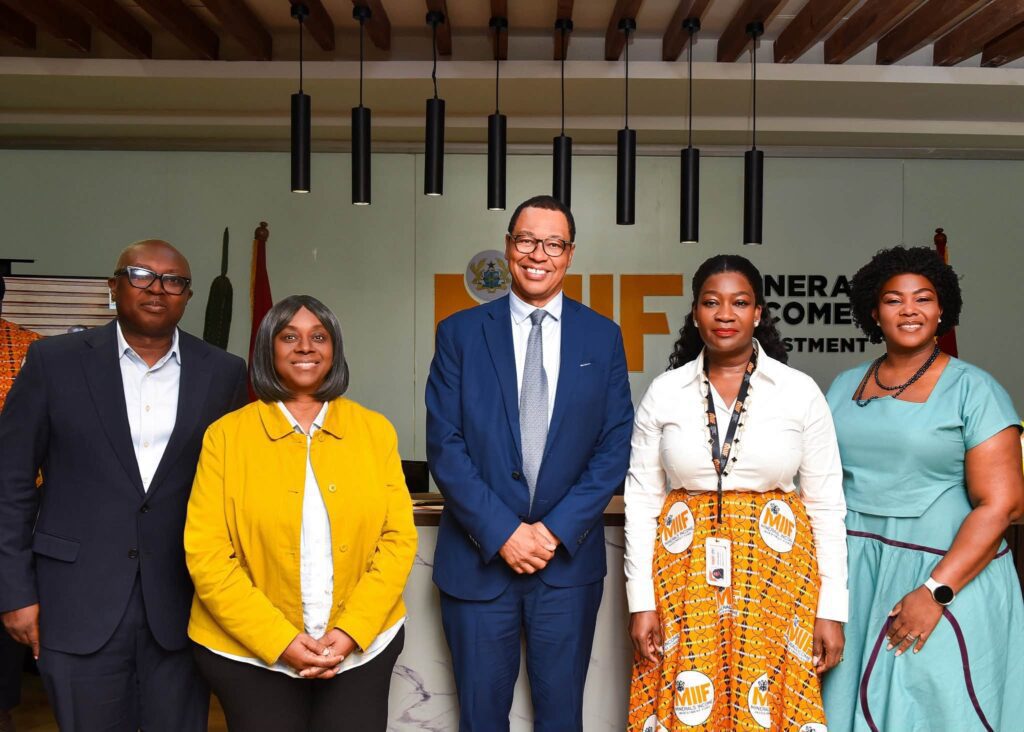
These active field engagements ensured that royalty calculations matched actual extraction rates across active concessions.
Furthermore, compliance mechanisms introduced across non-gold segments created measurable payment discipline among operators.
A key operational catalyst was “the requirement for operators to obtain MIIF clearance letters before the Minerals Commission issues relevant permits,” effectively closing systemic revenue leakage loops and compelling medium-scale and quarry operators to settle prior liabilities.
Macroeconomic Impact and Domestic Wealth Creation
This H1 revenue surge delivers concrete macroeconomic and socio-economic benefits for Ghana.
By law, 20 percent of all mineral royalties received by MIIF is disbursed directly to the Minerals Development Fund (MDF).
This automatic mechanism injects hundreds of millions of Cedis directly into mining-host communities to finance vital infrastructure, educational scholarships, and local economic development schemes.

At the national level, the surplus strengthening MIIF’s capital base enhances Ghana’s fiscal stabilization buffers.
The capital injection enables MIIF to expand equity investments across strategic domestic supply chains, including critical minerals processing, small-scale gold trading frameworks, and local mining infrastructure.
Consequently, this windfall retains a greater share of extractive value within the domestic economy, supporting currency stability, expanding non-tax revenue mobilization, and securing long-term wealth creation for present and future generations.
READ ALSO: Volta Region Records 280 Education Infrastructure Projects Underway – Hon. Gunu