UK Prime Minister, Andy Burnham has announced sweeping reforms to England’s education system aimed at creating clearer pathways from school into employment, unveiling plans that would allow students as young as 14 to combine traditional academic studies with technical training in sectors such as artificial intelligence, manufacturing, engineering and construction.
The proposals, described by the government as a “fundamental change to the education system,” are designed to tackle Britain’s persistent youth unemployment challenge while ensuring young people leave school equipped with practical skills that match the demands of a rapidly evolving labour market.
Under the reforms, students entering Year 10 will be able to study core academic subjects, including English, mathematics and science alongside high-quality technical courses tailored to industries with strong employment prospects in their local communities.
According to the government, the new programmes would also include structured work placements and employer engagement, enabling students to gain hands-on experience before completing secondary school.
The initiative comes as policymakers grapple with rising concerns over the growing number of young people disconnected from education and employment.
Official figures released earlier this year showed that more than one million people across the United Kingdom aged between 16 and 24 were classified as not in education, employment or training (NEET), the highest level recorded in more than a decade.
For Burnham, the reforms represent a broader attempt to redefine how vocational education is perceived in Britain, arguing that technical careers should enjoy the same respect traditionally afforded to academic pathways.
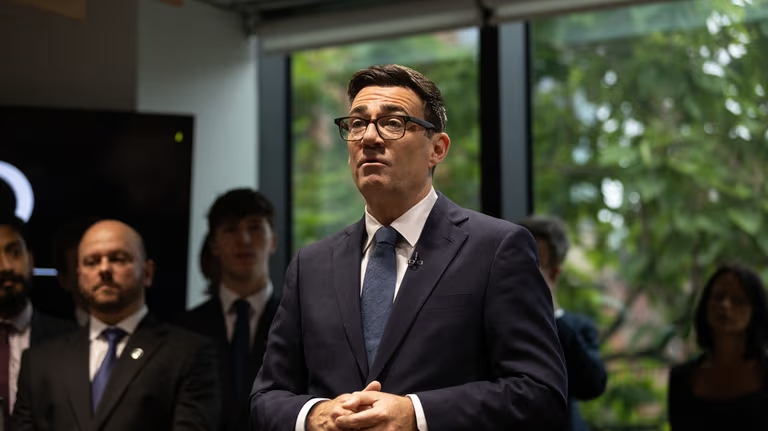
“For too long in this country, students have been told that you must take the academic path to do well and to be respected. The whole school system has been built around it and that has let down young people seeking technical qualifications.”
Andy Burnham
He added, “my message to young people is this – whether you choose construction, coding or classics, or maths, manufacturing or mechanics, you’ll get the skills you need and be given the respect you deserve.”
The Prime Minister stated that the revisions are part of a larger strategy to solve Britain’s young unemployment crisis while also training the workforce for an economy dominated by technological innovation and artificial intelligence.
Burnham argued that the rapid growth of artificial intelligence has increased, rather than diminished, the importance of vocational and practical skills.

“In the age of AI, practical and technical skills haven’t become less valuable – they’ve become more valuable than ever before. Britain will need brilliant engineers, electricians and cybersecurity experts more than ever before.”
Andy Burnham
He stated that the measures were ultimately designed to assist young people “build successful working lives from the start.”
According to government plans, students following the new pathways will receive careers guidance closely linked to local labour markets while spending time with employers to gain practical workplace experience before leaving school.
Although officials have described the ideas as one of the most substantial school reforms in recent years, many operational aspects have still to be finalised. Government officials estimate the first paths to be operational in certain areas of England by 2028, with universal deployment to follow gradually.
The amendments will only apply in England because education policy is devolved throughout the UK. However, as governments in Scotland, Wales, and Northern Ireland work to enhance young people’s employment chances, extending vocational and technical education has become a top focus.
Education Reform Wins Support Amid Funding Concerns

Alongside curriculum changes, the government announced that Ofsted will revise its inspection framework to assess how effectively schools deliver technical education alongside traditional academic learning.
Although there are still concerns about how schools will balance technical programs with current GCSE performance measures that continue to affect league tables and accountability systems, government officials argue that the changes are meant to put vocational education on an equal footing with traditional academic achievement.
The reforms build upon initiatives Burnham championed while serving as Mayor of Greater Manchester, particularly the Greater Manchester Baccalaureate (MBacc), launched in 2024. The programme encouraged pupils to combine academic and technical GCSE subjects linked to expanding sectors such as green energy, digital technology and advanced manufacturing, while strengthening careers advice and work experience opportunities.
The changes, according to Education Secretary Lucy Powell, mark the start a real shared effort between the government, businesses, and local governments with the goal of more closely tying education to local economic demands.

“The technological revolution we are living through should mean young people become the fresh lifeblood our economy needs to adapt and grow. I want to make sure this generation is able to seize that opportunity, whatever their background or postcode.”
Lucy Powell
Education professionals generally applauded the government’s goal of facilitating better school-to-work transitions, but they warned that successful execution would necessitate significant funding and more resources.
The Association of School and College Leaders stated that while it supported initiatives to keep more youth from dropping out of school after the age of sixteen, it cautioned that schools were already under a lot of financial strain while also handling significant reforms in areas like special education needs.
The latest proposals also received support from former Minister Alan Milburn, whose independent review into youth inactivity warned earlier this year that Britain risked creating a “lost generation” if more effective pathways into employment were not developed.

“They are a big step in the right direction and consistent with the findings of my review. A whole system reset is needed across health, welfare and labour market policy as well as in education and skills. “
Alan Milburn
However, opposition parties questioned whether the reforms alone would reverse broader labour market challenges.
Shadow Education Secretary Laura Trott argued that the proposals “don’t come anywhere close to undoing the damage Labour has already done to the job market.”
She indicated that, “the focus should be on the knowledge-rich curriculum that has helped the most deprived children.”
READ ALSO: Premier League Introduces Goalkeeper Injury Trial to Curb Time-Wasting