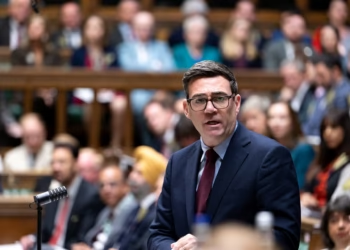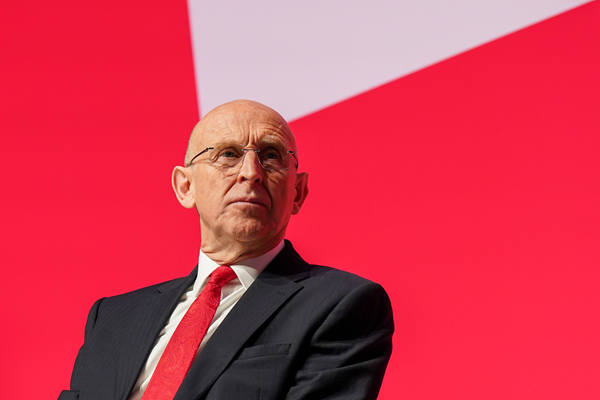
UK Chancellor John Healey has described the British economy’s stronger-than-expected performance as a “sign of resilience,” as the latest official figures showed growth despite persistent global economic pressures and mounting concerns over the cost of living.
UK economy expanded by 0.1% in August, according to the Office for National Statistics (ONS), defying analysts’ expectations of a slight contraction and extending the 0.4% growth recorded in July.
The figures also showed that the economy grew by 0.7% in the three months to August, reinforcing expectations that Britain’s economic performance could be stronger than previously anticipated.
Speaking to journalists in Bangkok during the annual meeting of the International Monetary Fund (IMF), Healey attributed the performance to the country’s resilience amid international economic uncertainty, including conflicts in the Middle East and Europe and elevated energy prices.
“It’s a sign of resilience in the UK economy that some had not expected,” the Chancellor stated, adding that it was “really tough in the face of these global economic shocks.”
The latest figures follow an upgrade to the IMF’s growth forecast for the UK earlier in the week, with the global financial institution acknowledging that Britain had a “bit of a better growth prospect” than other Group of Seven (G7) economies.
Production Growth Offsets Stagnation in Services and Construction
The ONS figures showed that increased production, including manufacturing, oil and gas extraction, and energy supply, supported the UK economy’s expansion in August.
The services sector, which accounts for the largest share of British economic activity, recorded no growth during the month, while construction contracted, highlighting the uneven nature of the recovery.
Over the three months to August, the economy expanded by 0.7%, with ONS Director of Economic Statistics Liz McKeown identifying computer programming as the largest contributor to what she described as “robust” growth over the period.
However, production and construction both contracted across the three months, indicating that weaknesses in important parts of the economy persisted despite the overall expansion.
Paul Dales, Chief UK Economist at Capital Economics, described the economy as “more robust than we thought,” although he cautioned that an anticipated rise in inflation could dampen future growth.
He added that the economy is demonstrating “remarkable resilience to higher energy prices and borrowing costs.”
PwC Senior Economist Jake Finney also attributed part of Britain’s relatively strong performance to investment in artificial intelligence infrastructure, noting that UK continued to lag behind the United States in the scale of investment and its contribution to economic growth.
Nevertheless, he maintained that Britain is making progress and remained ahead of many of its European peers in this area.
John Healey also pointed to the potential economic implications of artificial intelligence, arguing that its effects on productivity were only beginning to emerge.
“The impact of AI on the economy, on productivity, is only just beginning to register,” he noted, describing the technology as having “huge potential, as well as huge risks.”
He added that the government’s priority is to ensure artificial intelligence can be developed safely while enabling the country to benefit from the opportunities it presents.
Healey Promises Budget Relief While Maintaining Fiscal Rules
With his first Budget approaching in two weeks, John Healey has pledged to provide households and businesses with some relief from persistent financial pressures while maintaining the government’s commitment to controlling public spending.
“I want the budget to be a budget that gives Britain a bit of breathing space, but also reinforces the strength of our fiscal plans and the strength of our resilience and our economy for the future.”
John Healey
The Chancellor did not disclose specific tax or spending measures, including whether changes would be made to taxes affecting banks or capital gains. Instead, he warned against speculation, arguing that uncertainty ahead of previous Budgets had discouraged investment and prompted some people to make unnecessary financial decisions.
Healey also defended the government’s approach to supporting households amid high energy costs, pointing to a VAT cut on electricity bills while acknowledging that the measure would not eliminate the financial pressure facing consumers.
At the same time, he insisted that new spending commitments would have to be financed within the available Budget, stressing that the government would not abandon fiscal discipline.
Healey pledged to meet the government’s fiscal rules, under which day-to-day public spending must be covered by tax revenues and public debt must fall as a share of gross domestic product by the 2029/30 financial year.
“The test year is now just three years ahead, so this is a tighter set of fiscal rules than we had before. We will meet those fiscal rules, and I think one of the hallmarks of the IMF’s backing of our fiscal plans is recognition that there isn’t just a forecast for the future, but there’s some evidence of performance already.”
John Healey
The Chancellor also welcomed the IMF’s support for the government’s fiscal plans, particularly its efforts to reduce debt as global borrowing costs rise.
UK Economic Outlook Tied to European Cooperation
Moreover, the Chancellor used his engagements in Bangkok to reaffirm the government’s commitment to strengthening Britain’s economic relationships with European partners.
According to John Healey, “Brexit has not been good for Britain.”
He also highlighted disagreements with European partners over proposals linked to the bloc’s “Made in Europe” plans and access to its defence sector.
Healey argued that stronger cooperation among European countries had become increasingly important amid the growing economic and security influence of the United States and China.
READ ALSO: EPA Directs GoldBod, Others to Halt Unpermitted Reclamation Works