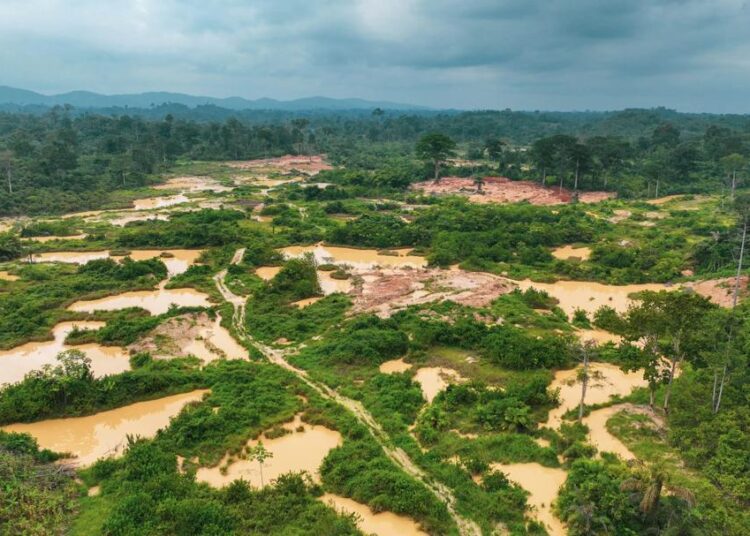
The Environmental Protection Authority (EPA) has issued a stern notice directing all state institutions, mining companies, contractors, and public bodies specifically citing the Ministry of Lands and Natural Resources, Forestry Commission, Ghana Gold Board (GoldBod), Minerals Commission, and the Mineral Development Fund to immediately halt all land reclamation, mine-site rehabilitation, dredging, and water-body restoration projects being conducted without statutory environmental permits.
The regulatory body emphasized that public funding, institutional sponsorship, or government mandates do not grant immunity from national environmental compliance, warning that any ongoing physical works undertaken without explicit authorization violate statutory frameworks.
The authority made it clear that possessing a mining lease, contract award, concession license, traditional authority consent, or memorandum of understanding does not replace an official EPA permit, directing all non-compliant developers, contractors, non-governmental organizations, and district assemblies to cease operations right away and present themselves to regional or head offices for regulatory review.

“The EPA supports Government’s efforts and legitimate private initiatives aimed at restoring lands and water bodies damaged by illegal and irresponsible mining. Such restoration is urgently needed. However, the urgency to reclaim degraded lands cannot justify bypassing the environmental safeguards established to ensure that reclamation itself does not become another source of environmental destruction.”
Environmental Protection Authority (EPA)
Statutory Safeguards and Regulatory Scope Under L.I. 2504
The legal backbone of the EPA’s directive rests squarely on Regulation 40 of the Environmental Protection (Environmental Assessment) Regulations, 2025 (L.I. 2504), which legally encapsulates all ecological repair activities within Ghana’s formal environmental assessment and permitting regime.

According to the public notice, this comprehensive coverage encompasses mine reclamation and rehabilitation, backfilling, grading, reshaping of excavated terrain, revegetation, river channel diversion or modification, and desilting operations.
Furthermore, the statute regulates interventions across polluted wetlands, disturbed aquatic ecosystems, abandoned mining concessions, and any related physical works designed to restore environmentally degraded areas.
Contracting institutions are now explicitly mandated to verify the environmental permit status of projects as a non-negotiable condition precedent before granting site mobilization clearance to contractors.
The Urgent Need for Regulated Land and Water Restoration
The critical necessity for this regulatory crackdown stems from decades of widespread environmental degradation caused by uncontrolled artisanal and illegal small-scale mining, popularly known in Ghana as galamsey.
Unregulated extraction has left vast swathes of agricultural land scarred with open, unsafe pits, destroyed cocoa plantations, and heavily polluted major river basins such as the Pra, Ankobra, Birim, and Offin with toxic heavy metals like mercury and cyanide, threatening municipal water processing systems and public health.

While public and private interventions to remediate these damaged eco-zones are urgently required, unapproved engineering works pose severe secondary risks.
Unsupervised backfilling can lead to catastrophic pit collapses, uncalculated river dredging often deepens siltation and destroys downstream fish spawning grounds, and improper soil grading risks leaching trapped toxins directly into underlying aquifers.
Consequently, rigorous EPA oversight remains indispensable to ensure that restoration methodologies adhere to established scientific standards, preventing well-intentioned reclamation projects from exacerbating environmental destruction.
Enforcing Compliance Across Public and Private Sectors
In reinforcing its institutional stance, the management of the EPA underscored that environmental protection constitutes a mandatory legal obligation rather than an optional administrative formality.

The directive applies uniformly to government-sponsored, publicly funded, privately financed, and donor-supported initiatives, leaving no loophole for public or private entities operating within the extractives sector.
The Authority cautioned that any institution, developer, or individual that persists with physical reclamation or dredging activities in defiance of this public notice will face immediate legal sanctions in strict accordance with the applicable laws of Ghana.
READ ALSO: Parliamentary Health Committee Calls on Government to Train Specialised Nurses