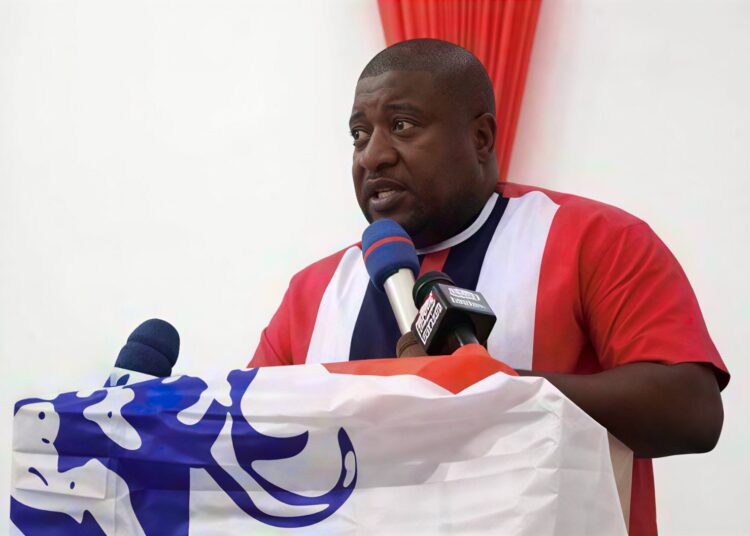
The National Organiser of the New Patriotic Party, Henry Nana Boakye, has criticised the government’s decision to revive tribunals, urging Ghanaians to reject the proposal because of what he believes could be its long term implications for the country’s justice system. He argued that the existing courts already possess the capacity to administer justice, making the proposed structures unnecessary.
Speaking during a press briefing on Friday, Mr Boakye linked the proposed tribunals to Ghana’s political history, contending that similar institutions generated fear and controversy in previous years. From his perspective, the country should strengthen the conventional courts instead of creating additional judicial bodies.

“The courts continue to perform their constitutional duty. Tribunals remind Ghanaians of painful experiences, and the NDC seeks to revive that chapter.”
Henry Nana Boakye
His remarks follows Parliament’s passage of the Tribunals Bill, 2026, legislation intended to operationalise Article 126 of the 1992 Constitution by establishing specialised tribunals within Ghana’s judicial system. Government has explained that the measure aims to improve access to justice while preserving constitutional safeguards and due process.
Against this backdrop, the NPP National Organiser argued that public confidence in the judiciary depends on reinforcing existing institutions through greater investment and administrative reforms. He indicated that introducing parallel adjudicatory structures risks creating uncertainty about the country’s justice delivery framework.
Additionally, Mr Boakye referred to earlier reservations raised by the Minority in Parliament during deliberations on the bill. These objections centers on the possibility that regional and district tribunals could duplicate functions already performed by the regular courts.
The emphasis also rests on the need for transparency throughout the legislative process. According to the NPP official, reforms affecting the judiciary deserve extensive public engagement because of their direct impact on constitutional governance.

Meanwhile, government has consistently defended the legislation, explaining that the tribunals will operate under judicial supervision with legal protections designed to safeguard fundamental rights. Officials have also stressed that the proposed system complements the existing courts instead of replacing them.
Mr Boakye nevertheless encouraged citizens to scrutinise every stage of the implementation process. He argued that judicial reforms should strengthen public trust, uphold constitutional principles and preserve confidence in the administration of justice.
Opposition Questions State Appeal Strategy After Acquittal Decision
The National Organiser of the New Patriotic Party, Henry Nana Boakye, also criticised the legal strategy adopted by the Attorney General in the appeal involving former MASLOC Chief Executive Sedina Christine Tamakloe Attionu, arguing that the State failed to defend its case with sufficient rigour. He contended that the outcome has intensified political and legal debate surrounding one of the country’s most closely watched prosecutions.
Discussing the appeal, Mr Boakye argued that the prosecution’s handling of the matter contrasted sharply with the evidence presented during the original trial. In his view, the acquittal has raised fresh questions about the direction of high profile criminal prosecutions under the current administration.
“How does extensive evidence suddenly lose its value before the appellate court? The Ghanaian public deserves a clear explanation.”
Henry Nana Boakye
The Court of Appeal recently overturned Ms Tamakloe Attionu’s ten-year prison sentence after determining that the prosecution failed to establish the charges beyond reasonable doubt. The decision set aside her earlier conviction by the High Court on multiple counts, including causing financial loss to the state, stealing and money laundering.

Furthermore, Mr Boakye argued that the Attorney General’slegal submissions did little to persuade the appellate court to uphold the conviction secured during the trial. He therefore called for greater public accountability regarding the State’s approach to appeals involving major corruption cases.
Attention also shifted to the wider implications of the judgment for Ghana’s justice system. According to the NPP National Organiser, confidence in criminal prosecutions depends on consistency, thorough preparation and vigorous legal representation whenever the State pursues appeals.
“The defence mounted by the Attorney General lacked the force expected in a case of this magnitude. That outcome naturally invites public scrutiny.”
Henry Nana Boakye
In addition, the opposition official suggested that the judgement would continue to generate legal discussion as the case progresses to the next stage. The Attorney General has already directed the Director of Public Prosecutions to file an appeal at the Supreme Court and seek a stay of execution of the Court of Appeal’s decision.
The legal challenge therefore is still active despite the appellate ruling.
READ ALSO: Ghana’s 96% Financial Access Faces a New Challenge