Bangladesh is holding its first contested presidential election in 35 years, marking a symbolic moment for the country as it continues to reshape its political institutions following years of upheaval and major political change.
The vote pits Bangladesh Nationalist Party candidate Mirza Fakhrul Islam Alamgir against retired army officer Oli Ahmad, the nominee of an 11-party opposition alliance led by Jamaat-e-Islami.
The election is significant because it will be the first time since 1991 that Bangladesh’s President is being chosen through a competitive vote.
A total of 349 members of parliament are eligible to vote in the presidential election, which is scheduled to take place in the parliamentary chamber between 08:00 GMT and 11:00 GMT today. Bangladesh’s Election Commission is expected to announce the result within hours of the vote.
Under Bangladesh’s constitutional system, the President serves as Head of state but has limited independent executive authority. Article 48(3) of the constitution requires the President to act on the advice of the Prime Minister, except in matters relating to the appointment of the Prime Minister and the Chief Justice.
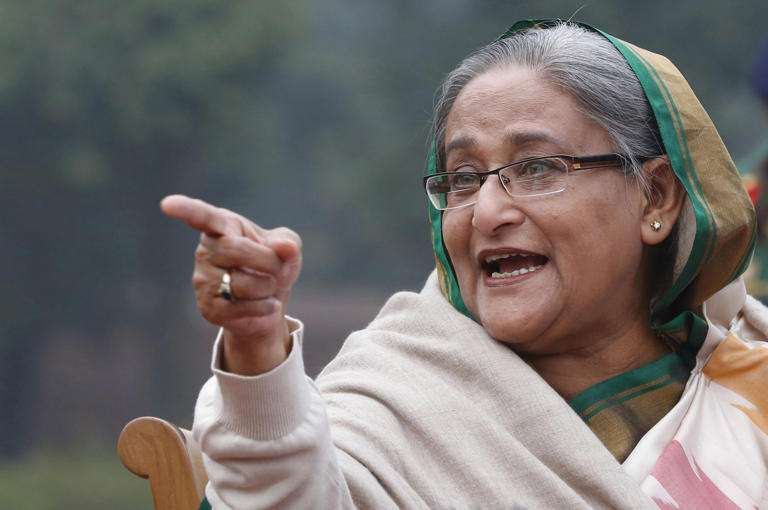
The election was triggered by the resignation last month of former President Mohammed Shahabuddin, who stepped down midway through his five-year term. Shahabuddin had been elected unopposed in 2023 as the nominee of former Prime Minister Sheikh Hasina’s Awami League. His presidency spanned a turbulent period in Bangladesh’s political history, including Hasina’s removal from power in August 2024, the interim administration led by Muhammad Yunus and the BNP’s return to government following its victory in February.
The election represents a break from more than three decades of uncontested presidential selections. The last competitive presidential election was held in October 1991, when BNP candidate Abdur Rahman Biswas defeated Awami League nominee Badrul Haider Chowdhury by 172 votes to 92.
Every presidential election since then has been uncontested. Today’s vote therefore carries significance beyond the immediate question of who will become Bangladesh’s next Head of state. It comes as the country continues to navigate a changing political landscape following the 2024 uprising that ended Sheikh Hasina’s 15-year rule and ushered in a period of political transition.
BNP Candidate Holds Commanding Advantage
Alamgir, 78, is one of the BNP’s most prominent political figures and is widely expected to win the presidency. He became the party’s Acting Secretary-General in 2011 and was formally appointed Secretary-General in 2016.
During the BNP’s years in opposition under Hasina’s government, Alamgir emerged as one of the party’s most recognisable public figures. Following the BNP’s victory in this year’s election, he became Minister for local government, rural development and cooperatives.
At a BNP parliamentary party meeting yesterday, Alamgir thanked Prime Minister Tarique Rahman for nominating him as the party’s presidential candidate and pledged not to compromise on Bangladesh’s independence and sovereignty. Rahman, in turn, urged BNP lawmakers to support Alamgir in the today’s vote. The outcome is widely expected to favour Alamgir because of the BNP’s commanding majority in parliament.
The BNP’s numerical strength in parliament gives its candidate a substantial advantage. Of the 349 lawmakers eligible to vote, 247 belong to the BNP, compared with 90 members of the Jamaat-led opposition alliance.That parliamentary arithmetic makes Alamgir’s election highly likely unless there is an unexpected development during the vote.
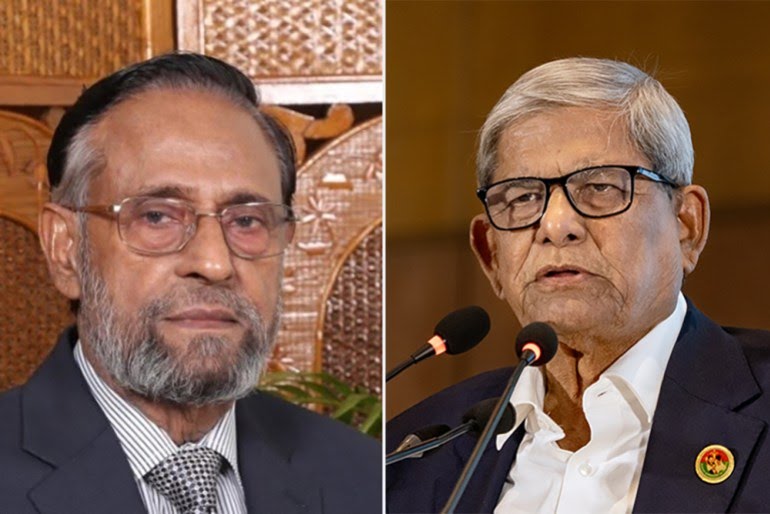
Alamgir’s challenger, retired Colonel Oli Ahmad, 85, is a veteran of Bangladesh’s 1971 Liberation War and chairman of the Liberal Democratic Party. A six-time member of parliament, Ahmad has been nominated by the Jamaat-e-Islami-led 11-party opposition alliance.
Although his chances of defeating Alamgir appear limited because of the BNP’s overwhelming parliamentary majority, his candidacy ensures that the presidential election will be contested rather than decided without opposition. The opposition alliance has described Ahmad as an experienced and broadly acceptable political figure, highlighting his military background, parliamentary experience and role in Bangladesh’s political life.
His nomination also gives the opposition an opportunity to participate in a presidential contest that would otherwise have been dominated by the governing party.
Although the presidency remains largely ceremonial and the next President will have limited independent executive authority, the contested election is being closely watched as a reflection of Bangladesh’s evolving political environment. For the BNP, the expected election of Alamgir would further consolidate its position following its return to power. For the opposition alliance, Ahmad’s candidacy provides an opportunity to demonstrate political participation and ensure that the presidency is decided through a formal contest.
Whatever the final margin, the vote marks the first contested presidential election in Bangladesh in 35 years, giving the process a symbolic importance at a time when the country is seeking to redefine its political institutions and direction.
READ ALSO: João Pedro Embraces Chelsea No.9 Challenge, Dares To End Curse Narrative