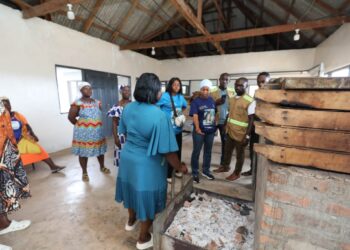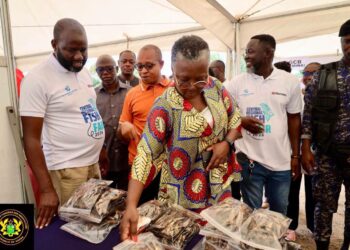
The Peasant Farmers Association of Ghana (PFAG) is calling on government to immediately roll out an emergency relief package for hundreds of rice farmers across the country who are counting severe losses after failing to find buyers for their produce.
According to the Association, the current rice marketing crisis has left many smallholder farmers in a desperate situation. While some are watching their harvested paddy deteriorate in poor storage facilities, others have been forced to abandon their matured crops on the field because there is no market incentive to even harvest.
Speaking on the crisis, the Executive Director of PFAG, Mr. Bismark Nortey, said government must move beyond promises and provide urgent financial cushioning for farmers whose entire seasonal investments have been wiped out.
“Government should, as a matter of urgency, announce some immediate emergency support or emergency relief to farmers who are unable to sell their produce. Some of them also who couldn’t get market and couldn’t harvest, they have lost them on the field. Others who had harvested, they have been burnt down through bushfires.”
Mr. Nortey
Mr. Nortey noted that this is why a simple mop-up exercise, even if it comes in the next few weeks, will not be enough to address the damage already done. Farmers who lost their crops to rotting, to fire, or to abandonment on the field have nothing left to sell, and therefore will not benefit from any future purchasing arrangement.
“Their investment is gone. Even if you bring money tomorrow to buy rice, they have no rice to sell again. That is why we need a separate support mechanism that specifically targets those who have already lost everything.”
Mr. Nortey

PFAG’s Two Pronged Solution to the Rice Glut Crisis
The Association is therefore proposing a two pronged approach: first, an emergency compensation or input-support package for farmers who have suffered total loss, and second, an aggressive and well-funded mop-up of all the quality local rice that is still available in farming communities.
At the centre of the mop-up challenge is the National Food Buffer Stock Company (NAFCO), the state agency mandated to purchase and store surplus grains for food security and for supply to public institutions.
According to Mr. Nortey, NAFCO itself has admitted that it is severely under-resourced to deal with the current glut. The company, he revealed, requested about GH¢1.5 billion to effectively carry out its mandate of buying excess grains across the country this season, but was allocated only about GH¢300 million.
He argued that the huge funding gap explains why NAFCO and its licensed buying companies (LBCs) have had a very limited presence on the ground, particularly in major rice-producing districts in the Volta, Northern, Upper East, Upper West, and Oti Regions where farmers are most affected.
PFAG says the GH¢300 million is woefully inadequate when compared to the volume of rice that needs to be purchased, transported, and properly stored to prevent further post-harvest losses.
PFAG Demands Transparency in NAFCO Rice Purchases
Beyond the funding issue, the Association is also raising concerns about transparency and equity in how the little is available is being used. Mr. Nortey is calling for a clear publication of where NAFCO is buying, from whom, at what price, and in what quantities, to ensure that support actually reaches the most vulnerable farming communities and not just a few well-connected aggregators.
For a long-term and sustainable solution, PFAG believes government must use its enormous purchasing power to create guaranteed demand for Ghanaian rice. NAFCO has been consistent regarding the fact that their monies are inadequate to mop up all the food system
The Association wants a deliberate policy that compels all public institutions, including the School Feeding Programme, senior high schools under the Free SHS policy, hospitals, prisons, and the security services, the military, police, immigration and fire service to procure and consume primarily Ghanaian rice.
Mr. Nortey argued that such institutional demand would provide a stable and predictable market for farmers and reduce the over-reliance on imported rice. He also called for stricter enforcement at the country’s borders to curb the smuggling of rice through unapproved routes.
According to PFAG, the influx of cheap imported rice, often evading duties and taxes, is making local rice uncompetitive on the market and further discouraging buyers from patronizing Ghanaian farmers.
“While our farmers are struggling to sell at GH¢400 to GH¢500 per bag, smuggled rice is on the market at cheaper prices because duties were not paid. How do you expect the local farmer to compete.’’
Mr. Nortey
PFAG has warned that if urgent action is not taken, the country risks not only losing millions of cedis invested by smallholder farmers but also demoralizing farmers ahead of the next farming season. Many farmers, the Association says, have taken loans to cultivate, and the inability to sell will push them into debt and potentially out of rice farming altogether, threatening Ghana’s agenda of attaining self-sufficiency in rice production.
The Association is therefore urging the Ministry of Food and Agriculture, the Ministry of Finance, and the Office of the President to treat the rice crisis as a national food security emergency and act swiftly to restore confidence, provide relief, and ensure that Ghanaian rice farmers do not collapse under the weight of market failure.
READ ALSO: Protect Ghana, Empower Local Producers— Kumasi City Market Director