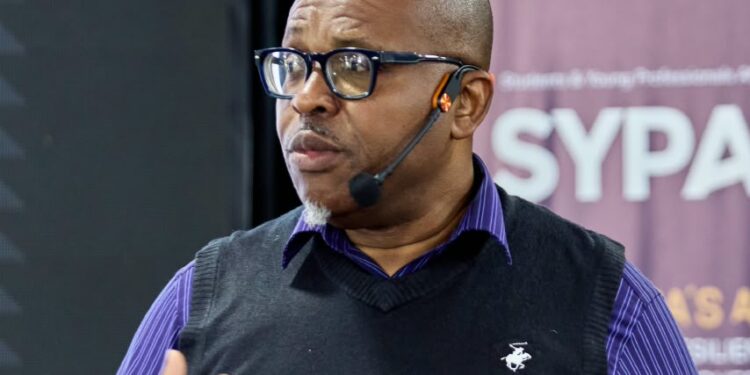
Ato Coleman, Senior Fellow at the IMANI Centre for Policy and Education, Co-Lead of the Black Alumni Network at the London School of Economics and a global human resources expert, has argued that effective public policy leadership in Africa must be anchored in personal values and disciplined execution, using Sierra Leone’s response to the 2014-2016 Ebola outbreak as a working model of what he calls Ubuntu leadership.
Speaking at SYPALA 2026 on the topic “What are the leadership, skills and policy priorities needed to position Africa for inclusive and resilient growth,” Mr Colman told participants that diagnosing, designing, executing and evaluating public policy requires a foundational mindset that most leadership training overlooks, one built on personal values rather than technical competence alone.
A Definition Built From Experience, Not Google
Mr Coleman was explicit that his framework did not come from published theory. “My definition is not on Google,” he said. “All the definitions you see here are definitions from 32 years of experience. So they come from my stomach, head, and my mind.”

He defined a leader as someone who lives their deepest personal values without compromise and uses those values to create a compelling case for others to follow. He pressed participants to examine their own values directly, warning that many people who hold leadership positions operate without any clearly held values at all.
He cited a large-scale study involving 10,000 employees across multiple countries, levels and industries, which he said identified family and work as the two values that consistently surfaced above all others.
He used family as an illustration of value intensity, arguing that the instinct to protect what one values most, the way a parent would instinctively defend a child from danger, is the same instinct effective leadership requires people to bring to their public responsibilities.
Recognising Context and Stakeholder Value
Mr Coleman’s presentation set out a structured approach to applying leadership in public policy, beginning with what he called recognising context, the external environment of technology trends, social norms, geopolitical events and economic uncertainty within which any policy must operate.
From there, he outlined a sequence: identifying stakeholder outcomes, defining the value each stakeholder could realistically expect, testing that value against real-world data and evidence, summarising and prioritising the recommendations with the highest return, and finally implementing an action plan grounded in change management principles.
He framed this sequence as the practical machinery beneath good intentions, arguing that even the most well-meaning policy fails without disciplined execution across each of these stages.
Sierra Leone’s Ebola Response as a Case Study
Mr Coleman used Sierra Leone’s Ebola outbreak, which struck the country from 2014 to 2016, as a detailed case study in applied leadership under crisis.
He noted that Sierra Leone recorded the highest number of Ebola cases of any country during the epidemic, with all 14 of its districts affected, the first case declared on May 25, 2014, in a region bordering Guinea, and the final case recorded in the last week of January 2016.
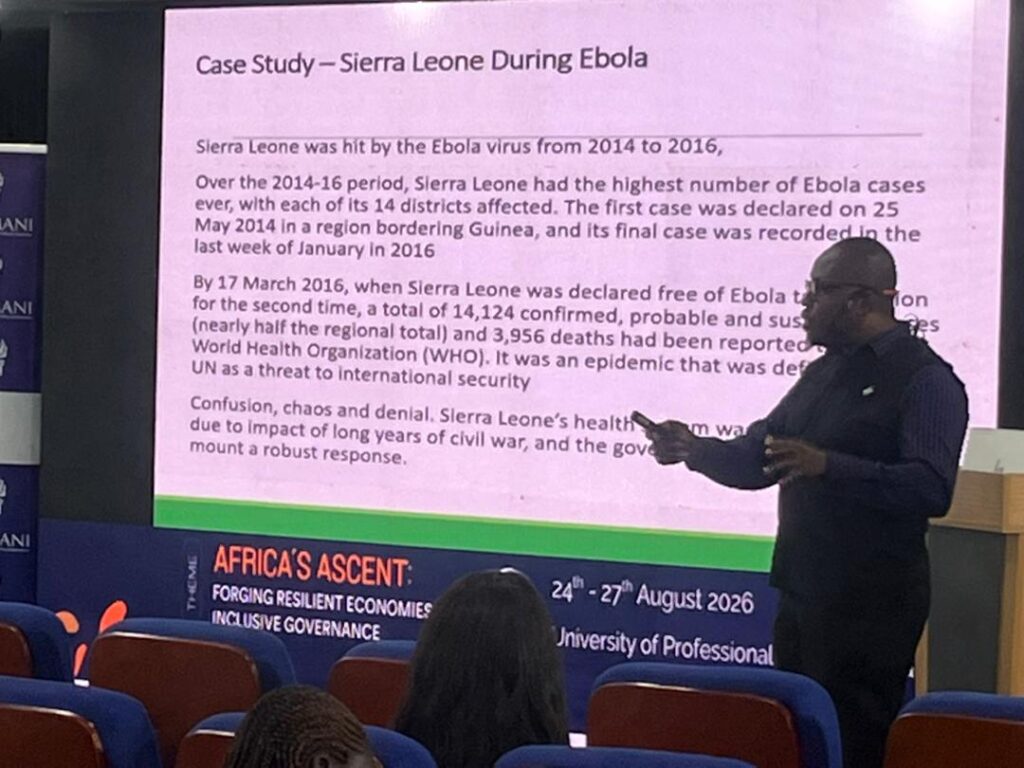
By March 17, 2016, when the country was declared Ebola-free for a second time, a total of 14,124 confirmed, probable and suspected cases and 3,956 deaths had been reported to the World Health Organization, nearly half the regional total. The United Nations had classified the epidemic as a threat to international security.
Mr Coleman said the crisis initially met confusion, chaos and denial, compounded by a health system already weakened by years of civil war and a government unable to mount an immediate, robust response.
Ubuntu Leadership in Practice
Mr Colman detailed how Sierra Leone’s response eventually took shape through what he termed an Ubuntu leadership model, engaging community structures far beyond formal government institutions.
At the community level, secret societies, faith-based organisations and traditional leaders facilitated and supported ownership of community care centres and drove social mobilisation.
Faith leaders, community leaders, secret society leaders and youth leaders combined to carry out surveillance, contact tracing and enforcement of bans on public gatherings, with secret societies specifically used to drive behavioural change through a programme funded by Plan International and led by then First Lady Sia Koroma.
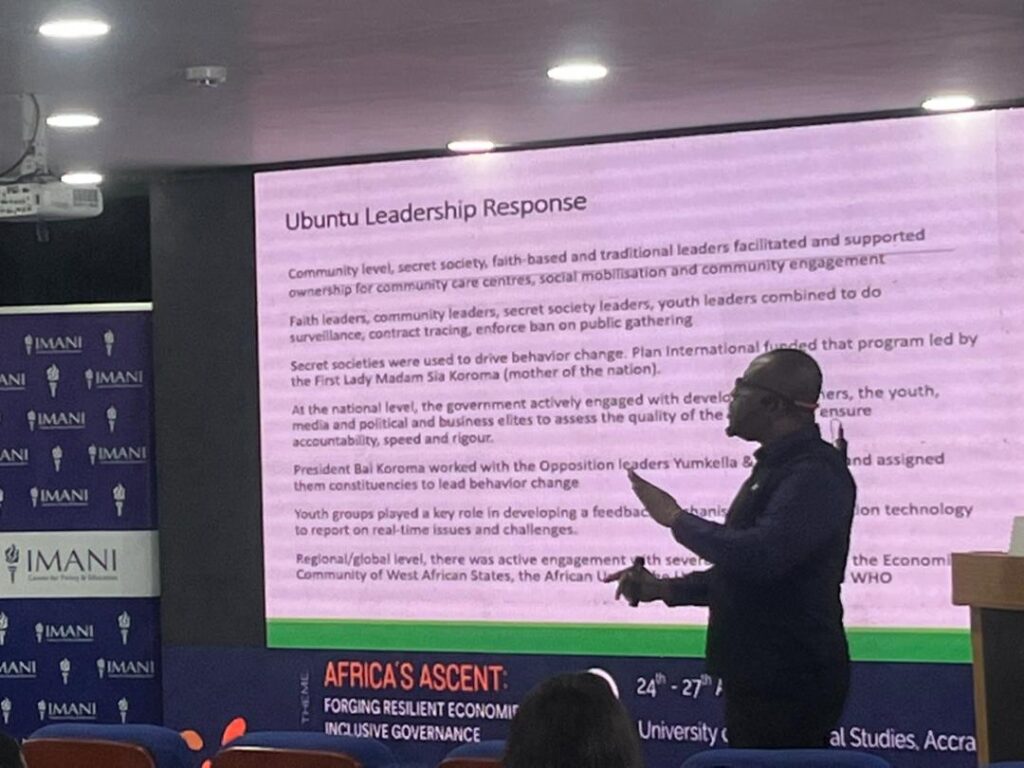
At the national level, government engaged actively with development partners, the media, and political and business elites to assess the quality, speed and rigour of the response and ensure accountability.
President Ernest Bai Koroma worked directly with opposition leaders, including Kandeh Yumkella, assigning them specific constituencies to lead behavioural change efforts in their areas.
Youth groups played a central role in developing real-time feedback mechanisms using technology to report emerging issues and challenges as they arose. At the regional and global level, Sierra Leone engaged actively with the Economic Community of West African States, the African Union and the World Health Organization.
At the regional and global level, Sierra Leone engaged actively with the Economic Community of West African States, the African Union and the World Health Organization.
Mr Coleman singled out President John Mahama and Senegalese President Macky Sall for particular praise, crediting them with helping open a humanitarian corridor that became one of four strategic and legacy achievements he identified from Sierra Leone’s Ebola response
Six Leadership Skills for Resilient Public Policy
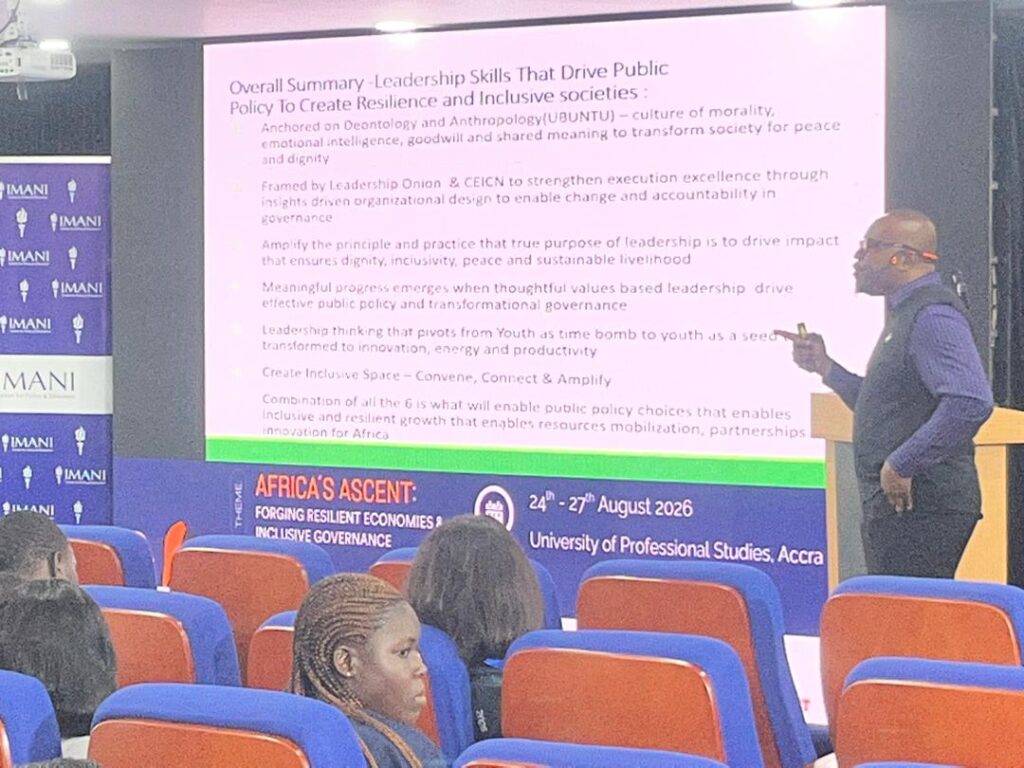
Mr Coleman closed by distilling his presentation into six leadership skills he said are necessary to drive resilient, inclusive public policy across Africa. Leadership must be anchored in deontology and Ubuntu, a culture of morality, emotional intelligence, goodwill and shared meaning capable of transforming society toward peace and dignity.
It must be framed by what he called the Leadership Onion and CEICN principles to strengthen execution excellence through insight-driven organisational design that enables change and accountability in governance. It must amplify the principle that leadership’s true purpose is to drive impact, ensuring dignity, inclusivity, peace and sustainable livelihoods.
He argued that meaningful progress emerges only when thoughtful, values-based leadership drives effective public policy and transformational governance, and called for a fundamental shift in how leaders think about young people, moving away from framing youth as a demographic time bomb and toward recognising youth as a seed that, properly cultivated, transforms into innovation, energy and productivity.
His final principle called on leaders to create inclusive space by convening, connecting and amplifying diverse voices, arguing that the combination of all six skills is what ultimately enables public policy choices capable of mobilising resources, forging partnerships and driving innovation across Africa.
READ ALSO: Africa Needs Strategic Industrial Partnerships- Ben Boakye