
UK Prime Minister Andy Burnham’s efforts to ease overcrowding in prisons across England and Wales have come under renewed scrutiny after Conservative Shadow Justice Secretary Nick Timothy warned that the proposed early release scheme could allow dangerous criminals to be released before completing their sentences.
The warning follows Burnham’s decision to further narrow the government’s controversial early prisoner release scheme, excluding anyone convicted of manslaughter from eligibility.
However, while the Prime Minister has moved to keep manslaughter offenders outside the early release programme, he has also proposed finding additional prison capacity by changing the arrangements surrounding prisoners serving Imprisonment for Public Protection (IPP) sentences.
The issue has placed the government under pressure to balance two competing demands: relieving an acute prison overcrowding crisis while ensuring that offenders considered a continuing danger to the public are not released before authorities are satisfied they can safely return to the community.
“In order to prevent one group of dangerous criminals being released early, he (Andy Burnham) is looking at releasing a different group of dangerous prisoners.”
Nick Timothy
His criticism centres on the government’s proposed approach to prisoners serving IPP sentences, a controversial form of indefinite sentence introduced in 2005 and abolished for new cases in 2012. The sentences were imposed on offenders considered to pose a significant risk of causing serious harm to the public.
Under the system, offenders are required to serve a minimum tariff before becoming eligible for release. However, completing that minimum period does not automatically result in freedom. The Parole Board must determine that continued detention is no longer necessary for public protection before a prisoner can be released.
The result has been a population of prisoners who have served their original minimum terms but remain behind bars because they have not been judged safe to release.
Ministry of Justice data showed that 2,271 people were serving IPP sentences as of June this year. Of those, 856 had never been released because the Parole Board had determined that it was not safe for them to return to the community.
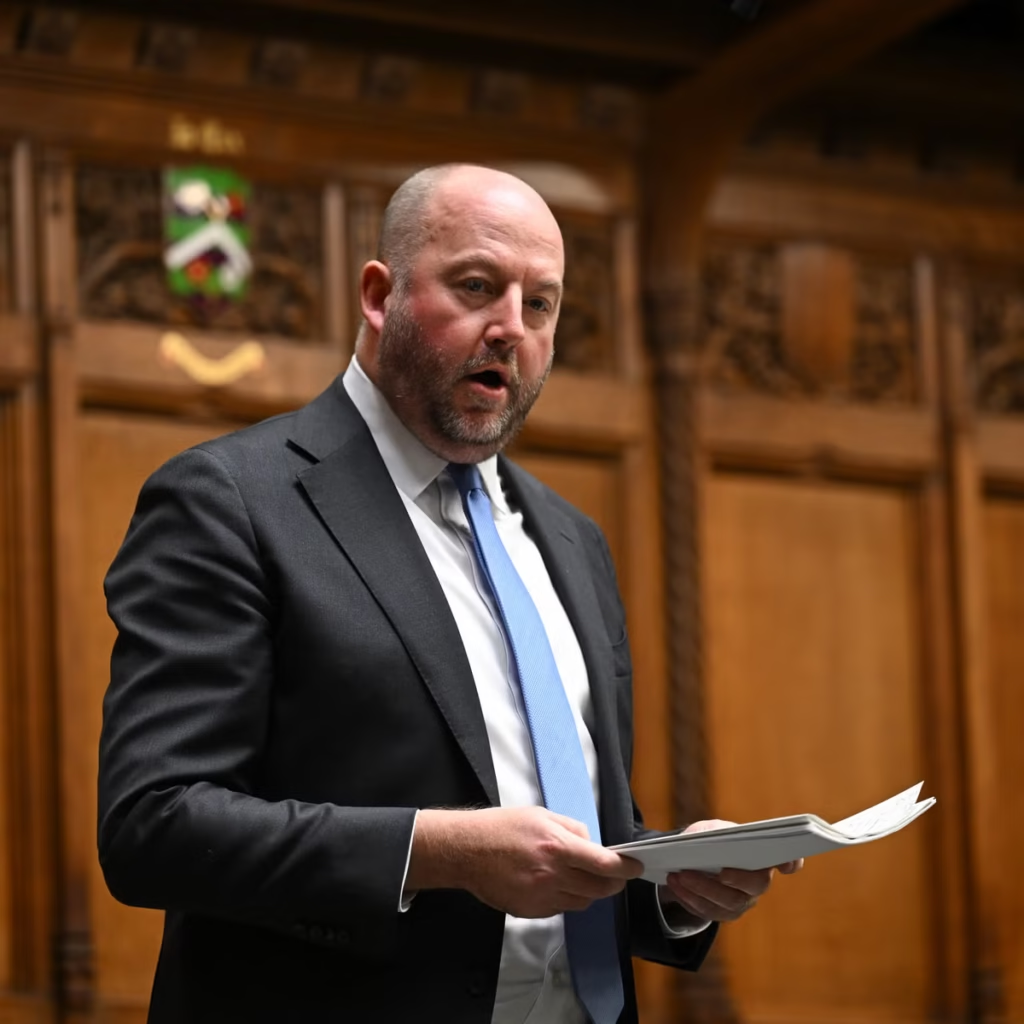
Nick Timothy argued that the continued detention of these prisoners reflected assessments made by independent experts rather than arbitrary government decisions.
“By definition, the people who are still in prison on those sentences are dangerous, because they’ve all been considered by independent expert assessors who have concluded that they are not safe to release and they would be a danger to the public.”
Nick Timothy
Pressure on the prison system in England and Wales has intensified as the number of inmates approaches the limits of available space. On 3 August, the prison population reached 86,495, leaving the system operating at roughly 97% of usable capacity.
The government’s response has included an early release scheme established under the Sentencing Act 2026. Due to commence on 1 October, the initiative is intended to ease overcrowding by allowing qualifying prisoners to leave custody before their original release dates.
Yet the measure has prompted growing concern among politicians and the public over whether reducing prison terms could compromise public safety.
Under the latest changes, offenders convicted of manslaughter will no longer qualify. Those convicted of rape, serious child sexual offences and grooming offences are also excluded.
Burnham acknowledged that narrowing the programme would mean keeping “hundreds” of additional prisoners behind bars and would require the government to identify further capacity within the prison system.
The Prime Minister nevertheless defended his decision, arguing that the government needed to apply “common sense” to the treatment of IPP prisoners.
UK Government Defends Prison Reform as Overcrowding Puts Justice System Under Pressure

Meanwhile, UK government has defended Burnham’s approach, arguing that maintaining public safety remains its central priority while acknowledging the severe pressures facing the prison estate.
Alex Davies-Jones, Minister for Victims, Violence Against Women and Girls and International Justice, noted that the government’s “number one priority is to keep the public safe.“
“The government’s number one priority is to keep the public safe and to do that we need a functioning criminal justice system.”
Alex Davies-Jones
Davies-Jones indicated that the government’s objective was to ensure that “there is always a prison space available for someone who needs it.“
She also sought to reassure the public that prisoners released under the scheme would not simply disappear from the supervision of the authorities.

Moreover, Davies-Jones added that “release doesn’t mean freedom” and indicated that there would be a presumption that those released would be subject to GPS electronic monitoring.
The government argues that such safeguards can provide a degree of oversight while helping to create space within prisons for offenders who need to remain incarcerated.
However, the proposed treatment of IPP prisoners remains particularly contentious because of the nature of their sentences and the decisions made by the Parole Board regarding their continued detention.
Changing the legal framework governing indefinite sentences would also require new legislation, meaning that any reforms may take years to produce additional prison capacity.
READ ALSO: Investors Could Reposition Portfolios Ahead of New Four-Year Treasury Bond- Analyst