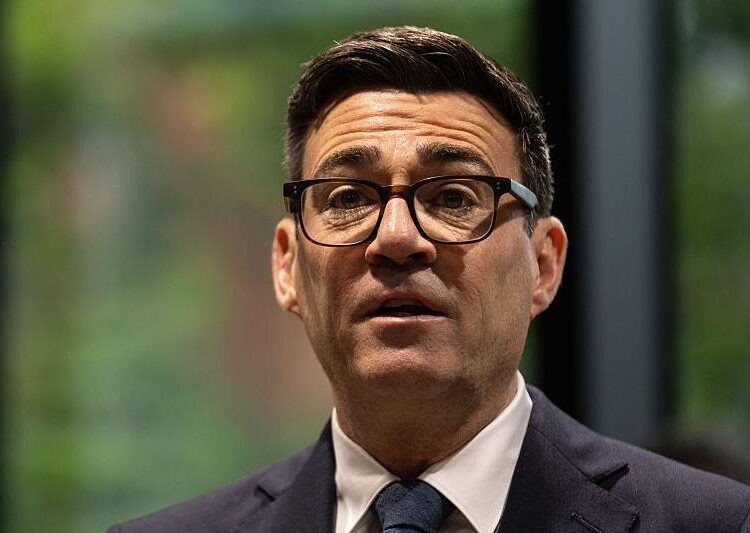
UK Prime Minister Andy Burnham has tightened England and Wales’ early-release rules, excluding prisoners convicted of unlawful killing, including manslaughter, from the scheme.
The changes will prevent those convicted of the killing of police officer PC Andrew Harper from benefiting from early release, keeping them behind bars for longer.
The decision follows months of campaigning by Harper’s family and former colleagues, who had urged the government to intervene after it emerged that two of the three men convicted of his death could become eligible for early release under changes introduced to ease severe overcrowding in the prison system.
Speaking in an interview, Andy Burnham noted that prisoners convicted of manslaughter would no longer qualify for early release, arguing that the government had a responsibility to ensure that those responsible for killing a police officer did not benefit from a policy designed primarily to relieve pressure on an overcrowded prison estate.
“I heard obviously what Andrew Harper’s family were saying, I mean who couldn’t? Nobody would want a position to arise where those guilty of killing a police officer are let out early from prison.”
Andy Burnham
The decision marks the latest adjustment to the government’s controversial early-release programme, which was introduced through the Sentencing Act 2026 in response to an escalating prison-capacity crisis.
The legislation was designed to reduce pressure on prisons by allowing thousands of prisoners to be released earlier than previously planned. The first releases under the revised arrangements are scheduled to begin on 1 October.
But the policy has faced growing political and public opposition, particularly in cases involving serious offences. Critics have argued that the government risks undermining confidence in the justice system by releasing offenders before they have served the proportion of their sentences previously expected.
Meanwhile, the Prime Minister acknowledged that “hundreds” more prisoners will remain behind bars as a result of the changes, creating an immediate need for additional capacity.
The prison estate in England and Wales is already operating close to its maximum capacity. Ministry of Justice figures show that the prison population stood at 86,843 on 24 August, representing 97.6% of total capacity.
Andy Burnham noted that the government would seek to create additional space through several measures, including the deportation of foreign prisoners and changes to the treatment of prisoners serving indefinite Imprisonment for Public Protection, or IPP, sentences.
He argued that these measures would allow the government to maintain the exclusion of serious offenders from early release while addressing the wider capacity crisis.
The Prime Minister’s intervention represents another significant change to a policy that has undergone repeated revisions since Labour came to power.
Earlier this month, the government announced that prisoners convicted of rape, serious child sex offences and grooming would be excluded from early-release eligibility. Murder convictions were also excluded.
The latest decision extends that list to include manslaughter and other offences that Burnham stated should remain subject to longer periods of imprisonment.
Prisoners convicted of indecent assault offences and death by dangerous driving will also remain excluded, while historic child sexual offences and causing or allowing the death of a child will be added to the list of offences that cannot benefit from the scheme.
In addition, the government is also introducing new “restriction zones” intended to provide greater protection for domestic violence survivors when perpetrators are released early.
The changes are designed to balance competing pressures: the need to prevent dangerous offenders from being released prematurely and the urgent need to create space within a prison system already operating near full capacity.
Prison Capacity Crisis Pushes UK Towards Deportations and IPP Reform

With hundreds of prisoners expected to remain behind bars under the new exemptions, Burnham has acknowledged that the government must find additional prison capacity to implement the revised policy without worsening overcrowding.
One of the government’s proposed solutions is to increase the removal of foreign nationals serving prison sentences in the United Kingdom.
Pressed on how many foreign prisoners could potentially be returned to their countries. The government has noted that new powers will be introduced early next year to allow some foreign criminals to be deported immediately after sentencing.
Under the proposed arrangements, some offenders would be removed from UK without serving their entire prison term domestically, while those convicted of the most serious crimes would remain incarcerated for a substantial period before removal.
Those deported under the new arrangements would also be prevented from returning to UK.
However, the government is not believed to have concluded additional prisoner-transfer agreements with other countries, raising questions about how quickly the policy can generate meaningful prison capacity.
Another major component of Burnham’s strategy is the treatment of prisoners serving IPP sentences.
Imprisonment for Public Protection sentences were introduced in 2005 for offenders considered to pose a significant risk of serious harm to the public. Although the scheme was abolished for new cases in 2012, thousands of prisoners remain subject to the sentences.
Under an IPP sentence, an offender can be kept in prison beyond the minimum tariff until the Parole Board determines that they no longer pose an unacceptable risk to the public.
As of June, 2,271 people were serving IPP sentences, with 856 never having been released because the Parole Board had determined that it was not safe to do so.
Burnham indicated that he had long-standing concerns about the system and argued that some prisoners who had already served beyond their minimum terms should be considered for release.
“I was faced with a situation where people on those sentences who have more than served their time, not being released when others who’ve committed very serious crimes being released early.
“The judgement I’ve made is the public, in my view, would prefer a situation where people who have served their time to be considered for release before those who haven’t.”
Andy Burnham
The Prime Minister nevertheless acknowledged that some prisoners serving IPP sentences could continue to pose serious risks to the public.
To address those concerns, the government plans to establish a cross-party oversight group as it moves towards terminating the remaining IPP sentences.
Burnham said legislation to end the sentences would be introduced by the “end of this Parliament.“
READ ALSO: Mahama Joins AU Leaders in Luanda to Adopt Continental Conflict Prevention Plan