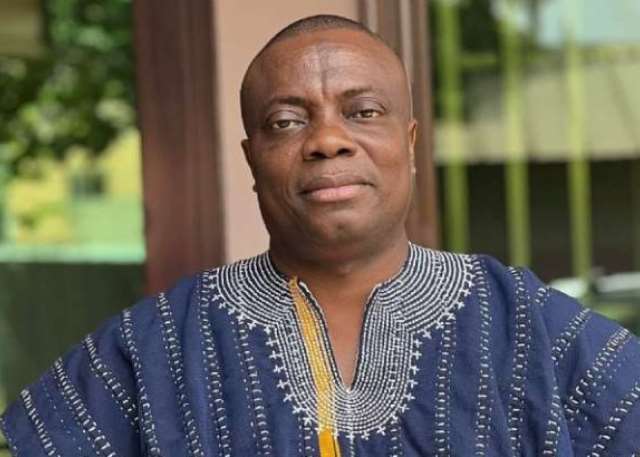
Pollster and Executive Director of Global InfoAnalytics, Mussa Dankwah, has published an assessment arguing that Chairman Wontumi’s endorsement of John Boadu could tilt the New Patriotic Party’s national chairmanship race in three regions while leaving four others largely untouched.
His analysis followed Tuesday’s September 8, 2026 announcement in Accra that the campaign of the former Ashanti Regional Chairman had thrown its weight behind the former General Secretary.
Mr Dankwah built the assessment on his firm’s delegate survey, conducted between 27 August and 1 September, which found a contest separated by roughly five points and clouded by a large body of delegates who have not settled on a candidate.
He argues that in a race this tight, an endorsement carrying regional weight becomes a variable worth measuring rather than a formality.
A race that remains wide open
The Global InfoAnalytics poll, released on 2 September, sampled 2,581 NPP delegates across all 16 regions through computer-assisted telephone interviews, with respondents drawn randomly from the party’s 2026 constituency register. It carries a 99 percent confidence level and an overall margin of error of 1.9 percentage points.
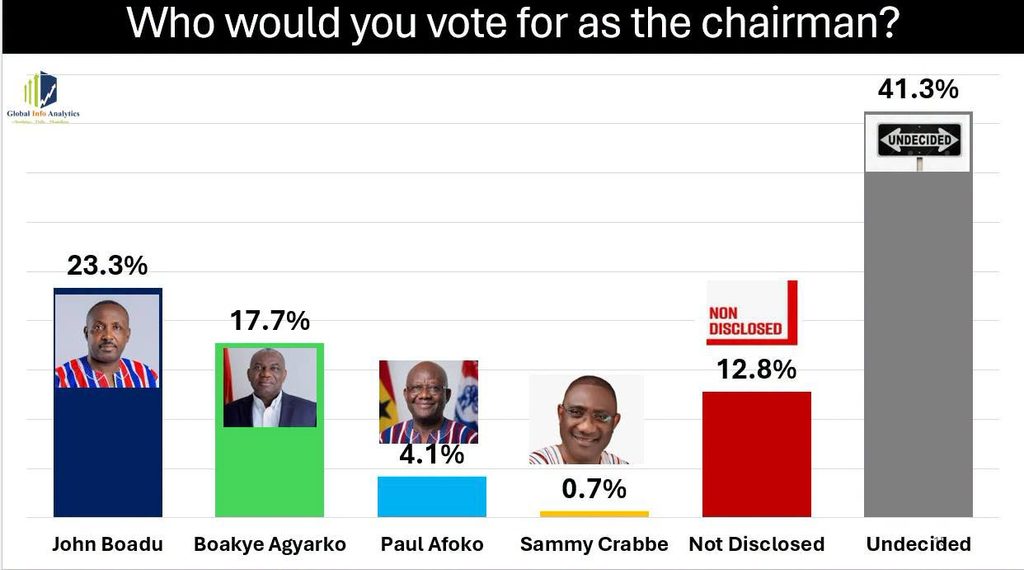
John Boadu led with 23.3 percent against 17.7 percent for former Energy Minister Boakye Agyarko. Former National Chairman Paul Afoko recorded 4.1 percent and former National Vice Chairman Sammy Crabbe 0.7 percent.
The decisive figure sat elsewhere. Some 41.3 percent of delegates had not made a choice, and a further 12.8 percent declined to disclose one, leaving more than half the electoral college unaccounted for.
That arithmetic frames Mr Dankwah’s central claim. Small gains, accumulated across constituencies, can decide a contest this narrow. “As we say in Patwah, ‘Every Mickle Mek A Muckle’, small things when combined one by one can have a big effect.”
Where Wontumi’s name still carries weight
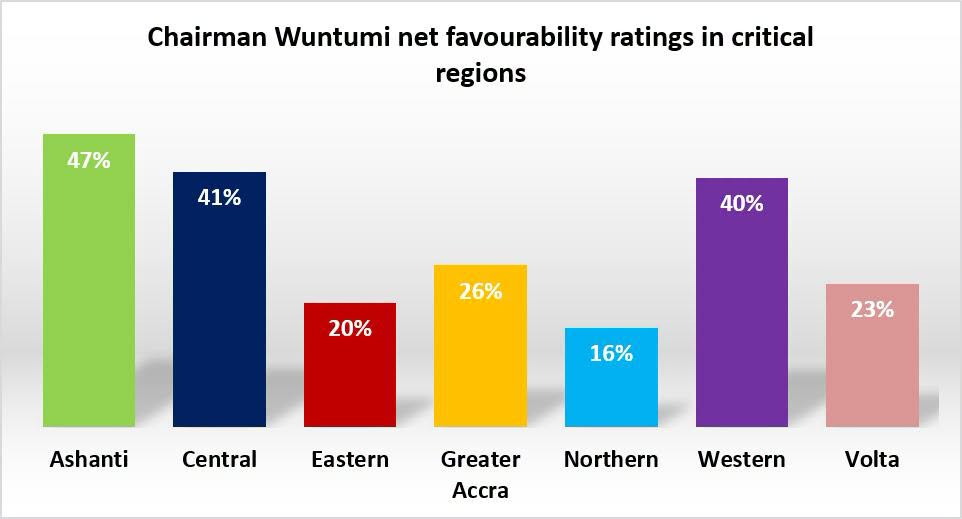
Mussa Dankwah identifies seven regions where he believes the chairmanship will be won or lost: Ashanti, Central, Eastern, Greater Accra, Northern, Western and Volta. Across those seven, Wontumi’s favourability sits high in only three. He records 47 percent in Ashanti, 41 percent in Central and 40 percent in Western.
Ashanti presents the tightest picture. Boakye Agyarko leads there by three points, a margin Mr Dankwah describes as a whisker. On his reading, the endorsement has likely closed that gap, and at worst for Boakye Agyarko, handed John Boadu a slim lead in the region. He cautions that the contest still has distance to run and that Ashanti remains volatile.
Central offers cleaner ground for John Boadu, who already leads by 14 points in a region where Wontumi polls at 41 percent favourability. Mr Dankwah expects the endorsement to consolidate that position and possibly widen the margin.
Western follows a similar logic. John Boadu leads by 12 points there, a lead Mr Dankwah attributes to spillover from Central, and Wontumi’s 40 percent favourability ranks among his strongest in any region.
Mussa Dankwah made a related point in remarks during an interview, where he cautioned against assuming a clean transfer of loyalty from one camp to another. “You’re not going to have 90% transfer of support or vote to an opponent,” he said.
The undecided bloc the endorsement targets
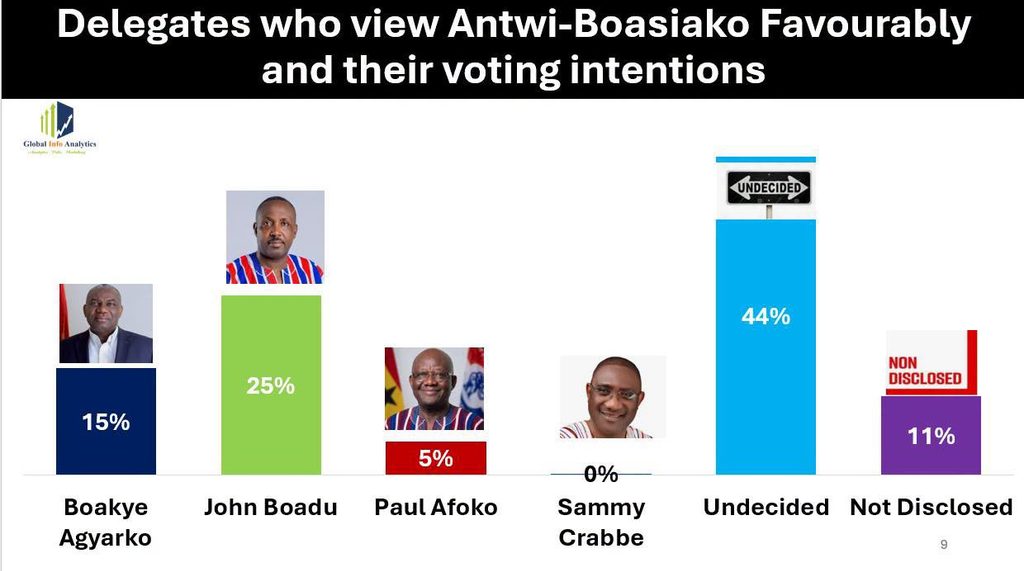
The most revealing figure in Mr Dankwah’s breakdown concerns delegates who already view Wontumi favourably. Among that group, 25 percent chose John Boadu, and 15 percent chose Boakye Agyarko. Paul Afoko drew 5 percent, 11 percent withheld their preference, and 44 percent had not decided.
That 44 percent is the prize. Mr Dankwah reads the endorsement as a signal aimed squarely at delegates sympathetic to Wontumi who have yet to commit, giving them what he calls clear direction from a figure he characterises as the party’s Mandela of the present era.
Whether the party’s wider membership accepts that framing of a man currently incarcerated is a separate question, and one Mr Dankwah does not address. He is equally direct about the endorsement’s limits.
In Eastern, Greater Accra, Northern and Volta, he sees little prospect of meaningful movement. Whichever candidate builds an advantage across those four, he argues, gains a strong path to the chairmanship.
How the endorsement reached the public
Dennis Okyere Danso, administrator of the Wontumi campaign, announced the decision at a press briefing in Accra on Tuesday, 8 September.
He said campaign leaders visited Wontumi at the Nsawam facility on Friday, 4 September, and consulted grassroots members, constituency actors, campaign leadership, party elders and stakeholders before arriving at the position.
Mr Danso described the outcome as a firm and decisive move to throw the campaign’s “full support, strength and political weight” behind Boadu, framing it as a deliberate step to strengthen the party ahead of 2028.
Wontumi withdrew from the chairmanship contest following his incarceration, leaving four contenders in the field. Not everyone accepts the polling that underpins this analysis.
After Global InfoAnalytics released an earlier survey on 20 August, Boakye Agyarko’s spokesperson Vincent Frimpong Manu stated that the findings missed the people who matter, insisting, “This did not target those who are actually going to vote.”
He urged the firm to survey the electoral college directly and maintained that the campaign’s internal assessment places Mr Agyarko ahead. The September poll answers part of that objection by drawing its sample from the party’s constituency register rather than the general NPP voter base.
Whether the Mr Agyarko camp accepts the revised methodology remains untested. Mr Dankwah himself attached an unusual caveat to the analysis, urging candidates to ignore it and disclaiming liability for anyone who relies on the data to their disadvantage. He describes it as material for his followers rather than campaign intelligence.
That posture aside, he has said the true measure of the endorsement will emerge as his firm tracks regional shifts over the coming weeks, which places the next survey, rather than this one, at the centre of the argument.
READ ALSO: Ghana Seeks To Replicate Shandong Gold Green Mining Operations Model