

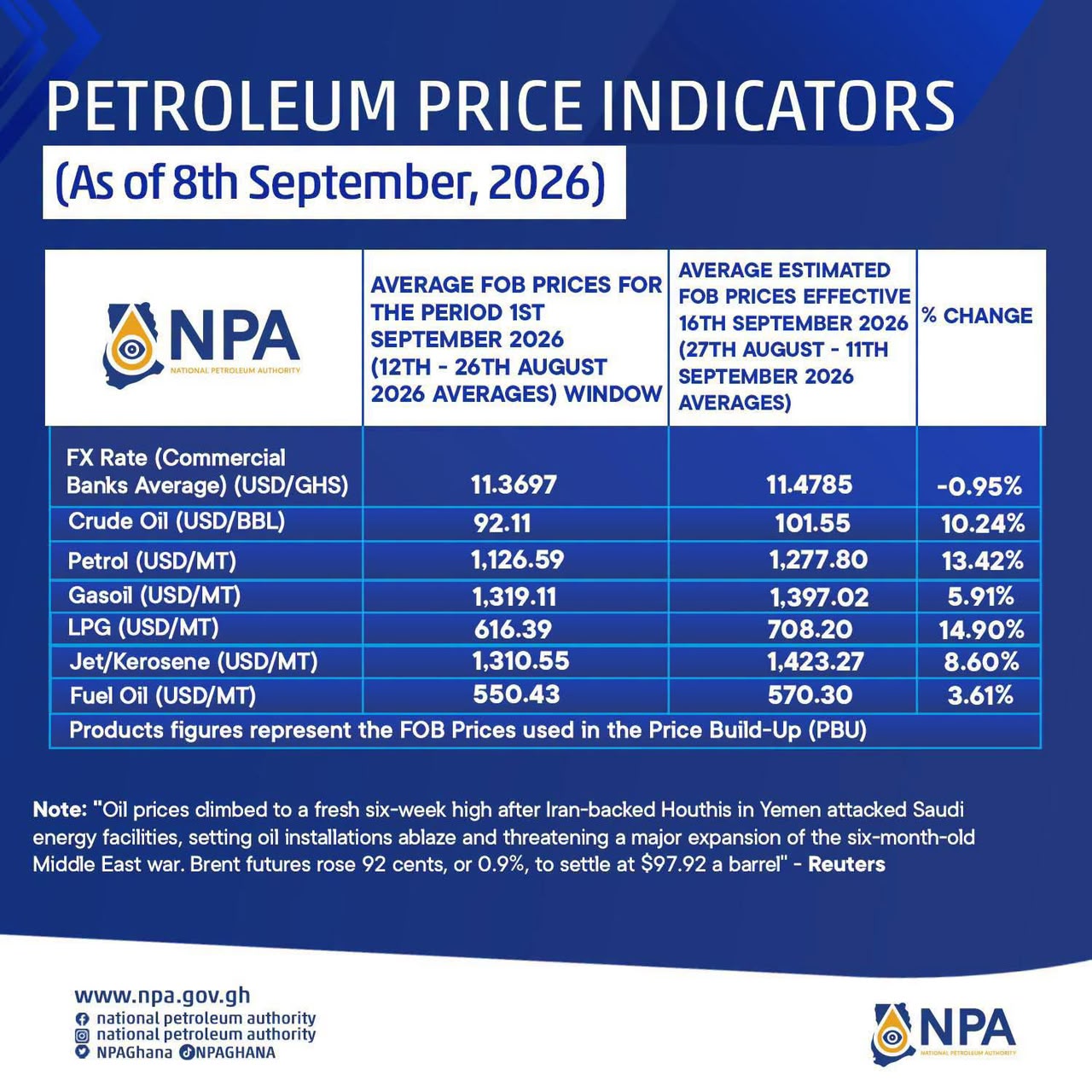
Ghana’s downstream petroleum market is entering a more sensitive phase as renewed volatility in international oil prices raises questions about how quickly changes in global crude and refined-product costs should be reflected at the pump.
The immediate concern is not simply whether fuel prices will rise, but when those increases should occur.
Industry stakeholders are questioning the practice of adjusting petroleum prices in the middle of an established pricing window, arguing that doing so could weaken the predictability of Ghana’s downstream pricing system and expose consumers to repeated price movements within a period that is supposed to provide some stability.
The debate comes as Brent crude has moved towards the US$100-per-barrel mark amid escalating tensions in the Middle East, creating fresh uncertainty for oil-importing economies such as Ghana.
For a country that remains exposed to international petroleum prices, exchange-rate movements and the cost of importing refined products, the latest developments underline the difficult balance between allowing businesses to respond to changing market conditions and protecting consumers from abrupt price adjustments.
Global Oil Shock Meets Local Pricing Rules
Ghana does not determine the international price of crude oil, meaning geopolitical disruptions thousands of kilometres away can eventually influence the cost of fuel consumed by Ghanaian households, motorists and businesses.
The country’s pricing framework is intended to provide an organised mechanism through which these external movements are incorporated into domestic petroleum prices.

That framework becomes particularly important when international prices move sharply after a domestic pricing window has already begun.
CEMSE Executive Director Benjamin Nsiah argues that market participants should not treat every movement in the international market as an immediate justification for changing prices.
“If any BDC varies their prices upward because of recent price increment on the international market, that particular BDC is acting contrary to the price regulation and that is illegal.”
Benjamin Nsiah, Executive Director, CEMSE
His argument puts the spotlight on the distinction between a new pricing window and movements occurring within an existing one.
If prices are recalculated at defined intervals, then consumers and businesses have at least some basis for anticipating the cost of petroleum products during that period.
Frequent adjustments could make that system less meaningful if prices are continually altered in response to developments occurring after the window has commenced.
The issue is particularly significant for businesses that rely heavily on diesel and petrol, because fuel costs are not isolated expenses.
They influence transportation, distribution, agriculture, construction, manufacturing and ultimately the prices consumers pay for goods and services.
The Consumer Cost Of Volatility
The economic importance of pricing stability becomes clearer when fuel is viewed as an input into the wider economy rather than simply a product sold at filling stations.
A transport operator facing a sudden increase in diesel costs may eventually seek higher fares. A logistics company may face increased distribution expenses.
Farmers using mechanised equipment or transporting produce may encounter higher operating costs, while manufacturers could see their production and distribution bills increase.
The cumulative effect is that a petroleum-price adjustment can travel well beyond the filling station.
This is why the timing of price changes matters.
A system in which prices are reviewed at predetermined intervals creates a degree of predictability.
A system where suppliers can repeatedly revise prices whenever international benchmarks move could instead transfer a greater portion of short-term market risk directly to consumers.
That does not eliminate the commercial pressures facing suppliers.
Importers and distributors must ultimately recover their costs, and sustained increases in international petroleum prices cannot be absorbed indefinitely without affecting the viability of businesses operating in the downstream market.
The more fundamental question is therefore whether those costs should be passed through immediately or incorporated into the next regulated pricing review.
Ghana Remains Exposed To External Oil Markets
The current situation also exposes a structural weakness in Ghana’s petroleum economy.
Even as the country works to strengthen domestic refining, Ghana remains vulnerable to movements in international petroleum markets because domestic demand is not yet fully insulated from imported refined-product costs.
This means that developments in crude oil supply, refinery utilisation, shipping costs and geopolitical risk can all eventually affect domestic fuel economics.
The recent rise in global prices is particularly significant because the Middle East remains central to global petroleum supply chains.
Any prolonged disruption or threat to regional production and transportation routes can increase the risk premium embedded in global oil prices.
For Ghana, the consequence is straightforward: higher international prices can translate into higher import costs and, eventually, higher domestic petroleum prices.
But the timing of that transmission remains a regulatory question.
Price Stability Cannot Mean Ignoring Market Reality
There is also a limit to how far price regulation can shield consumers.
If global petroleum prices remain elevated for an extended period, maintaining an artificially low domestic price without corresponding fiscal support would simply move the cost elsewhere, potentially onto petroleum companies, government finances or other parts of the economy.
The objective, therefore, should not be to prevent legitimate price increases.
Rather, it should be to ensure that price changes occur according to clearly understood rules.
That distinction matters because Ghana’s downstream market has historically had to navigate competing pressures: consumers want affordable and predictable fuel, while importers and distributors need prices that reflect their actual costs.
The regulatory framework attempts to reconcile those interests through defined pricing periods and price indicators.
The current debate is essentially testing how resilient that arrangement is when international markets become unusually volatile.
Refining Offers A Longer-Term Defence
The most durable solution to Ghana’s exposure will not come from pricing regulation alone.
Increasing domestic refining capacity could reduce the country’s dependence on imported refined petroleum products and potentially improve supply security.
But local refining does not completely disconnect Ghana from international oil prices.
A refinery still requires crude, and the cost of that crude is influenced by the global market.
Domestic refining can nevertheless change the nature of Ghana’s exposure by allowing the country to capture more value within the domestic petroleum chain, improve supply flexibility and potentially reduce some import-related costs.
That makes ongoing investment in refining, storage and petroleum logistics strategically important.
It also means that downstream regulation and infrastructure development cannot be viewed separately.
A strong regulatory framework can provide market discipline today, while greater domestic processing capacity could strengthen Ghana’s resilience over the longer term.
The Real Question Is Who Absorbs The Shock
The latest controversy ultimately raises a bigger question about Ghana’s petroleum market: when global oil prices suddenly rise, who should bear the immediate cost?
If suppliers absorb the increase, their margins come under pressure.
If consumers absorb it immediately, household and business costs rise.
If government intervenes, the fiscal burden may increase.
And if prices are allowed to move frequently within a pricing period, consumers lose some of the predictability that the pricing-window system is intended to provide.

There is no cost-free option.
What regulation can provide is clarity over the rules through which those competing pressures are managed.
That is why the current debate is more significant than a disagreement over whether one company should increase its price.
It touches on the credibility of Ghana’s entire downstream petroleum pricing architecture.
As international oil markets approach another period of heightened uncertainty, Ghana will have to manage two realities simultaneously: the country cannot control the global oil market, but it can control how transparently and predictably global price shocks are transmitted to its domestic economy.
The immediate test will be whether the existing pricing system can maintain that discipline while allowing legitimate commercial realities to be recognised.
For consumers, the outcome will be measured at the pump. For the wider economy, however, the consequences could be felt through transportation costs, inflation, business operating expenses and household purchasing power.
And that makes the debate over mid-window fuel pricing much bigger than the price of a litre of petrol or diesel.
READ MORE: Foreign Affairs Minister’s Briefing Cannot Nullify RTI Request — Minority