
The Bank of Ghana’s next interest-rate decision has become less straightforward after inflation edged up to 5.0 per cent in August, just as fresh national accounts showed the economy expanded by 6.0 per cent in the second quarter.
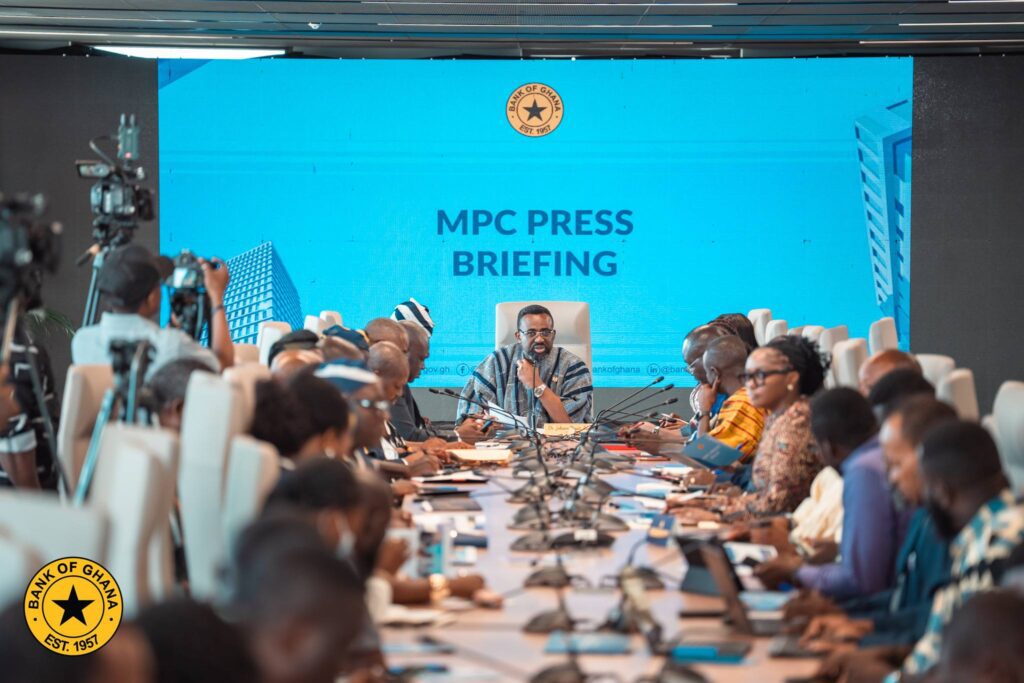
The Monetary Policy Committee will meet on 23 and 24 September 2026 with the policy rate at 14.0 per cent, confronting below-target inflation, resilient growth and rapidly expanding credit.
That mix gives the Bank room to ease, but weakens the case for a mechanical rate cut. Inflation remains below the 6 to 10 per cent medium-term target band, leaving the policy rate nine percentage points above the latest inflation reading.
Yet private-sector credit grew by 41.2 per cent year-on-year in June and by 34.1 per cent in real terms, while average bank lending rates had fallen to 15.6 percent from 27.0 per cent a year earlier.
The September choice is therefore less about whether monetary policy is still restrictive than about how quickly the Bank should use the space created by disinflation.
A cut could reinforce falling borrowing costs for firms and households. A hold would give the Committee more time to judge whether August’s inflation increase is temporary and whether the substantial easing already delivered is still working through credit, demand and the exchange rate.

Inflation Remains Below Target, but Risks Persist
The August reading needs careful interpretation. Headline inflation increased by 0.4 percentage points from July’s 4.6 percent, but one monthly rise does not establish a renewed inflation cycle. Inflation had been 5.3 percent in June before falling in July and moving back to 5.0 percent in August.
For policymakers, the more important questions concern underlying price pressures, inflation expectations and risks to the forecast.
In the July voting record, one MPC member warned that “premature monetary easing could reverse progress towards restoring price stability”, citing energy prices, utility-tariff adjustments and external uncertainty among the risks.
Those concerns matter because Ghana remains exposed to imported fuel and other traded inputs. Renewed cedi weakness or another rise in global energy costs could feed into transport, production and consumer prices.
The Bank must distinguish a temporary rebound in inflation from evidence that price pressures are broadening.
Growth Removes the Urgency for Extra Stimulus
Ghana Statistical Service data show real GDP expanded by 6.0 percent year-on-year in the second quarter of 2026. That is a favourable growth outcome, but it also means the MPC is not being asked to rescue a weak economy.
When growth is resilient and financial conditions are already easing, the cost of waiting for more information is lower than during a sharp slowdown. At the same time, keeping rates too high for too long could unnecessarily restrain investment and working-capital financing.
The issue is whether current growth and demand conditions leave enough room to ease without rebuilding inflationary or exchange-rate pressure.
Credit Easing Is Already Reaching the Economy
The credit channel is one of the strongest arguments for caution. Bank of Ghana data show nominal private-sector credit growth reached 41.2 percent in June, compared with 8.6 percent a year earlier. More importantly, real private-sector credit grew by 34.1 percent, showing that the acceleration cannot be explained simply by higher prices.
Borrowing costs are also moving lower. The average lending rate fell to 15.6 percent in June from 27.0 percent a year earlier, while the Ghana Reference Rate has declined sharply. That suggests previous monetary easing is increasingly passing through to market rates and bank lending.
For firms, cheaper credit can support inventories, payrolls, machinery and expansion. For households, it can reduce financing costs. But the macroeconomic effect depends on where new credit goes.
Lending that expands productive capacity can support non-inflationary growth; lending concentrated in consumption and imports can lift demand faster than domestic production responds.
Cedi and Energy Prices Remain Swing Factors
The exchange rate and global energy market could quickly alter the September calculation. A fresh bout of cedi depreciation would raise the local-currency cost of imported fuel, raw materials and capital goods, while higher oil prices would compound that pressure. These channels explain why low current inflation does not automatically imply an equally low policy rate.
The Committee must also consider expectations. If businesses, households and markets interpret rapid easing as reduced commitment to price stability, expectations can adjust before the effect becomes visible in headline CPI.

September Decision Is About Pace
A cut on 24 September would likely indicate that the Committee places greater weight on subdued inflation and sees the external and demand-side risks as manageable. A hold would suggest it wants more evidence that the August increase is temporary and that strong credit growth will not destabilise prices or the cedi.
Either way, the accompanying statement may be as important as the rate itself. Markets, banks and businesses should watch the Bank’s assessment of inflation expectations, exchange-rate conditions, energy prices, credit growth and the speed at which lower policy rates are reaching borrowers.
Ghana has created valuable monetary-policy space through disinflation and stronger macroeconomic conditions. The September meeting will show not simply whether the Bank wants lower rates, but how quickly it believes that space can be used without putting recent stability gains at risk.
READ ALSO: IMANI Engagement Exposes Seven Structural Cracks in Ghana’s Social Protection System