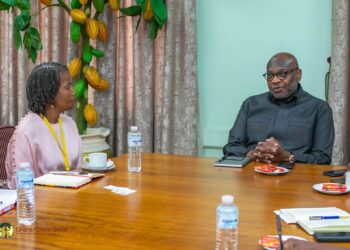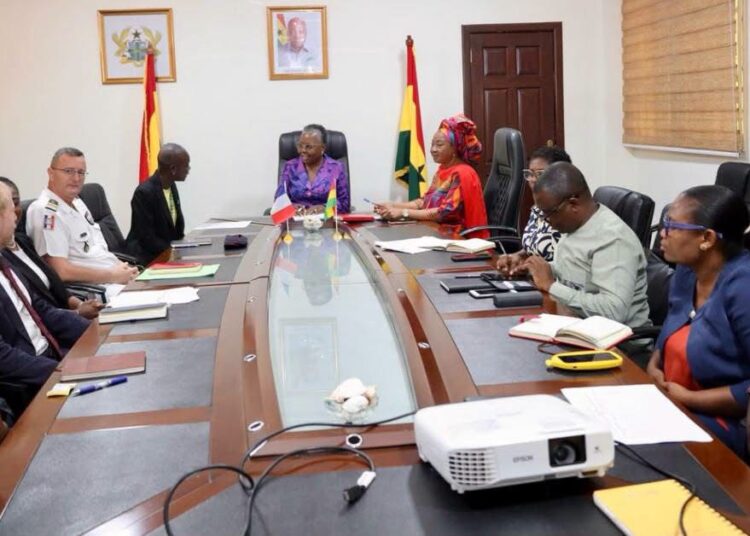
The Minister for Fisheries and Aquaculture, Hon. Emelia Arthur, holds a high level meeting with the Ambassador of France to Ghana, H.E. Diarra Dime-Labille, and her delegation to explore areas of collaboration aimed at strengthening Ghana’s fisheries and marine resources sector.
The courtesy call, held at the Ministry in Accra, focuses on potential partnerships in fisheries research, investment, regulation, fisheries security, marine resource management, and the advancement of Ghana’s Blue Economy Agenda.
A key area of discussion is Ghana’s ongoing efforts to strengthen fisheries governance and regulatory compliance, particularly in response to the European Union’s Yellow Card issued over concerns relating to illegal, unreported and unregulated (IUU) fishing.
Hon. Emelia Arthur notes that the Ministry is intensifying measures to address these concerns and is committed to achieving the reforms necessary for the removal of the Yellow Card. She says Government has taken bold steps to modernise and strengthen governance in the fisheries sector.
“Government has enacted the Fisheries and Aquaculture Act, 2025 (Act 1146), which provides a modern legal framework to promote sustainable practices. In addition to the Fisheries (Port State Measures) Regulations, 2024 (L.I. 2490), these legal frameworks demonstrate Ghana’s commitment to sustainable fishing practices and combating IUU fishing in line with our international obligations.”
Hon. Arthur
She emphasizes the importance of strengthening regulatory frameworks, enhancing enforcement mechanisms, and improving monitoring, control and surveillance systems to ensure the sustainable management of Ghana’s fisheries resources.
The Minister says IUU fishing accounts for 30 to 40 per cent of total catches in the West African sub-region, translating into annual economic losses of over $2.3 billion, depriving governments of much-needed revenue, undermining artisanal livelihoods, and in some cases, fuelling piracy and organised crime.
“To achieve this, Ghana is exploring new technologies, such as installing electronic monitoring systems on all industrial trawl vessels and procuring patrol boats to enhance enforcement in collaboration with the Ghana Navy and Marine Police.”
Hon. Arthur
Highlights on Opportunities that Comes with Research and Knowledge
The discussions also highlight opportunities for scientific cooperation and knowledge exchange. France, through its renowned research institutions, including the French Research Institute for Exploitation of the Sea (Ifremer), the French National Research Institute for Sustainable Development (IRD), and the French National Centre for Scientific Research (CNRS), possesses extensive expertise in ocean science, fisheries resources and marine ecosystem management.
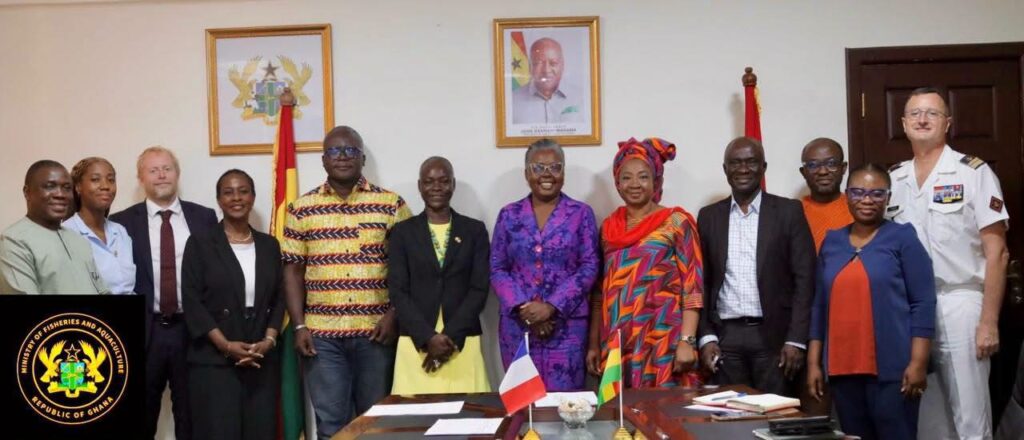
Both parties explore opportunities for collaboration in fisheries and marine research, covering artisanal, coastal and pelagic fisheries, aquaculture development, climate change adaptation, biodiversity conservation, and marine protected area management.
The French Ambassador says France through civilian and military commitments is providing strong support to promote regional and international cooperation in combatting IUU fishing and strengthening collaboration between law enforcement and fisheries authorities while developing partnerships for integrated maritime security and resource management.
“Fisheries are not just about food; they are about stability, livelihoods, and peace. France stands with Ghana and its partners in strengthening surveillance, promoting sustainable practices, and combating illegal fishing. Together, we must work for the prosperity and security of our people.”
Diarra Dime-Labille
Ambassador Dime-Labille notes that engagement builds on existing cooperation. The Kofi Annan International Peacekeeping Centre (KAIPTC) has hosted international conferences on fisheries and stability with support from the French Embassy and French Navy, spotlighting maritime security surveillance along the Gulf of Guinea.
The SIREN Maritime Academy, created by the French Navy four years ago in close coordination with countries along the Gulf of Guinea, has trained 33 officers and agents from 20 countries, including Ghana.
Speaking during the meeting, Hon. Emelia Arthur reaffirms the Ministry’s commitment to transforming Ghana’s marine, inland and aquaculture sectors, including exploring opportunities in mariculture, to increase fish production, create employment opportunities and enhance food security.
She highlights ongoing efforts to protect Ghana’s marine resources, particularly within the Greater Cape Three Points Marine Protected Area, while advancing sustainable ocean governance under the country’s Blue Economy Agenda.
Ghana’s coastline stretches over 550 kilometres, with an Exclusive Economic Zone of 225,000 square kilometres, resources that remain significantly underdeveloped relative to their economic potential.
Blue Economy Addresses Gap in Management
She also discloses that the proposed National Blue Economy Policy will address gaps in the management of Ghana’s marine and inland resources through a coordinated approach across government institutions.
The policy, built on six pillars: wealth creation, environmental health, knowledge development, financing, equity, and safety and security positions the Blue Economy as a driver of sustainable growth.
“The framework covers marine, inland and wetland ecosystems and focuses on economic growth, environmental sustainability, knowledge, equity and security. Plans are also underway to establish a Blue Economy Commission and strengthen the legal and policy framework.”
Hon. Arthur
The Minister further stresses the importance of effective regulation and enforcement across the fisheries sector, noting that the Fisheries Enforcement Unit (FEU) remains central to efforts to strengthen surveillance, combat illegal fishing activities and ensure compliance with fisheries laws and regulations.
She says fisheries remain central to Ghana’s food system, providing about 60 per cent of animal protein consumed in the country, with annual per capita consumption estimated at between 22 and 25 kilograms.
The artisanal sector contributes over 70 per cent of marine fish production, making reforms including licensing, canoe registration, closed seasons and improved monitoring and surveillance systems critical to protecting livelihoods.
On aquaculture, Hon. Arthur says the Ministry is intensifying support for fish farmers through provision of improved fingerlings, quality feed, access to finance and extension services, as well as modern production technologies to increase output and reduce reliance on fish imports.
The engagement between Ghana and France reflects a shared commitment to leveraging science, research, investment and strong governance to build a resilient and sustainable fisheries sector while unlocking the full potential of Ghana’s Blue Economy.
READ ALSO:Minority Declines Participation In Foreign Affairs Briefing On South Africa Evacuation