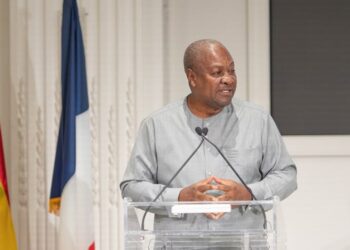
Dr Eva Mensah, Director of Nursing and Midwifery at the Ghana Health Service (GHS) headquarters, has presented an account of progress made under the Five-Year Operational Plan for the Office of the Director of Nursing and Midwifery, marking the completion of the plan’s first year and the transition into year two of implementation.
Delivering her report, Dr Mensah outlined the structural framework guiding the plan, explaining that implementation has been anchored on five service delivery building blocks designed to guide nursing and midwifery practice nationwide.
These blocks comprise administration and management, focused on strengthening governance and leadership; practice, centred on quality and patient-centred care; clinical education, which addresses in-service training; monitoring, evaluation and learning, concerned with data for accountability; and research and knowledge generation.
Nursing At the Heart Of Free Primary Healthcare
Dr Mensah linked the plan’s first year of implementation directly to the free primary healthcare initiative announced by President John Dramani Mahama, noting that nurses and midwives constitute between 95 and 98 percent of the workforce responsible for delivering the policy on the ground. She said this placed considerable responsibility on the nursing and midwifery profession to ensure the initiative’s success.
While acknowledging that primary healthcare itself was not a new concept, Dr Mensah argued that nursing and midwifery leadership had introduced new interventions that strengthened its delivery under the free healthcare model, positioning the profession’s contribution as central rather than incidental to the policy’s outcomes.
Digital Innovation and System Strengthening
Among the key achievements highlighted, Dr Mensah pointed to the development and piloting of two major digital innovations, a patient navigation system and the Nurture app, the latter developed in collaboration with Project Hope and the Christian Health Association of Ghana (CHAG).

The Nurture app, she noted, was piloted in five health facilities and designed specifically to support the tracking of high-risk pregnancies, a response to persistent challenges around maternal mortality recorded in the previous year.
“We should be the advocates of the mothers who come and have to lose their lives.”
Dr Eva Mensah, Director of Nursing and Midwifery at the Ghana Health Service (GHS)
Dr Mensah also reported strengthened monitoring and evaluation systems, including the introduction of monthly “pause and reflect” sessions encouraged across all regions, alongside quarterly review meetings.
She acknowledged, however, that the intensive work required to establish the patient navigation and continuity of care systems had consumed significant time, necessitating a renewed focus on monitoring and evaluation systems going into year two.
Leadership Training And International Partnerships
A significant component of the year’s achievements centred on nursing and midwifery leadership development. Dr Mensah reported that, with funding from the United Nations Population Fund (UNFPA), her office had begun building a nursing and midwifery leadership and management programme at the University of Health and Allied Sciences (UHAS), in partnership with university leadership.
She further disclosed an ongoing collaboration with the Royal College of Nursing in the United Kingdom to develop administration and management guidelines tailored to the Ghanaian context.

Dr Mensah explained that the partnership was intended to help clarify practical managerial responsibilities for nurse leaders, including workforce management and logistics oversight, while learning from challenges the Royal College had already encountered in developing its own guidelines.
Reframing Public Health Nursing
Dr Mensah also detailed a collaboration with Yale University and a public health nursing training school focused on paediatric healthcare, aimed at empowering community health nurses.
She reported that a scoping review and situation analysis had been completed, with training now underway for community health nurses in specialised home visits for paediatric palliative care.
Recounting an exchange during a training session, Dr Mensah described a community health nurse questioning her own role in palliative care, having viewed her work as strictly preventive rather than curative.
Dr Mensah used the episode to underscore a broader institutional message about the foundational training of public health nurses.
“You must be a good curative nurse so that you can see the potentials of the people you are identifying.”
Dr Eva Mensah, Director of Nursing and Midwifery at the Ghana Health Service (GHS) headquarters
She explained that public health nurses are trained first as nurses and midwives specifically so they can identify and address health issues within communities before they escalate into complications, arguing that this foundational understanding is at risk of being lost among newer entrants to the profession.

Concluding her report, Dr Mensah outlined priorities for the second year of the operational plan, including scaling up interventions that have already proven effective, institutionalising the systems and processes developed during the first year, and strengthening the measurement of results and impact.
She said these efforts were aimed at building a stronger nursing and midwifery service for the Ghana Health Service, in support of a healthier nation.
READ MORE: Mahama Calls for National Hate Speech Dialogue, Warns Against Arrests Over Criticism