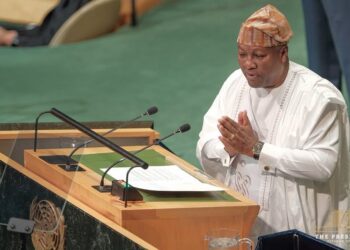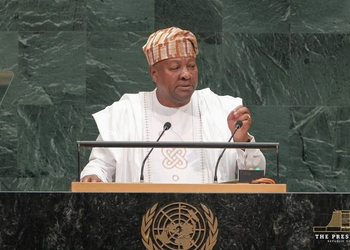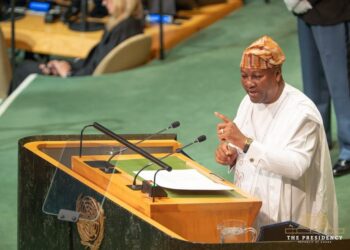
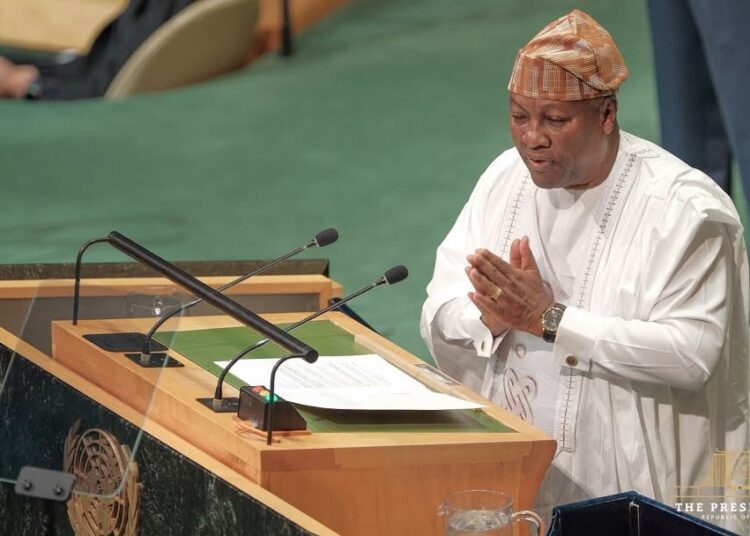
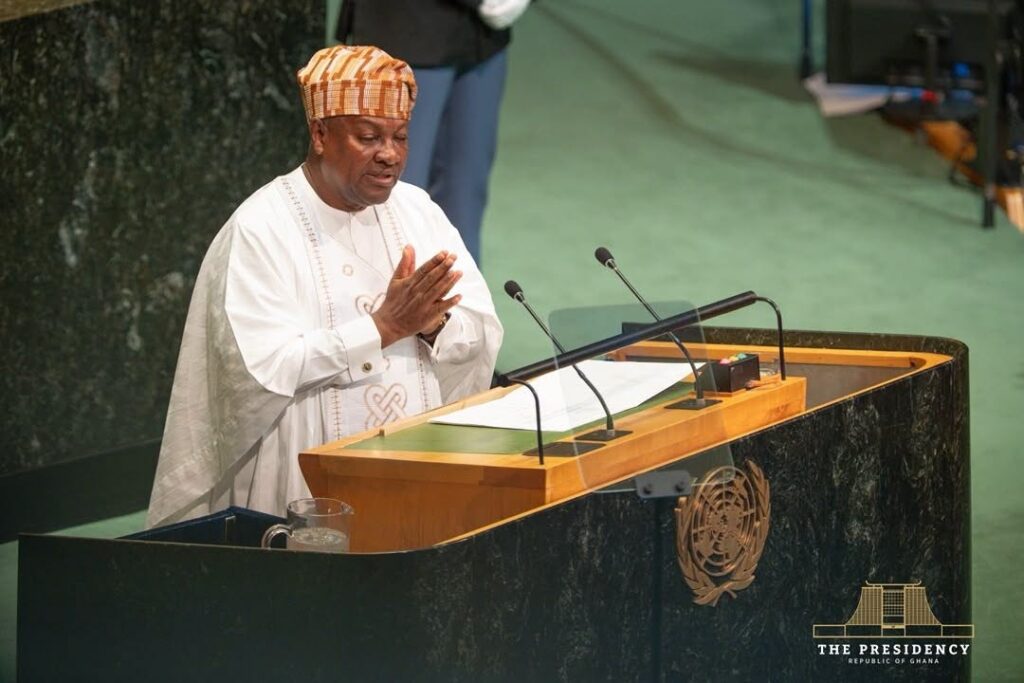
President John Dramani Mahama has told the United Nations General Assembly to abandon diplomatic euphemisms about Gaza, naming a five-year-old girl killed in the war and citing more than 20,000 children dead. He delivered Ghana’s national statement on Thursday, 24 September 2026, during the General Debate of the 81st Session in New York.
The President paired that language with a condemnation of Hamas and applied the same test to Cuba, Sudan, the Sahel and the widening war in the Middle East. His argument was that the credibility of the international system depends on judging every conflict by one measure rather than by the identity of the parties.
Naming A Child
President Mahama located the crisis of credibility he had been describing in the treatment of Palestinians in Gaza and the West Bank, then pressed the Assembly to drop the language that has cushioned it.
“How many more lives must be lost before the world acts with decisive moral authority? The blood of 5-year-old Hind Rajab and the more than 20,000 children that have been killed in this brutal conflict cries out to the conscience of the world”.
President John Dramani Mahama
Hind Rajab became one of the war’s defining cases after she was killed in a car in Gaza City while pleading for rescue, along with relatives and the paramedics sent to reach her. Naming a single child rather than citing a casualty figure is a deliberate choice, and it carried the passage.
Collective Punishment And The Law
From the moral appeal, President Mahama moved to legal characterisation, which is where governments usually retreat into ambiguity. “Collective punishments, enforced starvation and mass displacement are flagrant violations of international law,” he said.
He restated Ghana’s position on statehood alongside it, describing the country as unwavering in its recognition of the sovereign state of Palestine, a position Accra has held since 1988, and steadfast in supporting a viable two-state solution in which Israel and Palestine live side by side in peace and security with guaranteed borders.
Condemning Hamas In The Same Breath
The address did not confine its criticism to one side. President Mahama told the Assembly that Ghana condemns all acts of terrorism by Hamas that triggered the conflict, and insisted that all parties unconditionally respect international humanitarian law.
“Our moral standards cannot be selective,” he said. That sentence is the organising principle of the whole section, and it carries a cost for any government that uses it. A standard applied to Israel and Hamas must also be applied to allies, to trading partners and to neighbours, which is precisely what the rest of the address attempted.
Cuba, Sudan And The Sahel
Invoking the same principle, President Mahama repeated Ghana’s call for the immediate lifting of the decades-long economic, commercial and financial embargo on Cuba, and urged the world to support Havana’s new economic and social programme.
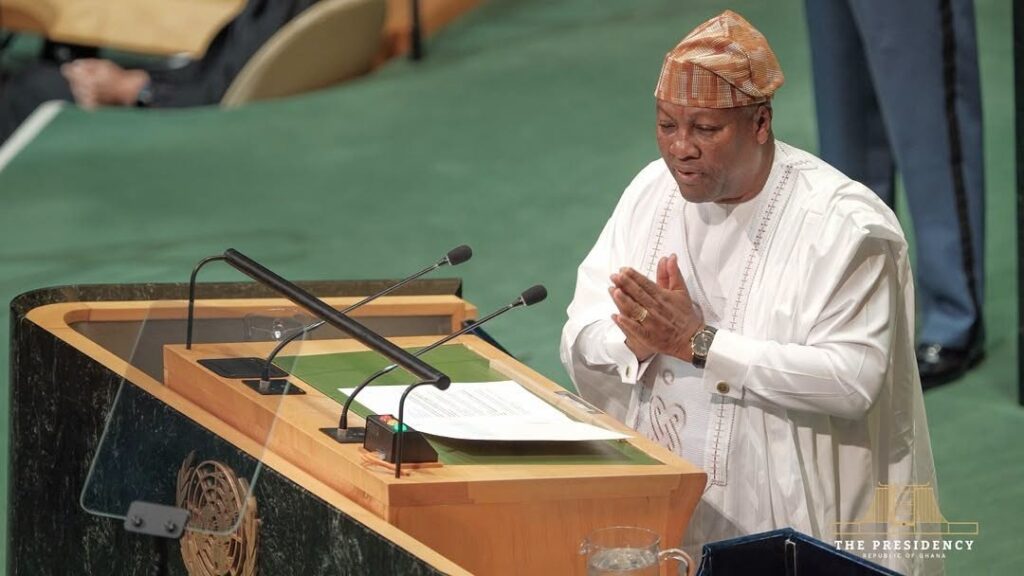
Measures that inflict collective economic hardship on ordinary citizens, he argued, run counter to shared commitments to human dignity and international law. The General Assembly has voted overwhelmingly against the embargo almost every year since 1992 with little effect, which makes the call a statement of position rather than an expectation of change.
He then turned to Sudan, describing the conflict as what is reported to be the world’s worst humanitarian crisis and urging an elevated global response. Closer to home, he called for solidarity with countries facing the terrorist scourge, naming Ghana’s neighbours in the Alliance of Sahel States.
That reference matters for Accra, since Mali, Burkina Faso and Niger left the Economic Community of West African States in 2024, and Ghana has since pursued its own channel to the three governments through a presidential envoy rather than allowing the rupture to harden.
A Warning On The Middle East War
On the wider Middle East crisis, Mahama noted its deleterious effect on the world economy and called for a return to the negotiating table. He followed with the address’s most striking sentence. “No human civilisation deserves to be annihilated and certainly not a member of the United Nations.”
He named no state. The remark came as fighting involving the United States, Israel and Iran has continued through a closed Strait of Hormuz and a naval blockade, with oil prices climbing and the Security Council unable to compel a halt.
“I believe that dialogue can resolve even the most intractable of global problems,” he added.
One Standard, Every Conflict
President Mahama ended the section by setting out what a uniform test would require. Across every conflict, whether in Europe, the Middle East or Africa, he said, the standard must remain the same: respect for sovereign integrity, protection of civilians, unhindered humanitarian access and accountability for perpetrators of war crimes.
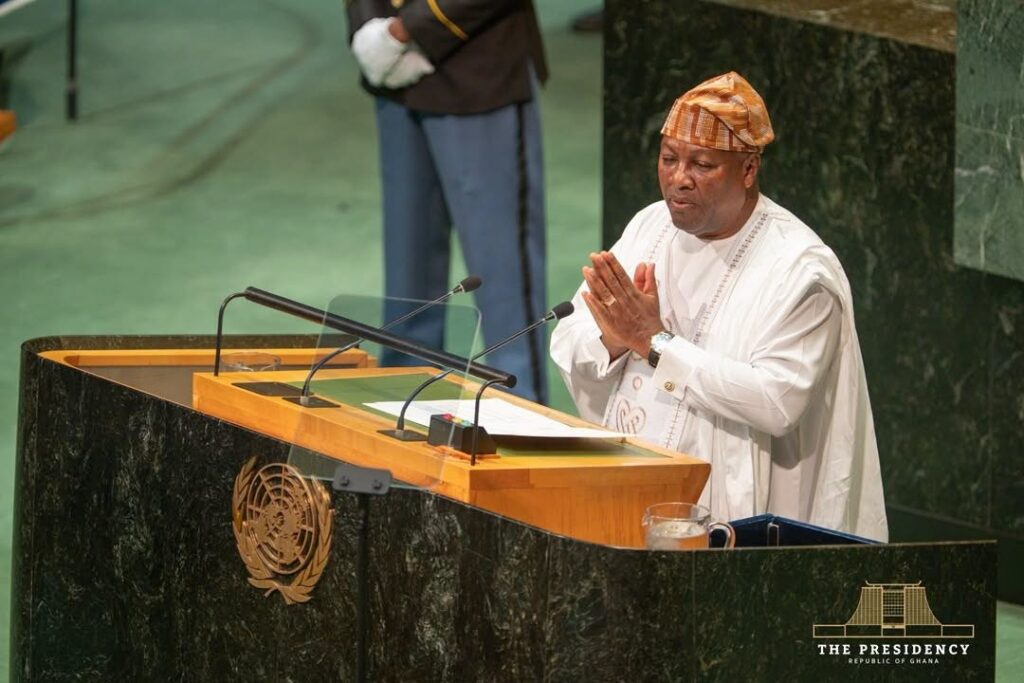
The four requirements are drawn from existing law rather than new proposals, which is the point. None is contested in principle, and all are routinely set aside by states that vote for them.
Ghana has no leverage to enforce any of it. What it has is a seat, a voice, and, from January, the chairmanship of the African Union, which decides whether this becomes a continental position or remains one country’s speech.
READ ALSO: Energy Debt Threatens Ghana’s Gas Supply Security