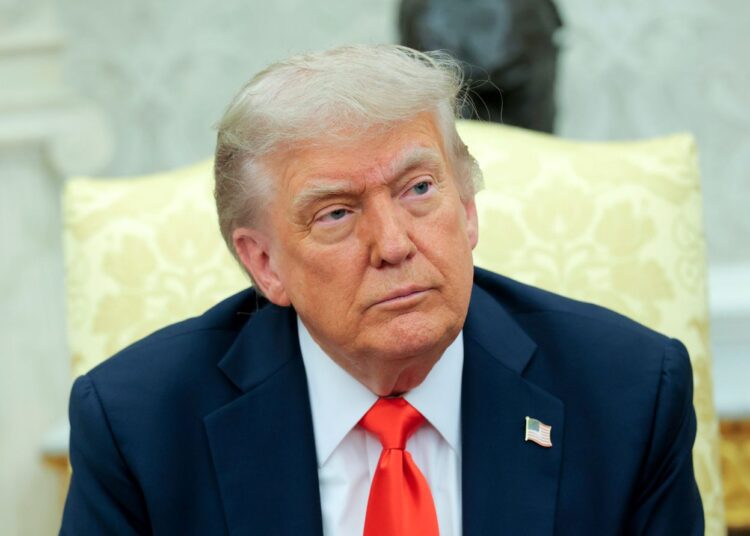
The administration of US President Donald Trump has removed Syria from a list of countries barred from purchasing or importing American weapons, marking another step in Washington’s gradual easing of restrictions on Damascus and its new leadership.
The decision, announced by the US State Department in a notice published in the Federal Register today, amends the International Traffic in Arms Regulations (ITAR), which govern the export and transfer of American defence equipment and services.
Under the revised regulations, Syria is no longer subject to the policy of automatic denial for licences and other authorisations required to export US weapons and ammunition.
The change, which takes effect on Thursday, will allow requests for arms exports to Syria to be assessed individually rather than rejected outright.
The move forms part of a broader shift in US policy towards Syria following the overthrow of former President Bashar al-Assad and the emergence of a new government in Damascus. It also reflects Washington’s efforts to gradually normalise relations with the country’s new leadership after decades of sanctions and diplomatic restrictions.

The decision follows several measures taken by the Trump administration to ease restrictions on Syria. Last year, Trump moved to lift economic sanctions imposed during Assad’s rule, which had significantly constrained the country’s access to international financial markets and foreign investment.
In August, US Secretary of State, Marco Rubio rescinded Syria’s designation as a state sponsor of terrorism, removing another major obstacle to the normalisation of relations between Washington and Damascus.

The latest decision on arms exports further expands the scope of engagement between the two governments, although it does not guarantee that Syria will receive American weapons. All applications will remain subject to individual assessments and the relevant US export control requirements.
Washington has also announced plans to reopen its embassy in Damascus, which has remained closed for 14 years. The proposed reopening would mark a significant development in diplomatic relations between the two countries following years of limited engagement.
Syria’s political transition has been central to the changing US approach. Interim President Ahmad al-Sharaa, a former rebel leader who led the overthrow of the Assad government nearly two years ago, has pursued a series of political and economic changes that have attracted the Trump administration’s attention.

His administration has sought to establish a new political order following years of civil war, economic devastation and instability. The conflict also created conditions for the expansion of the Islamic State (IS), whose insurgency affected large parts of Syria and neighbouring Iraq.
The US administration’s growing engagement with Damascus has raised expectations that the country’s new leadership could contribute to restoring stability after years of conflict. However, the extent to which the political transition will deliver lasting security and institutional stability remains uncertain.
The removal of Syria from the arms export restrictions also comes amid changes in the American military presence in the region. The withdrawal of US forces from Iraq today could increase the Syrian government’s responsibilities in addressing security threats, particularly the risk of an IS resurgence.
It ends a 12-year mission to fight the Islamic State group. The last U.S. troops left an air base in northern Iraq under a deal between Baghdad and Washington.
The withdrawal, agreed on two years ago, comes against the backdrop of the ongoing war between the United States and Iran that has also sometimes spilled over into Iraq, with Iran-backed militias firing on U.S. troops and the U.S. striking the groups’ strongholds.
Seven Countries Remain On US Arms Export Denial List
Syria’s removal from the US arms export denial list leaves seven countries subject to the policy, under which applications for licences to export American weapons are generally denied.
The countries still covered by the restrictions are Belarus, China, Cuba, Iran, Myanmar, North Korea and Venezuela.
Unlike Syria, these countries remain subject to the policy of denial for licences and other approvals required for US arms exports, maintaining significant restrictions on their access to American military equipment.
Syria’s removal marks a change in its regulatory status, allowing its arms export applications to be considered individually rather than automatically denied under the previous policy.
However, the amendment does not constitute blanket approval for weapons sales to Damascus. Any proposed transfers will still be subject to US government scrutiny and applicable export control requirements.
The development shows the changing scope of Washington’s arms export restrictions as its diplomatic and security engagement with Syria evolves under the country’s new leadership.
READ ALSO: Plane Makes Emergency Landing In Saudi Arabia After Pilot Brawl