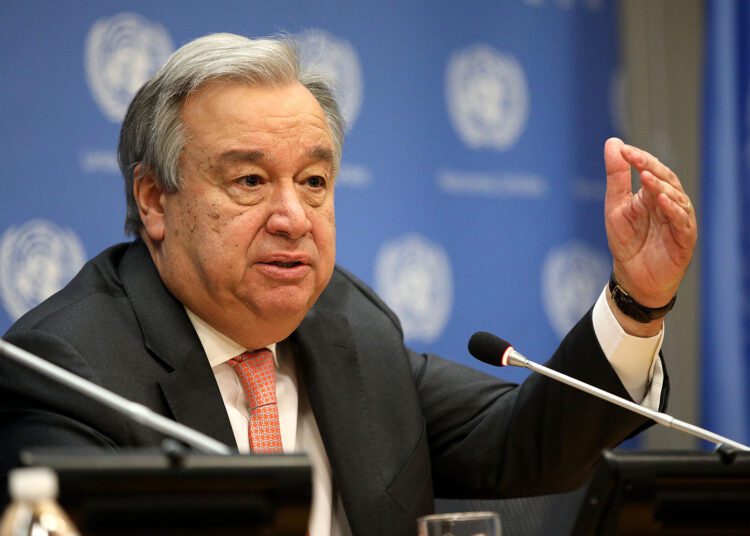
United Nations Secretary-General António Guterres has called for an immediate end to the United States-Iran war and a return to diplomacy, warning that the conflict has moved beyond the battlefield to threaten global trade and freedom of navigation.
Speaking to journalists in Islamabad at the start of an official visit to Pakistan, Guterres delivered a direct appeal to the countries involved in the conflict, placing the disruption of maritime traffic and the wider economic consequences of the war at the centre of his message.
“From Islamabad, I want to send a loud and clear message to all parties. End the conflict. Return to diplomacy. Fully restore navigational rights and freedoms in accordance with international law.”
António Guterres
Guterres’ appeal follows months of conflict that began in late February with joint United States-Israeli strikes on Iran and has since disrupted activity across key strategic waterways.
Iran responded with counterattacks against targets in Gulf countries and Jordan and subsequently blocked transit through the Strait of Hormuz, a narrow maritime chokepoint through which significant volumes of globally traded energy commodities move.
The disruption has transformed a conflict rooted in military confrontation between the United States, Israel and Iran into a wider challenge for international commerce.
The Strait of Hormuz is a crucial route for crude oil, fertilisers and liquefied natural gas, meaning restrictions on shipping through the waterway can affect energy markets, industrial production, food systems and transport costs far beyond the Middle East.
Hundreds of ships and their crews have been left stuck at sea for months as the confrontation has complicated navigation through the region. The prolonged disruption has also raised broader concerns about the resilience of global supply chains at a time when governments and businesses remain exposed to the consequences of geopolitical instability.
The crisis has simultaneously widened geographically. The war has spread to Yemen’s Red Sea coast, where Iran-backed Houthi forces are battling government troops supported by Saudi Arabia for control of the Bab al-Mandab Strait.
The development has created a second strategic pressure point along a maritime corridor linking the Red Sea with the Gulf of Aden and the wider Indian Ocean.
Pakistan’s role in facilitating conditions for dialogue between the United States and Iran formed an important backdrop to the UN chief’s appeal.
During his visit, he emphasised negotiations as the preferred path towards addressing the crisis and avoiding further escalation.
The United Nations has continued to emphasise the importance of maintaining channels of communication even as the conflict has complicated regional diplomacy.
UN’s official record shows that Guterres arrived in Pakistan for meetings with senior Pakistani officials, including Prime Minister Muhammad Shehbaz Sharif, Deputy Prime Minister and Foreign Minister Mohammad Ishaq Dar, and President Asif Ali Zardari.
Pakistan’s Push for Dialogue
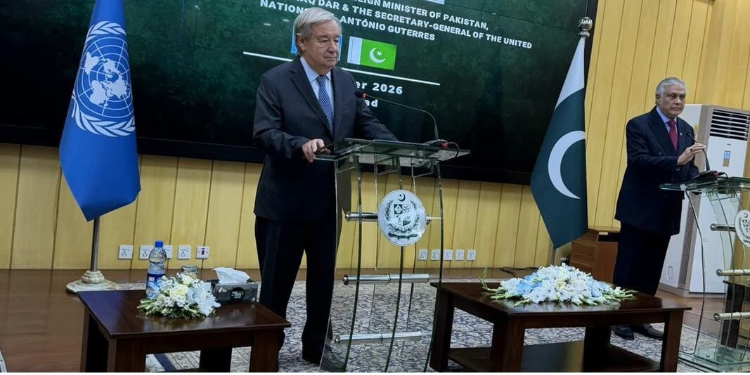
Guterres used his visit to recognise Pakistan’s contribution to efforts aimed at reducing tensions between the United States and Iran.
He credited Islamabad with helping create the conditions that led to the June 17 Islamabad Memorandum of Understanding, the subsequent ceasefire and a framework for further negotiations.
According to Guterres, “every Pakistani should be proud of that pivotal role.”
The recognition places Pakistan at the centre of a diplomatic effort that has become increasingly important as the conflict threatens to expand across the region.
For Islamabad, the diplomatic role also reflects its broader position in a region affected by overlapping conflicts, strategic rivalries and humanitarian crises.
Guterres linked the question of regional stability to the unresolved Palestinian issue, arguing that lasting peace could not be achieved without Palestinian self-determination.
“There will never be peace in the region until the right of self-determination of the Palestinian people is fully realized, as Pakistan has long championed.”
António Guterres
The statement connected the immediate US-Iran confrontation to the wider political disputes that have shaped instability across the Middle East, highlighting UN’s position that regional peace requires more than temporary military pauses.
Guterres also praised Pakistan’s longstanding role in hosting millions of Afghans who fled conflict and instability, while stressing that any returns should be voluntary, safe and dignified.
The country has also played a role in the UN system beyond regional diplomacy. Guterres recalled Pakistan’s recent two-year membership of the UN Security Council and its longstanding contribution to UN peacekeeping. He also paid tribute to more than 180 Pakistani peacekeepers who lost their lives while serving in UN missions.
READ ALSO: MTN FA Cup Final Changed to Historic Two-Legged Format