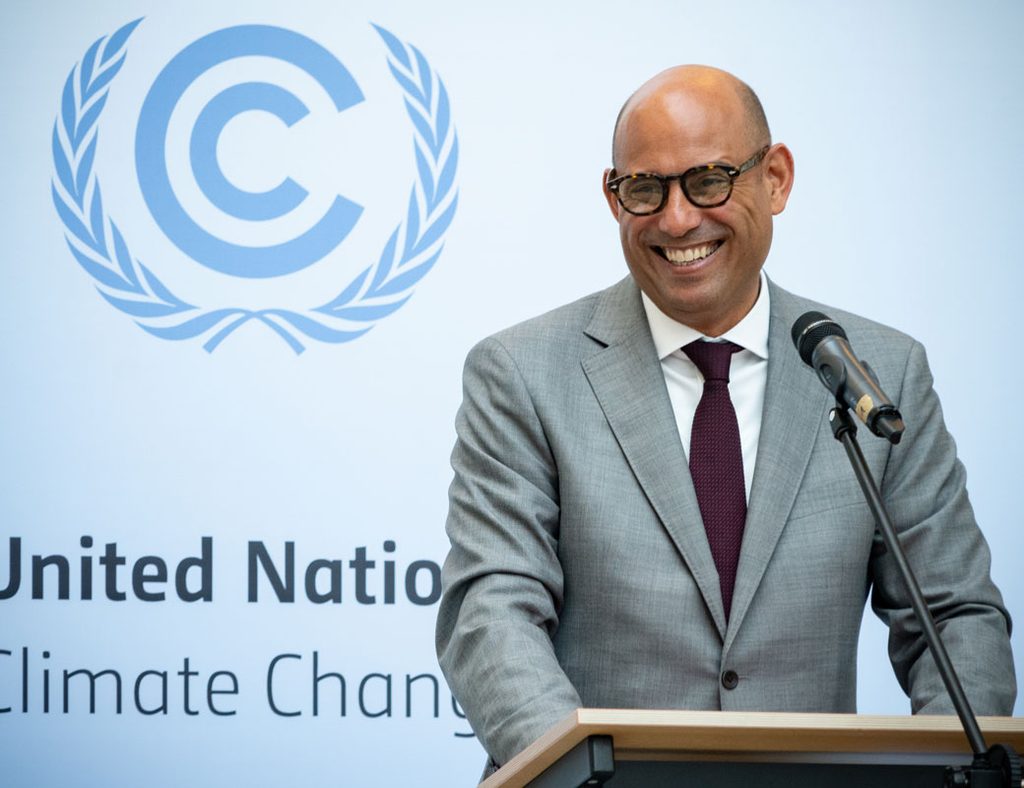
UN Climate Change Executive Secretary Simon Stiell has warned that rising temperatures are increasingly threatening the safety of pregnancy and childbirth, exposing mothers, unborn children and newborns to growing health risks.
Addressing an event organised by Wellcome on the first day of the official Pre-COP ministerial meeting in the Pacific, the UN Climate Chief indicated that climate change can no longer be treated as an abstract environmental challenge, arguing that its consequences are already being experienced in homes, communities, farms, fisheries and health facilities.
The Pacific meeting forms part of the preparations for COP31 in Antalya, Türkiye, where governments and climate negotiators will gather in November. Scheduled for October 5 to 8, the official Pre-COP ministerial meeting is being jointly delivered by Fiji, Tuvalu and Australia to bring decision-makers closer to Pacific communities and regional perspectives.
UN Climate Chief used the meeting to draw attention to a dimension of climate change that he stated could no longer remain peripheral to global climate policy: the effect of extreme heat on maternal, fetal and newborn health.
He cited new survey findings commissioned by Wellcome involving 1,000 healthcare professionals working across Australia, Brazil, India, the United Kingdom and Zimbabwe.
The survey found that 73% of respondents had seen heat-linked cases or complications increase during the previous five years, while 81% were concerned that extreme heat would increasingly threaten maternal, fetal and newborn health without stronger action.
The findings add to a growing body of evidence linking exposure to excessive heat during pregnancy with adverse outcomes including premature birth, low birth weight, stillbirth and maternal complications.
UN Climate Chief described the emerging threat as a new “fault line” in the global climate crisis, warning that the consequences can deepen existing inequalities in access to safe maternity care.
“The picture is clear and very disturbing: as extreme heat worsens, pregnancy and birth are now a new fault line in the global climate crisis, and one which is potentially fatal.”
Simon Stiell
He added that “‘staying cool’ is simply not an option when there is no cool place to go.”
This comes as climate policy moves towards COP31, where health, adaptation and implementation are expected to feature prominently. Türkiye will host COP31 in Antalya from November 9 to 20, while Australia is serving as President of Negotiations and working with Türkiye and Pacific island countries on the conference’s agenda.
The COP31 Action Agenda already identifies health among its priority areas, alongside electrification, food security, resilient cities, green industrialisation and education.
Against that backdrop, Stiell argued that maternal and newborn health should be incorporated more directly into national climate adaptation and heat-action planning, adding that, “a changing climate must never be accepted as a reason pregnancy and birth become less safe.”
Heat, Health and the Growing Climate Inequality
Meanwhile, the connection between climate change and everyday life is already visible. Stiell noted that climate change is experienced through disruptions to homes, villages, farms, fisheries and clinics, as well as through challenges involving food, water, energy and transport.
Those pressures illustrate why Pacific leaders have consistently pushed for climate action that recognises the particular vulnerabilities of small island states and other countries that have contributed relatively little to global greenhouse gas emissions.
UN Climate Chief noted that this reality should shape the journey towards COP31, particularly in discussions about adaptation finance.
“The tripling of adaptation finance agreed at COP30 in Belém must be delivered,” he stated, adding that countries and the wider financial system must work towards making $1.3 trillion annually available to developing nations.
The funding, he argued, is necessary not only to respond to immediate climate impacts but also to build resilient systems and accelerate the transition towards clean, affordable and secure energy.
Stiell therefore identified three priorities for addressing the emerging climate threat to pregnancy.
The first is to make maternal and newborn health a recognised component of climate adaptation, heat and health planning.
“What is not named in a plan is too often not funded, not measured and not protected,” he stated.
Such measures could include resilient clinics, dependable electricity and water supplies, trained health workers and systems capable of responding to heat-related emergencies.
The second priority is translating scientific evidence into practical protection.
The UN Climate Chief called for clearer guidance, training, heat alerts, safer healthcare facilities, reliable water and electricity, and health systems prepared to respond before extreme heat becomes a crisis.
The third is improved measurement and analysis. According to UN Climate Change Executive Secretary Simon Stiell, “harm that is not counted is too easily ignored.”
Better data, he argued, would allow governments and international organisations to identify where risks are increasing, determine which interventions are effective and establish which communities require greater financial and technological support.