Ghana inflation rose to 5.2% in September 2026 from 5.0% in August, as domestic price pressures persisted despite a substantially lower inflation environment than a year earlier. The increase marks a second consecutive monthly acceleration and shifts attention from the scale of Ghana’s disinflation to the composition of the remaining price pressure.
The Government Statistician, Dr Alhassan Iddrisu, explained that inflation has nearly halved from 9.4% in September 2025. In practical terms, a basket of goods and services that cost GH¢100 a year ago now costs GH¢105.20.
The GSS inflation update also shows that prices rose 1.1% between August and September after falling 1.0% in August, signalling a clear reversal in short-term price momentum.
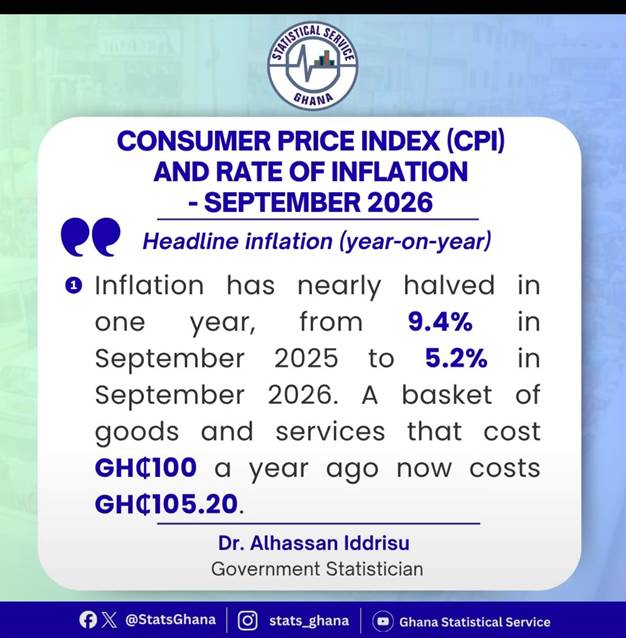
GSS September 2026 CPI: headline inflation rose to 5.2%. Source: Ghana Statistical Service.
Domestic Costs Take Centre Stage
The composition of September inflation is more revealing than the 0.2 percentage-point increase in the headline rate. GSS says locally produced items account for 85.7% of inflation, while imported-item inflation stands at only 2.4%. The immediate pressure is therefore predominantly home-grown rather than principally the result of imported inflation or exchange-rate pass-through.
That distinction matters for policy. Imported inflation can moderate when the cedi strengthens or international commodity prices ease, but domestic pressures can prove more persistent when they reflect wages, rents, utilities, distribution costs and locally determined service prices.
It also complicates the BoG policy hold at 14%, because the central bank must distinguish a temporary monthly rebound from a broader rebuilding of underlying price pressure.
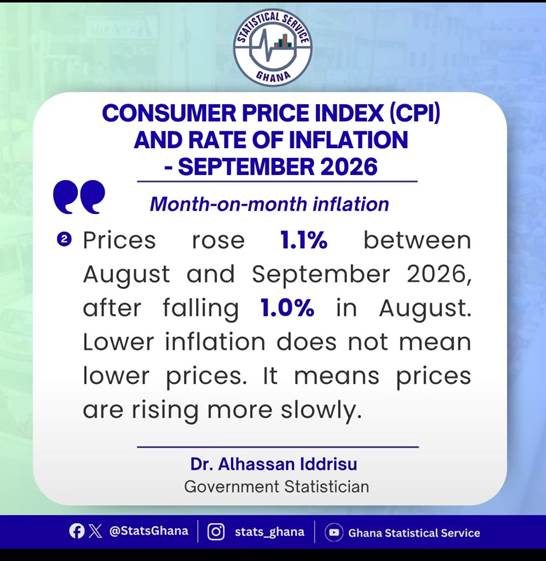
Monthly prices rose 1.1% in September after falling 1.0% in August. Source: Ghana Statistical Service.
Services Remain the Sticky Point
The clearest sign of persistence is in services. Services inflation stood at 8.3% in September, almost twice the 4.2% recorded for goods. More strikingly, services inflation was 4.8% in September 2025. Thus, while headline inflation has nearly halved over the past year, services prices are rising substantially faster than they were a year earlier.
The divergence is economically important because services prices are typically more closely tied to domestic operating costs than many traded goods. Persistent services inflation can therefore make the final stage of disinflation slower and less predictable, even when imported price pressure remains subdued. It also means a low headline rate can coexist with pockets of considerably stronger price growth.
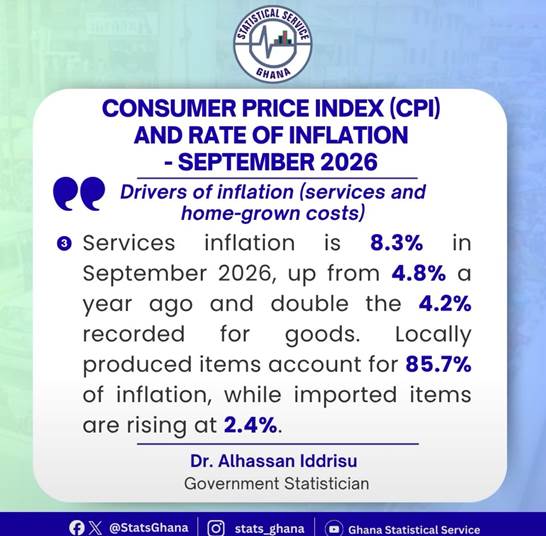
Services and locally generated costs dominate September’s inflation picture. Source: Ghana Statistical Service.
Low Inflation, Changed Direction
September should nevertheless be interpreted with proportion. At 5.2%, inflation remains far below the 9.4% recorded a year earlier. Two consecutive increases are a warning signal, not proof that Ghana has entered a renewed inflationary cycle. What has changed is the near-term direction: headline inflation moved from 4.6% in July to 5.0% in August and 5.2% in September.
For households, that distinction is important. Lower inflation does not mean lower prices; it means prices are rising more slowly than before. September’s 1.1% month-on-month increase therefore helps explain why consumers can continue to experience higher living costs even when annual inflation remains low by Ghana’s recent standards.
The latest reading also arrives as 2027 inflation risks have returned to the policy debate. The immediate macroeconomic question is whether September represents temporary volatility around a low-inflation path or the early stages of more persistent domestic pressure. That distinction will determine how much room the Bank of Ghana has to support lower borrowing costs without weakening its price-stability anchor.
The September configuration also changes how the inflation story should be read alongside Ghana’s improving financial conditions. With the policy rate at 14% and lending conditions easing, the central bank has an incentive to preserve the recovery in credit and investment.
But a widening gap between headline inflation and services inflation would make premature easing more costly if domestic price-setting becomes entrenched. The policy challenge is therefore no longer simply to drive inflation lower, but to ensure that lower inflation becomes broad-based across the economy.

For businesses, the same distinction affects planning. A low national inflation rate can improve confidence and reduce uncertainty, yet firms concentrated in services or dependent on locally priced utilities, rents and distribution may still face cost increases well above the headline average.
That uneven experience helps explain why macroeconomic stabilisation may take time to translate into uniformly lower operating costs, even when the aggregate CPI appears favourable.
Policy Test Moves Inward
For policymakers, the September figures sharpen the trade-off. Ghana has made substantial progress in restoring price stability, but the remaining challenge increasingly appears to concern domestic cost formation and sticky services rather than imported prices alone. The next few CPI readings will therefore matter more for direction and composition than for any single headline number.
For now, the message is balanced but consequential: Ghana’s inflation rate remains low by recent standards and dramatically below its level a year ago, yet short-term momentum has turned upward and the pressure is concentrated at home.
Preserving the gains of disinflation will increasingly depend on whether domestic and services-sector costs begin to converge towards the much lower headline rate.
READ ALSO: Fitch Sees Ghana’s Inflation Doubling to 11.3% in 2027