The OSCE Office for Democratic Institutions and Human Rights (ODIHR) and Kazakhstan’s Commissioner for Human Rights have renewed their cooperation on protecting and promoting human rights, establishing a framework that will guide joint efforts through the end of 2030.
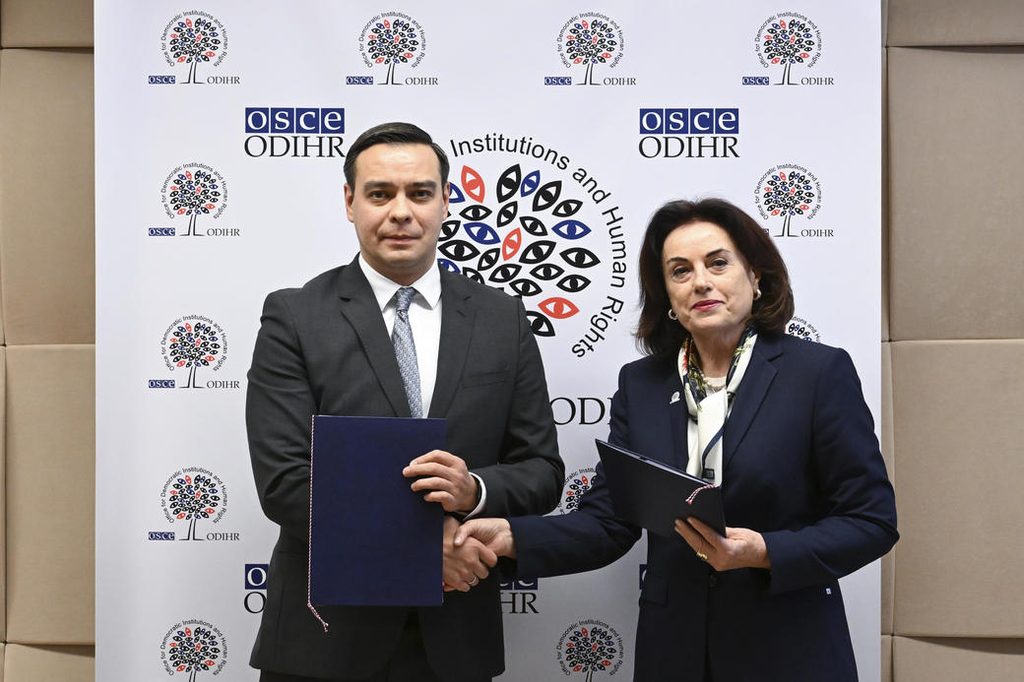
The new agreement, signed in Warsaw by ODIHR Director Maria Telalian and Kazakhstan’s Commissioner for Human Rights Artur Lastayev, provides a longer-term basis for cooperation between the two institutions as Kazakhstan continues to develop its national human rights framework.
The Memorandum of Understanding sets out areas ranging from institutional capacity-building and human rights education to legal advice, civil society engagement and the protection of vulnerable groups. It also places particular attention on preventing torture, strengthening the National Preventive Mechanism and addressing emerging human rights challenges associated with digital technologies.
“Independent national human rights institutions have an important role in protecting human rights and ensuring that OSCE commitments and international standards are reflected in law and practice.
“This Memorandum provides a practical framework for continuing our co-operation with the Commissioner’s Office, strengthening its effectiveness in promoting and protecting human rights, in line with ODIHR’s mandate.”
Maria Telalian
The agreement extends cooperation at a time when questions surrounding institutional independence, legal safeguards and effective mechanisms for protecting individuals remain important elements of human rights governance.
Agreement Strengthens Kazakhstan’s Human Rights Institution
A central component of the memorandum is support for strengthening the capacity and effectiveness of Kazakhstan’s Commissioner for Human Rights.
The cooperation will include capacity-building for the Commissioner’s Office, alongside legal opinions on draft or existing legislation when formally requested. This gives the partnership a practical legislative dimension, allowing ODIHR to provide expertise on laws and legal reforms relevant to human rights protection.
According to Kazakhstan’s Commissioner for Human Rights, “our institution has been granted guarantees of independence, an expanded mandate, and a stronger institutional framework, supported by a nationwide network of regional offices.”
He added that the Commissioner’s Office is continuing efforts to strengthen the National Preventive Mechanism, prevent torture and domestic violence, and protect vulnerable groups.
The National Preventive Mechanism is particularly significant within the renewed cooperation because it provides an institutional channel for monitoring places where people may be deprived of their liberty and for identifying risks of ill-treatment. By including the mechanism within the memorandum, the agreement provides scope for continued institutional support and exchanges focused on strengthening safeguards against torture and other forms of abuse.
Human Rights Priorities Extend to Digital Technology
The renewed cooperation also covers a wider range of contemporary human rights challenges, including those arising from the growing use of digital technologies.
The memorandum identifies human rights education as another area for cooperation, alongside efforts to strengthen the protection of human rights defenders. These areas reflect the changing environment in which human rights institutions operate, where technology can affect privacy, access to information and other fundamental rights.
ODIHR and the Commissioner’s Office will also cooperate on torture prevention and related work under the National Preventive Mechanism.
The agreement therefore brings together established human rights concerns, such as torture prevention and protection of vulnerable groups, with newer challenges linked to digitalisation.
Lastayev described the memorandum as providing a foundation for further cooperation on legislation and human rights education.
Civil Society Engagement Included in Long-Term Framework
The memorandum further provides for consultations and dialogue involving the Commissioner’s Office, relevant public institutions, civil society organisations and experts.
The inclusion of these groups creates a mechanism for broader engagement around human rights policy and implementation, allowing institutional cooperation to extend beyond direct interaction between ODIHR and the Commissioner’s Office.
The arrangement also creates scope for continued discussion of the practical implementation of human rights standards in Kazakhstan, rather than limiting cooperation to formal legal commitments.
The renewed framework ultimately links institutional strengthening with practical human rights protection, bringing together legislative advice, education, torture prevention, support for human rights defenders, digital rights concerns and civil society dialogue.
Its implementation will determine how effectively those commitments translate into stronger protections and greater institutional capacity in Kazakhstan over the coming years.
READ ALSO: Ghana Chamber of Mines Clarifies Proposed Mining Bill