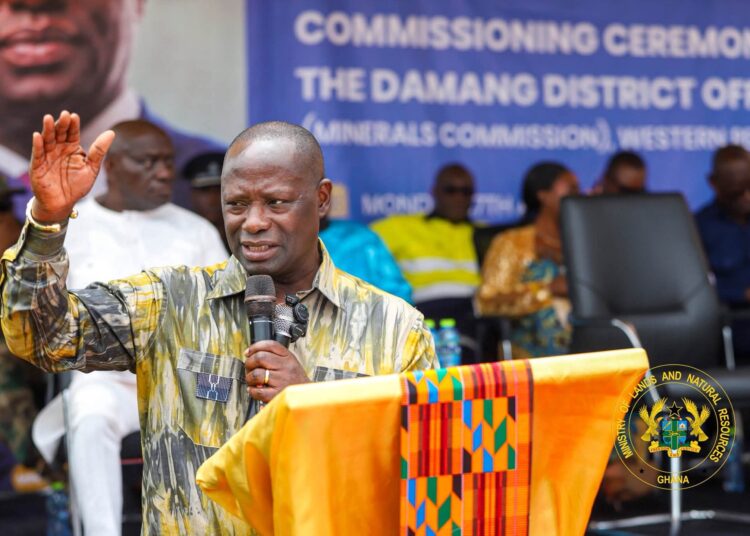
The Minister for Lands and Natural Resources, Hon. Emmanuel Armah-Kofi Buah, has charged five newly inaugurated small-scale mining cooperatives in Nkroful to champion environmentally sustainable practices and restore degraded concessions while extracting gold.
Addressing stakeholders in the Ellembelle District, the Minister emphasized that economic exploitation must no longer come at the cost of the environment, establishing a firm directive that small-scale operations must align with national environmental standards.
The mandate underscores a strategic shift toward regulated mining, tasking local operators to prove that mineral wealth creation can coexist with ecological preservation.
“Take the Gold, but Restore the Land,” charged Hon. Emmanuel Armah-Kofi Buah during his address to the five cooperative societies at Nkroful. He reinforced that Ghana can successfully mine its gold reserves “without sacrificing its land, rivers and the livelihoods of future generations.”
Ministry of Lands and Natural Resources

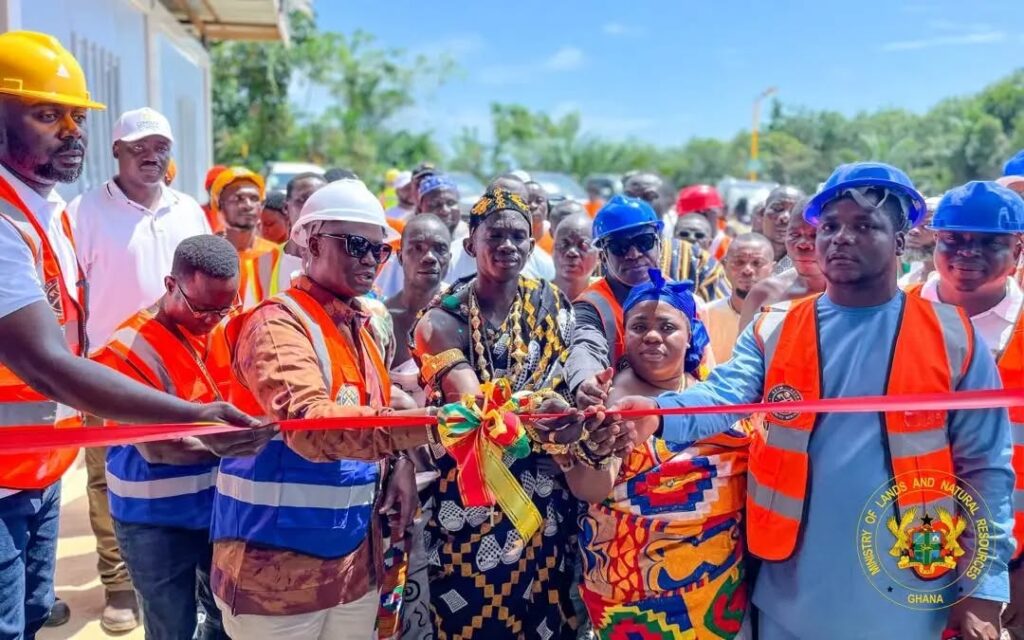
Expanding on this mandate during the inauguration of the Responsible Cooperative Mining and Skills Development Programme (rCOMSDEP) societies comprising Salman, Atomic, Asanta, Bomoakpole, and Akropong the Minister formally presented certificates and operational permits to permit legal mining within designated, approved concessions.
This government-led initiative represents a structured attempt to bring order to a traditionally chaotic sector, converting informal artisanal miners into legally registered cooperative entities bound by strict statutory regulations.
By placing regulatory frameworks directly into the hands of community-led cooperatives, the state aims to establish an operational model that balances local economic empowerment with mandatory land rehabilitation.
Transforming Artisanal Mining Through Cooperative Governance
The initiative marks a decisive point in reshaping the public perception and operational reality of small-scale mining across the Western Region.
Regional Director of the Department of Cooperatives, Mr. Akwasi Adjei Bawuah, noted that the inauguration represented “more than a formal ceremony,” describing it as a vital opportunity to replace the long-standing stigma of illegal mining with a structured framework rooted in legality, safety, and shared prosperity.
He reminded executives and miners alike that operational compliance relies on strict adherence to institutional guidelines, insisting that “no individual should be bigger than the society” when implementing operational bylaws.

To ensure long-term viability and prevent internal friction, cooperative governance must prioritize operational transparency and stringent occupational safety standards.
Mr. Bawuah highlighted that sustainable management requires transparent record-keeping, open weighing of harvested gold, and the fair, accountable distribution of financial proceeds among members.
Furthermore, mandatory safety protocols such as the routine deployment of personal protective equipment including helmets and boots must become non-negotiable operational standards.
Crucially, active tree planting and continuous land reclamation must be integrated into daily routines, ensuring that ecological restoration progresses concurrently with resource extraction.
The Imperative for Reform in the Extractive Sector
The urgent drive toward cooperative-led regulation stems from decades of unchecked artisanal and small-scale mining (ASM) across Ghana, which has severely impacted vital river bodies, arable agricultural soils, and forest reserves.
Unregulated operations historically utilized heavy machinery and dangerous chemicals like mercury near major watersheds, causing extensive deforestation and heavy-metal contamination that compromised rural drinking water and farming livelihoods.
Transitioning from fragmented, unregulated mining to formalized rCOMSDEP cooperatives provides a critical mechanism to monitor environmental impact, enforce safety codes, and track gold supply chains from origin to export.
Moreover, formalizing small-scale miners into recognized cooperatives addresses acute socio-economic vulnerabilities within host communities.
Historically, artisanal miners faced exploitation due to lack of capital, insecure tenure, and informal trade networks that deprived the state of revenue while leaving workers without legal protection or financial security.
By granting formal permits, legal concessions, and skills training, the government builds a resilient, sustainable extractive framework.
This strategy mitigates environmental degradation while securing local employment, elevating safety standards, and ensuring that mineral wealth directly enriches the communities where extraction takes place.
A New Framework for Sustainable Resource Management
Ultimately, the successful rollout of the rCOMSDEP societies in the Ellembelle District creates a scalable blueprint for responsible resource extraction across Ghana’s mining belts.
By combining legal access to concessions with strict oversight from the Department of Cooperatives and the Ministry of Lands and Natural Resources, the government sets a higher standard for community-based mining.

The long-term success of this intervention relies on the active commitment of cooperative members to respect their bylaws, prioritize worker safety, and fulfill their mandatory land reclamation duties.
As Ghana continues to leverage its vast mineral reserves for national development, the alignment of economic incentives with strict environmental stewardship remains essential.
The charge delivered at Nkroful serves as a benchmark for the entire extractive sector: commercial success must be tied to ecological accountability.
Through continued regulatory support, continuous skills training, and unwavering community compliance, the rCOMSDEP model offers a sustainable path forward where mineral wealth is harvested responsibly, safeguarding the land, water, and economic future of generations to come.
READ ALSO: Adwumawura Links Entrepreneurs to Business Regulators