
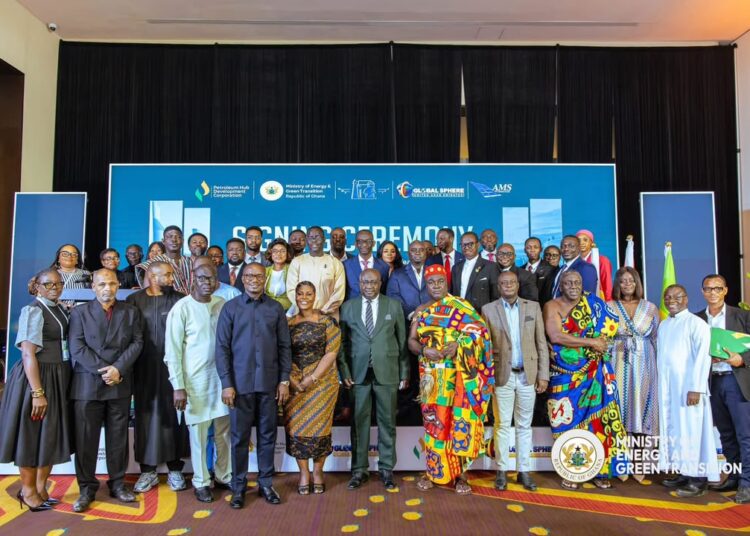
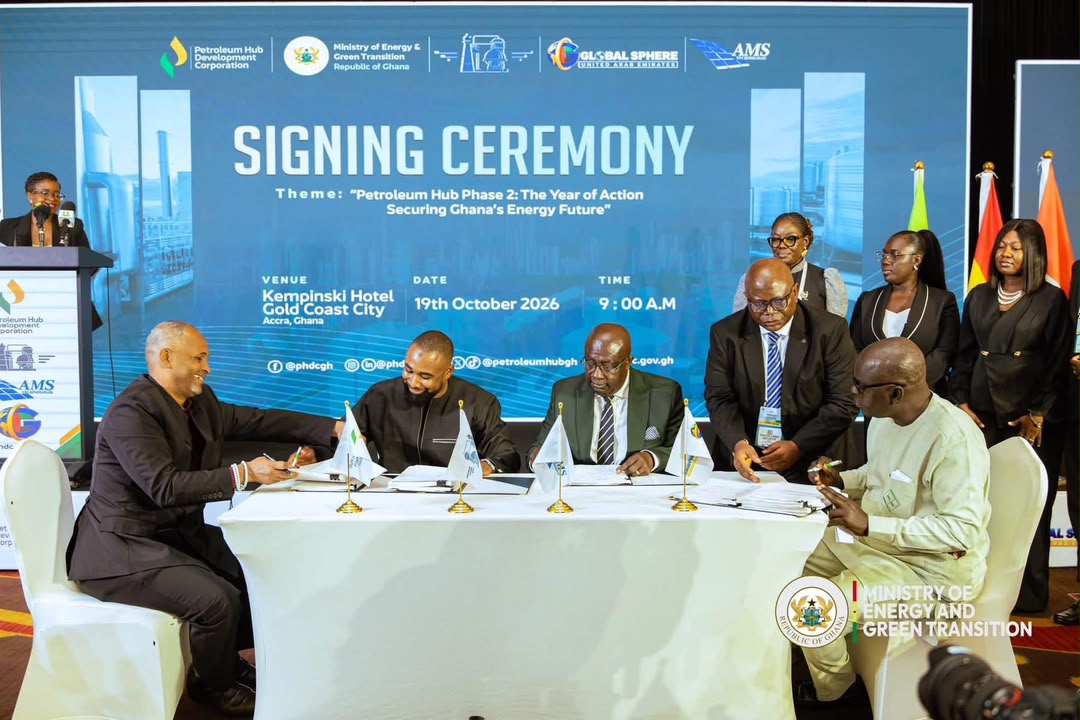
Ghana’s plan to establish a major petroleum refining and trading centre in West Africa has entered another phase, following the signing of a partnership between the Petroleum Hub Development Corporation (PHDC) and Global Sphere to advance Phase 2 of the Petroleum Hub project.
The proposed development, scheduled for implementation over five years, includes a refinery with a capacity of 300,000 barrels per stream day, two petrochemical plants, storage facilities capable of holding four million cubic metres of petroleum products, and a multi-berth jetty.
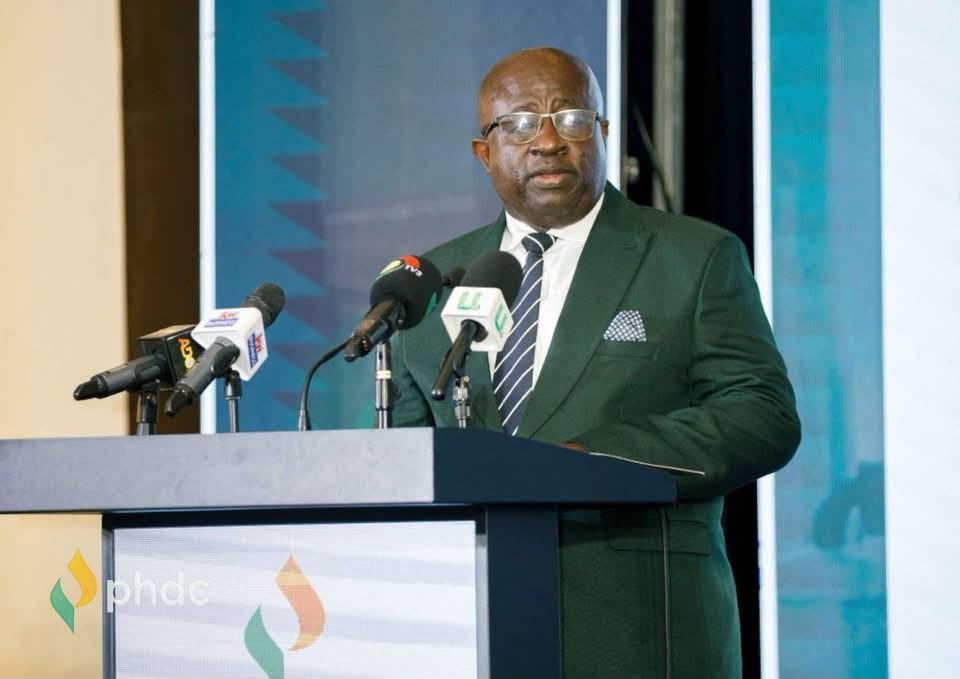
Energy and Green Transition Minister Dr John Abdulai Jinapor, who attended the signing ceremony as Special Guest of Honour, described the partnership as an important step towards Ghana’s ambition to become a leading regional energy hub.
The proposed facilities could expand Ghana’s capacity to process petroleum, handle large volumes of products and develop industries linked to refining.
But the project’s significance will ultimately depend on whether the partnership can mobilise the capital, secure feedstock supplies and establish commercially viable operations needed to turn the announced capacity into productive infrastructure.
Refining Capacity Could Expand Ghana’s Regional Role
The planned 300,000-barrel-per-stream-day refinery is central to the project’s potential to reshape Ghana’s position in the regional petroleum market.

A facility of that scale, supported by storage and marine infrastructure, could serve domestic demand while creating opportunities to supply neighbouring markets.
The multi-berth jetty and proposed storage capacity could also support the movement of crude oil and refined products, making logistics and trading important parts of the project’s commercial proposition.
Jinapor said the partnership aligns with the government’s broader objectives of attracting investment, creating employment, advancing industrialisation and strengthening energy security.
“This strategic partnership marks a significant milestone in Ghana’s ambition to become the leading energy hub in West Africa, driving industrialisation, attracting investment, creating jobs, and strengthening our energy security.”
The ambition is substantial, but planned capacity should not be confused with actual supply. A refinery’s contribution to energy security depends on the availability and cost of crude oil, operational efficiency, maintenance, financing and the ability to sell its output at competitive prices.
Ghana will therefore need to demonstrate that the proposed facility can operate sustainably within a market where petroleum products are already traded across borders and compete with supplies from established refining centres.
Petrochemical Plants Could Deepen Industrialisation
The inclusion of two petrochemical plants gives the project a wider industrial dimension beyond refining fuels for transport and other uses.
Petrochemical facilities can produce materials used by manufacturing industries, creating opportunities to connect petroleum processing with domestic production and regional supply chains.
If the project develops viable markets for its output, Ghana could retain more economic value from petroleum-related activity and create demand for technical services, logistics and skilled labour.
However, the presence of petrochemical plants does not automatically guarantee industrial growth. Their contribution will depend on the products to be manufactured, the availability of competitive feedstocks and utilities, access to buyers and the ability to compete with imported alternatives.
The government and project developers will also need to establish how local businesses could participate in the supply chain and whether Ghanaian manufacturers can use some of the output. Without such connections, the project’s industrial benefits could be concentrated mainly within the facilities themselves.
Financing and Feedstock Will Determine Delivery
The five-year development schedule places implementation at the centre of the project’s next stage. Refinery and petrochemical developments require substantial capital, dependable infrastructure and long-term commercial arrangements before they can begin generating revenue.
Yet the minister’s announcement did not disclose the project’s total cost, the financing structure, the respective obligations of PHDC and Global Sphere, or specific construction milestones.
Those details will be essential to assessing how far the project has progressed beyond the signing ceremony. The commercial model must establish how construction will be financed, where the refinery will obtain crude oil, how the petrochemical plants will secure feedstocks and where the finished products will be sold.
The proposed storage capacity of four million cubic metres could support trading and supply operations, but its commercial value will depend on the types of products stored, facility utilisation and the volume of transactions handled.
Similarly, the refinery’s stated capacity will translate into economic benefits only if it can secure supplies and operate at viable rates.
Ghana’s energy-security gains will depend on these practical considerations as much as on the scale of the proposed infrastructure.
Investment Must Translate Into Operating Assets
Jinapor commended the stakeholders involved in advancing the project, describing the partnership as part of Ghana’s wider effort to establish a major energy hub in the sub-region.
For the project to deliver on that ambition, the next steps will need to demonstrate progress in financing, construction, infrastructure integration and commercial agreements.

The proposed refinery, petrochemical plants, storage facilities and jetty must function as parts of a coordinated system rather than as separate infrastructure targets.
The project could strengthen Ghana’s regional petroleum role and support industrial development, but the scale of its potential benefits also makes transparent implementation and commercial viability particularly important.
For now, the PHDC–Global Sphere agreement establishes a partnership for Phase 2 of the development.
The decisive test will be whether the five-year schedule produces functioning facilities capable of attracting sustained trade, supporting local industry and contributing measurably to Ghana’s energy security.
READ ALSO: Republic Financial Holdings Names Karen Yip Chuck as New CEO