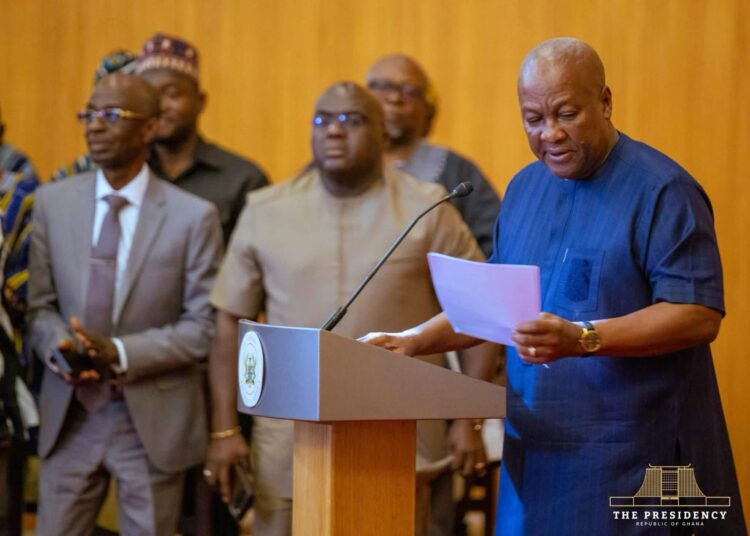
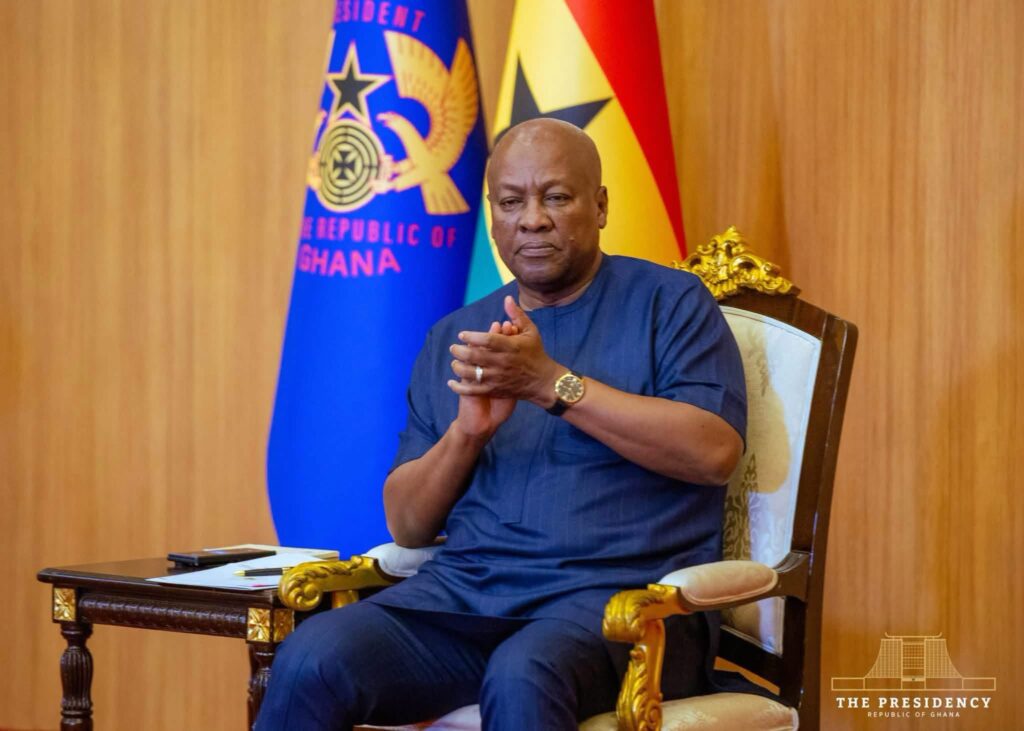
President John Dramani Mahama has reaffirmed his government’s commitment to closing northern Ghana’s infrastructure deficit, identifying peace, reliable public utilities and improved economic connectivity as critical conditions for attracting private investment, expanding businesses and creating sustainable employment for young people.
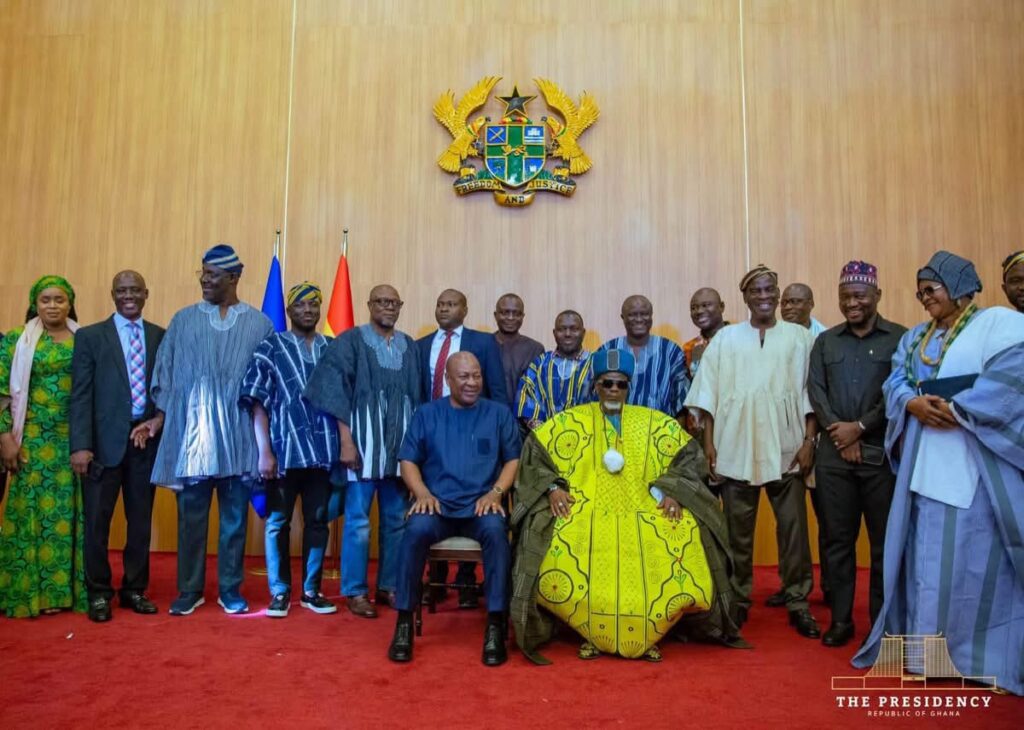
The President gave the assurance when he received a delegation of chiefs from the Dagbon Traditional Area at the Jubilee House in Accra.
The delegation was led by the Regent of Dagbon, Kampakuya Naa Yakubu II, who paid a courtesy call to express appreciation for the government’s support during the illness, funeral arrangements and burial of the late Ya-Na Abukari Mahama II.
The meeting also provided an opportunity for the President to outline development priorities for the north, particularly in water supply, roads, education, healthcare and agricultural livelihoods.
These sectors are essential to reducing operating costs for businesses, strengthening local production and improving the region’s attractiveness to investors.
”Peace and reliable public infrastructure are the twin engines needed to drive private investment and create sustainable jobs for our youth.”
President of Ghana, John Dramani Mahama
The President’s position reflects a broader economic challenge facing Ghana: translating national economic recovery into productive employment and more balanced regional development.
The World Bank’s August 2026 Ghana Economic Update reported that the economy grew by 6.0 per cent in 2025, but cautioned that growth had not generated enough quality jobs to absorb the country’s expanding working-age population.
Water Infrastructure to Support Business Expansion
A major component of the government’s announced interventions is an externally financed water expansion project covering Tamale, Yendi and Damongo.
According to the President, funding has been secured for the three water systems, with the Finance Minister engaging the European Union on the financing arrangements.
The project is intended to expand piped water networks in the three urban centres, addressing a longstanding constraint on households, public institutions and commercial establishments.
The government is also replacing ageing pumps at the Dalong waterworks to increase water production for Tamale before the broader expansion project begins delivering its intended benefits.
”By November, when the new pumps begin operating, Tamale will already see an increase in water supply, even before the EU-funded project begins.”
President of Ghana, John Dramani Mahama
Reliable water supply has direct implications for the operating costs and productivity of businesses. Hotels, restaurants, healthcare facilities, schools, food processors and other enterprises require consistent access to water to maintain operations and meet service standards.
The President did not disclose the total cost of the three-city water project during the reported meeting. Its financial and operational performance will therefore need to be assessed against published project costs, implementation milestones and measurable improvements in supply.
Infrastructure Gaps Remain an Economic Constraint
The scale of the challenge is reflected in development research. A World Bank document on Ghana’s infrastructure and poverty disparities identified significant infrastructure gaps in northern regions, including limited access to roads, electricity and essential services.
The document reported that poor rural communities in the north faced average journeys exceeding 3.3 hours to reach the nearest road. It also highlighted disparities in electricity access, citing a 2023 household access rate of 98.2 per cent in Greater Accra compared with 58.3 per cent in the Upper East Region.
These figures illustrate the geographical inequalities that can increase transportation costs, constrain enterprise development and make it more difficult for rural producers to reach markets.
”As long as I remain President, Dagbon will receive its fair share of the development projects my government can undertake.”
President of Ghana, John Dramani Mahama
For businesses operating in the north, the commercial benefits of infrastructure development extend beyond the immediate construction phase. Better road access can improve the movement of agricultural produce, reduce delays in transporting goods and connect businesses to suppliers, customers and financial services.
Peace, Traditional Leadership and Youth Employment
Beyond physical infrastructure, President Mahama emphasised the importance of preserving Dagbon’s peace and respecting the authority of traditional institutions.
The courtesy call followed the installation of Kampakuya Naa Yakubu II as Regent after the death of Ya-Na Abukari Mahama II. The delegation’s visit was intended, among other things, to acknowledge the government’s support during the late Overlord’s illness and funeral arrangements and to introduce the Regent to the President.
The President urged the Regent and traditional leaders to sustain dialogue, promote unity and protect the stability achieved in the kingdom. He also reaffirmed the government’s position that traditional authorities should have the space and institutional support necessary to discharge their responsibilities with dignity.
”The peace of Dagbon is precious, and we must protect it through our words, our decisions and our treatment of one another.”
President of Ghana, John Dramani Mahama
The President also encouraged communities to keep children in school, support skills training and create opportunities that would give young people confidence in their future.
Such measures are relevant to the development of a workforce capable of supporting expanding businesses, particularly in manufacturing, logistics, agriculture and services.
The Regent, speaking through one of his chiefs, reaffirmed his commitment to implementing the peace legacy of his late father and expressed readiness to work with the government to promote development in Dagbon.
”Above all, the people of Dagbon deserve to see the peace we enjoy reflected in better livelihoods, stronger public services and greater opportunities for their children.”
President of Ghana, John Dramani
For northern Ghana, closing the infrastructure deficit is therefore not simply a public works objective. It is an economic development priority that could determine how effectively the region attracts investment, supports local enterprises and creates opportunities for its growing youth population.
READ ALSO:Mahama Assures Dagbon Fair Share of Development Projects