Ghana’s stronger petroleum receipts in the first half of 2026 have boosted allocations to its petroleum savings funds, but increased withdrawals from the Ghana Stabilisation Fund raise questions about how effectively the country is protecting itself against future revenue shocks.
The Public Interest and Accountability Committee (PIAC), in its 2026 Semi-Annual Report on the Management and Use of Petroleum Revenues, recorded a sharp increase in transfers to the Ghana Petroleum Funds during the January-to-June period.
Yet the report also shows that withdrawals from the Stabilisation Fund rose to US$132.94 million, while investment returns were weaker than in the corresponding period of 2025.
The figures present a more complicated picture than the increase in petroleum revenue alone suggests.
Ghana is collecting more from its petroleum resources under favourable market conditions, but the sustainability of that position depends partly on whether savings can be preserved and deployed effectively when oil receipts weaken.
PIAC’s assessment makes clear that the purpose of the funds extends beyond accumulating balances.
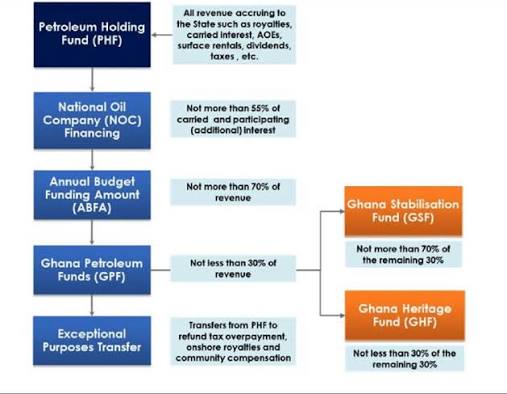
The Ghana Stabilisation Fund (GSF) is intended to help manage unexpected shortfalls in petroleum revenue, while the Ghana Heritage Fund (GHF) is designed to preserve part of the country’s petroleum wealth for future generations.
The central issue is whether Ghana’s improved receipts are translating into greater fiscal resilience or whether spending pressures and withdrawals are limiting the benefits of the current revenue recovery.
Higher Allocations Do Not Automatically Mean Stronger Buffers
PIAC reported that petroleum receipts increased by 52%, from approximately US$370.34 million in the first half of 2025 to US$561.41 million during the same period in 2026.
The increase supported transfers to the Ghana Petroleum Funds, which comprise the GSF and GHF. Allocations to the two funds rose by 210.3%, according to PIAC’s consolidated findings.
However, higher allocations should not be interpreted in isolation from withdrawals, investment performance and the rules governing the funds.
A savings fund can receive substantial inflows while simultaneously facing withdrawals that reduce the amount available to absorb future shocks.
The GSF received approximately US$137.99 million during the period, but withdrawals classified under the sinking fund amounted to US$132.94 million. Its closing book value stood at approximately US$182.68 million at the end of June 2026.
The figures show why gross transfers alone provide an incomplete picture of the fund’s capacity. The amount entering the account is only one part of the equation; the closing balance, the purpose of withdrawals and the fund’s ability to respond to future revenue shortfalls are equally important.
PIAC also reported that accumulated excess over the fund’s cap reached US$82.68 million. This raises a separate question about the management of balances relative to the statutory framework and the appropriate treatment of amounts above the applicable cap.
The report’s findings should prompt closer scrutiny of how withdrawals are authorised, what fiscal pressures they are intended to address and whether the remaining balance is adequate for the risks Ghana faces.
Stabilisation Must Be Judged Against Future Revenue Risks
The Stabilisation Fund exists because petroleum revenue is volatile. International crude prices can shift sharply, production can decline unexpectedly and operational disruptions can affect the timing and volume of receipts.
Ghana’s first-half 2026 revenue improvement was supported by higher achieved crude prices and stronger corporate income tax collections. That provides a stronger immediate position, but it does not eliminate the possibility of a reversal.
PIAC cautioned that the country’s petroleum revenue outlook remains constrained by its production profile and dependence on international prices. Its broader assessment captures the challenge facing policymakers:
“The central issue is therefore not simply whether petroleum revenues have improved, but whether the improved outturn can be sustained and translated into enduring national value.”
That warning is relevant to the management of the petroleum funds. If higher receipts are temporary, the government must avoid treating them as a permanent increase in the resources available for spending.
A well-managed stabilisation mechanism should help smooth the impact of weaker petroleum receipts on the budget.
If the fund is depleted too quickly or its resources are committed without sufficient attention to future risks, the government could face greater pressure to borrow, cut spending or seek alternative revenue sources when prices fall.
The appropriate assessment is therefore not simply whether the GSF balance increased or decreased during one reporting period.
It is whether withdrawals complied with the applicable rules, whether the balance provides meaningful protection and whether fiscal planning reflects the uncertainty surrounding future oil income.
Heritage Savings Face a Different Responsibility
The Ghana Heritage Fund serves a different purpose from the Stabilisation Fund. While the GSF is designed to cushion short-term revenue shocks, the GHF is intended to preserve petroleum wealth for future generations.
PIAC reported that the GHF closed the first half of 2026 with a book value of approximately US$1.46 billion, following receipts of about US$59.14 million during the period. The fund recorded a net return of approximately US$25.14 million.

Although the heritage fund’s balance was considerably larger than that of the Stabilisation Fund, its performance must still be assessed in relation to investment risk, returns and the long-term objective of preserving wealth.
PIAC reported weaker investment returns than in the first half of 2025, reflecting a less favourable fixed-income environment.
That observation highlights the distinction between revenue transfers and investment performance: the amount deposited into a fund does not determine how effectively its assets grow over time.
For a country whose petroleum resources are finite, the heritage fund’s performance matters because the assets are intended to retain value beyond the period of commercial oil production.
Sound investment management, appropriate risk controls and transparent reporting are therefore essential to protecting the intergenerational purpose of the fund.
The government and relevant institutions must also ensure that the different purposes of the two funds remain clear.
A stabilisation reserve should not be treated as an unrestricted source of finance, and a heritage fund should not lose its long-term purpose because of immediate fiscal pressures.
Transparency Is Essential to Public Confidence
The report’s findings reinforce the need for clear public disclosure of petroleum fund movements, including receipts, withdrawals, investment returns and compliance with the applicable legal framework.
PIAC’s reporting gives the public a basis for examining these developments, but the figures also create questions that require answers from the institutions responsible for fiscal and investment management.
How were withdrawals from the Stabilisation Fund determined? What explains the accumulated excess over the cap? How are investment risks being managed in the current market environment? And how are the funds’ balances being assessed against the country’s longer-term revenue outlook?
These are not merely accounting questions. They concern the government’s ability to manage a resource that generates substantial revenue but remains vulnerable to external market movements.

The petroleum funds should strengthen Ghana’s capacity to withstand volatility and preserve wealth beyond the life of its oil fields.
That requires fiscal discipline during periods of strong receipts as much as it requires careful management when revenues fall.
Ghana’s first-half petroleum windfall has created an opportunity to reinforce its financial buffers.
Whether that opportunity is realised will depend on how withdrawals are justified, how savings are protected and whether the management of petroleum wealth remains focused on long-term resilience rather than short-term revenue gains.
READ ALSO: War-Torn Sudan Faces Growing Famine Threat From Drought