Consolidated Bank Ghana (CBG) has called for stronger partnerships among banks, development finance institutions, research organisations and donor agencies to unlock funding for nature-based solutions, warning that limited access to finance could undermine efforts to address environmental challenges in Ghana and across Africa.
The bank believes that greater collaboration among financial sector players and development partners could help mobilise the resources needed to scale up climate-related projects that deliver environmental, social and economic benefits.
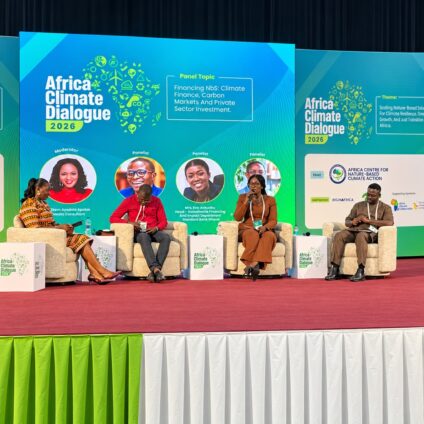
Speaking at the Africa Climate Dialogue 2026, CBG’s Head of Sustainable Financing and Impact Department, Mrs Eva Ackuaku, identified limited access to finance, grants and donor support as major obstacles preventing promising nature-based solutions from attracting the investment required for implementation.
Her concerns highlight a persistent challenge facing green investment in Ghana. Although projects such as forest restoration, wetland conservation and mangrove protection can support communities and strengthen environmental resilience, their commercial viability often remains a major concern for conventional lenders.
Mrs Ackuaku argued that stronger partnerships and innovative financing arrangements could help bridge the gap between the environmental benefits of these projects and the financial requirements banks must satisfy before committing funds.
CBG Sounds Alarm Over Climate Financing Gaps
The growing need to finance climate-related projects has placed financial institutions under increasing pressure to support sustainable development while protecting the interests of their customers.
Mrs Ackuaku explained that banks cannot overlook commercial risks when considering projects, even when those initiatives promise substantial environmental and social benefits.
Financial institutions must conduct due diligence to establish whether proposed investments can withstand potential risks and generate sufficient returns. This requirement can leave nature-based solutions struggling to secure conventional financing, particularly when they lack reliable revenue streams or adequate financial guarantees. “The major setback that I see is limited access to finance,” she said.
According to Mrs Ackuaku, grants, donor funding and financial guarantees could help address this challenge by reducing the risks associated with projects that struggle to demonstrate immediate commercial viability.
Such support could make a significant difference to initiatives that require substantial upfront investment but deliver benefits over extended periods.
Without appropriate funding arrangements, environmentally beneficial projects may struggle to progress beyond the planning stage, leaving communities and investors unable to realise their full potential.
Stronger Partnerships Could Unlock Green Investment
CBG is advocating a more coordinated approach to climate financing, with financial institutions working alongside development partners to identify funding opportunities and support projects that might otherwise struggle to attract investment.
Mrs Ackuaku stressed that collaboration should take precedence over competition when stakeholders are working towards shared environmental objectives. “We do not compete, but we collaborate,” she said.
Her position underscores the importance of building partnerships that combine the strengths of different institutions. While banks can provide financial expertise and assess investment risks, development finance institutions and donor agencies may offer funding structures, guarantees and other forms of support that make challenging projects more attractive.
Research institutions can also contribute technical knowledge, project assessments and evidence of environmental outcomes, helping investors better understand the long-term value of proposed initiatives.
This collaborative approach could expand the pool of available financing and help stakeholders develop projects with stronger governance arrangements, clearer financial models and more credible implementation plans.
For Ghana, such partnerships could help connect sustainability ambitions with practical investments capable of supporting environmental protection, local livelihoods and long-term economic development.
Land Ownership Concerns Could Scare Investors
Beyond funding constraints, Mrs Ackuaku identified uncertainty surrounding land ownership as another obstacle to developing carbon projects, particularly those located outside major urban centres.
Disputes over land rights can complicate project development, delay implementation and discourage investors who require clarity over ownership, access and the ability to sustain activities over time.
Nature-based solutions frequently depend on the protection or restoration of land and ecosystems over extended periods. Unresolved ownership questions can therefore introduce considerable uncertainty into project planning and financing.
Mrs Ackuaku urged governments to establish supportive policies that encourage climate investment while remaining consistent with national development objectives and international commitments. “Governments need to create that conducive environment for us. The policies must align with national priorities, international priorities,” she said.
A predictable policy environment could help investors assess risks more confidently, while clearer land rights and stronger institutional coordination could reduce uncertainty surrounding project execution.
Banks Demand Strong Governance and Risk Management
Despite the environmental benefits associated with nature-based solutions, CBG maintains that projects must demonstrate the financial discipline required to attract institutional funding.
Mrs Ackuaku explained that banks examine governance structures, internal policies, procedures and risk management systems before making lending decisions.
Financial models are also assessed under different scenarios to determine how projects might perform when economic or operating conditions deteriorate.
These evaluations help lenders establish whether projects can remain viable when faced with unexpected costs, weaker revenues or other adverse developments.
The approach highlights the need for project developers to combine environmental objectives with credible business plans and measurable outcomes.
Grants and guarantees may help address financing gaps, but sound governance and effective risk management remain essential to building investor confidence.
CBG Prepares to Showcase Sustainability Efforts
Meanwhile, CBG is preparing to showcase its sustainability activities through an upcoming Sustainability Week celebration aimed at increasing public awareness of the bank’s work in the sector.
The initiative is expected to provide an opportunity to highlight sustainability efforts and encourage broader engagement with climate-related issues.
The Africa Climate Dialogue 2026 brought together stakeholders to examine how climate finance, carbon markets and private-sector investment could support the expansion of nature-based solutions in Ghana and across Africa.
As discussions continue, the availability of funding, stronger institutional partnerships and a supportive policy environment will remain important to translating climate ambitions into projects that deliver tangible benefits.
CBG’s call places renewed attention on the role of financial institutions and development partners in making green investments commercially viable, while ensuring that environmental protection and community development remain central to the financing process.
READ ALSO: World Bank Warns Ghana’s Recovery Remains Fragile Despite 6% Growth