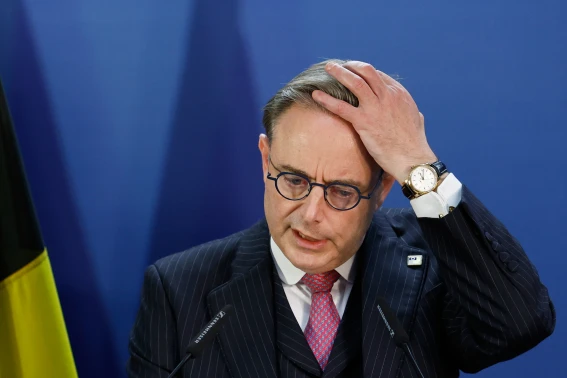
Belgian Prime Minister Bart De Wever has submitted his government’s resignation to King Philippe after overnight budget negotiations collapsed, deepening a political crisis over how to address the country’s mounting debt.
The King has not yet decided whether to accept the resignation. Following a meeting at the royal palace that lasted about 90 minutes, De Wever left without addressing the media.
Belgium’s Royal Palace confirmed that the Prime Minister had resigned “following the failure of budget negotiations within his government.”
King Philippe said that he was considering his decision and would consult the leaders of the coalition parties from Tuesday. He expressed regret that the negotiations had failed, warning that Belgium could not afford a prolonged political crisis.
The King called on all parties involved “to put the general interest and a willingness to compromise first.” De Wever is scheduled to meet him again on Friday.
Coalition Divided Over Budget Measures
De Wever, a conservative Flemish nationalist who took office in February 2025, had pledged to tackle Belgium’s public debt and bring government spending under control. However, he has struggled to secure agreement among the five parties in his coalition on how to achieve those objectives.
The governing alliance comprises De Wever’s New Flemish Alliance (N-VA), the liberal Reformist Movement (MR), the centrist Les Engagés, the socialist Vooruit and the Christian Democrats (CD&V).
The coalition agreement was reached after 234 days of negotiations, but disagreements over taxation and spending have continued to strain relations among its members.
During the latest budget talks, the N-VA and MR favoured spending cuts, while Vooruit, CD&V and Les Engagés sought to raise between €1 billion and €1.5 billion through higher taxes on wealthy earners. The differences proved difficult to resolve during overnight negotiations, prompting De Wever to offer his resignation.
Deputy Prime Minister David Clarinval blamed the socialist Vooruit party for the breakdown, accusing it of maintaining its position on higher taxes.
Foreign Minister Maxime Prévot also acknowledged the depth of the disagreement, telling Belgian media there were “too many sticking points.” “If I were to list all the sticking points, it would take an eternity,” he said.
The government needs to identify approximately €10 billion in savings to bring its finances closer to European Union spending requirements.
Mounting Debt Adds To Pressure
Belgium’s political impasse comes as the country faces growing pressure to contain its public debt and reduce its budget deficit.
The European Commission has forecast that Belgium’s debt will reach 110% of gross domestic product this year. The country is among the most heavily indebted members of the 27-nation European Union, alongside France and Italy.
The debt burden has accumulated over several years, with the COVID-19 pandemic and the energy crisis adding to the strain on public finances. Rising interest payments have further complicated efforts to balance spending priorities, including plans to increase defence expenditure.
Belgium recorded a budget deficit of 5% of GDP last year, exceeding the EU’s reference limit of 3%. Its public debt has also surpassed the bloc’s reference threshold of 60% of GDP.
The government’s inability to agree on a budget has added to uncertainty over how the country will meet its fiscal commitments. Interest rates on Belgian government bonds have risen, increasing the cost of servicing its debt.
The crisis is unfolding amid student protests and recurring labour strikes, including several nationwide days of action organised by trade unions.
Opposition Criticises De Wever
The breakdown in negotiations has drawn criticism from opposition figures, who have accused De Wever of failing to unite his coalition behind a common approach.
Matti Vandemaele of the Green party, Groen, said the Prime Minister had struggled to reconcile the competing positions of the governing parties. “Prime Minister De Wever is failing to get his government on the same page, unless everyone follows his N-VA programme,” Vandemaele said.
He also criticised the prospect of Belgium relying on provisional monthly budget arrangements, known as provisional twelfths, if a full budget agreement cannot be reached.
“De Wever likes to present himself as the man of the big deals, but in practice he is mainly the Prime Minister of standstill. The fact that we risk falling back on provisional twelfths for the second year in a row is a complete humiliation for a sitting Prime Minister.”
Matti Vandemaele
The latest impasse is not the first budget dispute to threaten the Arizona coalition. In November 2025, De Wever asked King Philippe for additional time to reach an agreement on measures intended to save €10 billion. He received a 50-day extension but did not offer his resignation at the time.
The current crisis leaves the government’s future uncertain as the King considers whether to accept the resignation and consults coalition leaders.
If the resignation is accepted, Belgium could face a process leading to new elections. Until then, the coalition’s ability to reach a compromise will remain central to resolving the budget dispute and addressing the country’s worsening fiscal pressures.
READ ALSO: Russia, Ukraine Report Cyberattacks On Emergency Alert Apps