AfroFuture has announced the opening of Future Club, its first permanent home, in Accra this December. The year-round creative compound will launch at 1 Shiashie, marking a significant shift for the Pan-African cultural platform as it moves beyond its traditional annual festival format.
The organisers confirmed that the 2026 edition of the AfroFuture festival will not return to El Wak Stadium. In its place, Future Club will host the December programming and continue operating throughout the year.
The full festival is scheduled to return to El Wak Stadium in December 2027 as the centrepiece of AfroFuture’s tenth-anniversary celebrations.
The Future Club
Future Club occupies roughly 1.5 acres and is designed as a multi-use creative compound. Facilities include bars presented by Martell, a full kitchen, a main stage capable of hosting large performances, daytime programming spaces, a recurring market, and rotating art and fashion exhibitions.
The space is positioned as a “third place” for both residents of Accra and members of the African diaspora-a venue where people can relax, create, learn, eat and belong. It will operate with membership options while remaining open to the public through day passes and event tickets.
Central to the December launch is the AfroFuture Residency, a series of standalone 3,000-capacity concerts. Confirmed headliners include award-winning songwriter and producer Young Jonn, Afrobeats artist Victony, and Amapiano act Jazzwrld. Supporting programming throughout the festive season will feature live recordings of podcasts such as Adesope Live and other African-led shows, film screenings, poetry slams, art and fashion showcases, and AfroFuture’s New Year’s Eve party.
Membership opens with the grand opening. Every ticket holder for the opening night automatically becomes a member for a full year, granting access to the full programme of events and facilities. Day passes will also be available for those who wish to attend individual nights or activities.
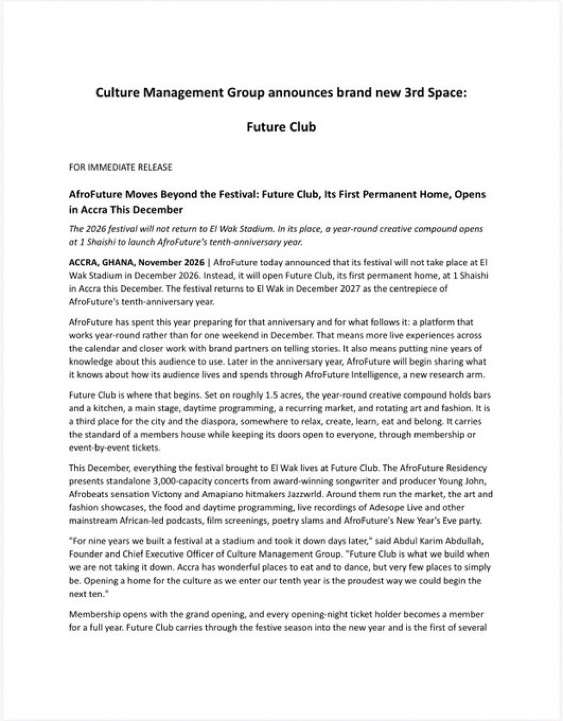
Abdul Karim Abdullah, Founder and Chief Executive Officer of Culture Management Group, the parent company of AfroFuture, explained the decision. “For nine years we built a festival at a stadium and took it down days later,” he said.
“Future Club is what we build when we are not taking it down. Accra has wonderful places to eat and to dance, but very few places to simply be. Opening a home for the culture as we enter our tenth year is the proudest way we could begin the next ten.”
Abdul Karim Abdullah, Founder and Chief Executive Officer of Culture Management Group
About Afrofuture
AfroFuture began in 2017 as Afrochella and has grown into a recognised platform celebrating African and diaspora creativity through music, art, fashion and cultural experiences. In addition to its Accra base, the brand has staged editions in Detroit, Johannesburg and Zanzibar, along with activations across the United States.
The permanent Accra venue represents the next stage of that evolution, providing a fixed base for year-round activity rather than a single annual event.
The opening of Future Club comes as Accra continues to strengthen its position as a major destination for cultural tourism during the December festive season, often referred to as Detty December. By establishing a permanent physical presence, AfroFuture aims to offer consistent programming, deeper brand partnerships and a lasting cultural hub for both local audiences and international visitors.
Further details on membership packages, full programming schedules and ticket information are expected to be released in the coming weeks. For now, the announcement confirms that December 2026 in Accra will centre on Future Club at 1 Shiashie, with the larger stadium festival returning the following year to mark a decade of the platform.
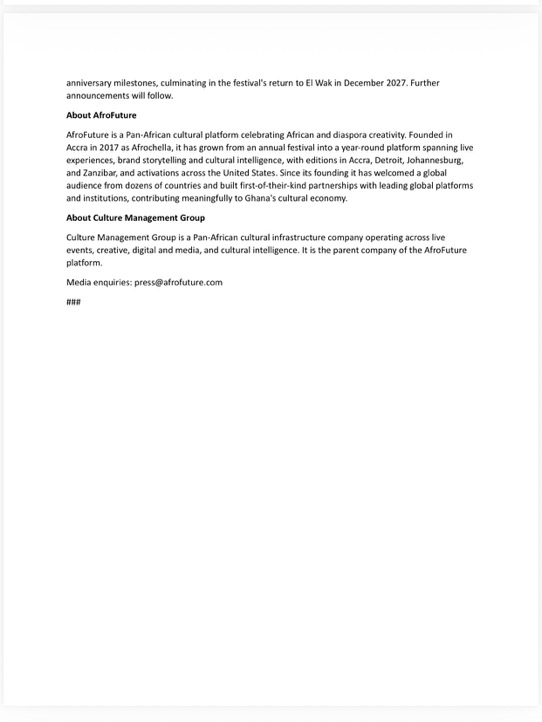
Culture Management Group, which oversees AfroFuture, operates across live events, creative and digital media, and cultural intelligence. The new venue is described as the first of several anniversary milestones planned ahead of the 2027 return to El Wak Stadium.
As AfroFuture enters its tenth year, Future Club stands as both a practical expansion and a symbolic statement: a permanent home for African cultural expression in the city where the platform was born.
READ ALSO:Ato Forson Nears Bawumia in NPP’s Stronghold Regions