


Ghana’s efforts to revive investment in its upstream petroleum industry are unfolding against a changing global energy market, raising questions about whether attracting new oil and gas capital is enough to secure long-term economic benefits.
The concern is central to a November 2026 policy brief by the Africa Centre for Energy Policy (ACEP), which argues that African countries should stop treating continued fossil fuel development as a common continental prescription.
Instead, decisions should reflect each country’s resource base, energy needs, production costs, market prospects and broader development priorities.
For Ghana, the argument comes at a critical time. The country is seeking to reverse declining crude oil production, attract fresh investment and develop new petroleum resources, while also pursuing a transition towards cleaner energy and more diversified sources of economic growth.
ACEP’s brief, titled Putting Africa’s Best Foot Forward: The Need to Rethink Africa’s Common Position on Energy Transition, warns that a strategy which encourages every African country to expand oil and gas production could expose smaller and emerging producers to investments that may not deliver sustainable returns.
“Continued fossil fuel development should be a country-specific economic decision rather than a presumed continental pathway,” the brief states.
The recommendation challenges the assumption that Africa’s petroleum resources automatically provide a viable route to industrialisation and energy security.
It also puts pressure on governments to demonstrate that proposed projects can generate domestic value without creating expensive infrastructure or long-term financial liabilities.
Ghana’s Production Challenge Meets Investment Uncertainty
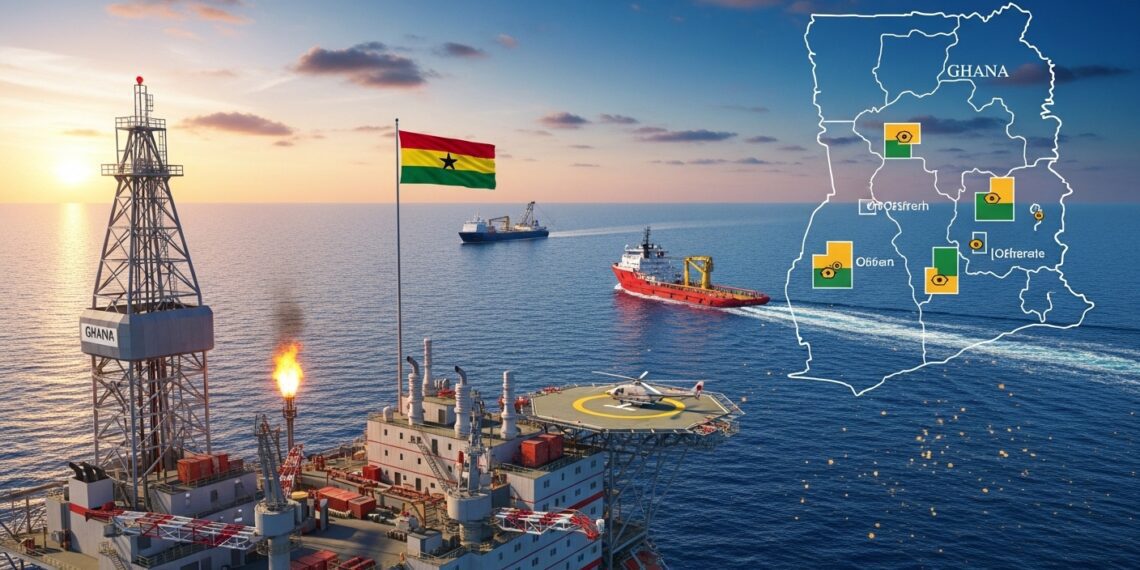
Ghana has a direct interest in the debate because its petroleum sector is already facing production pressures.
The Energy Commission’s 2026 Energy Outlook reports that crude oil production fell to 37.30 million barrels in 2025, down approximately 22.7 per cent from 48.24 million barrels in 2024.
It attributes the decline largely to maturing fields, insufficient drilling activity, operational shutdowns and weak new investment inflows.
The Ghana National Petroleum Corporation (GNPC) has also acknowledged the difficult conditions facing the upstream industry.
In August 2026, the Corporation said Ghana had recorded a fifth consecutive year of crude oil production decline, while outlining efforts to bring new petroleum resources into development.
The immediate policy response is understandable. Without fresh exploration, development drilling and investment in existing fields, Ghana risks further pressure on production and the petroleum revenues that support public expenditure.
However, ACEP’s argument is that attracting investment should not become an end in itself.
New petroleum projects require substantial capital, supporting infrastructure, technical capacity and a commercially viable market.
For an emerging producer, these requirements can be particularly demanding because the country may not have the established infrastructure, production scale or domestic market available to major petroleum exporters.
The brief notes that Africa’s oil and gas production is highly concentrated. Five countries account for approximately 81 per cent of the continent’s oil output, while five countries account for about 89 per cent of natural gas production.
This uneven distribution means that a continental policy favouring continued fossil fuel development could benefit established producers differently from countries with smaller reserves or less mature industries.
Ghana must therefore distinguish between investments capable of improving domestic energy security and projects whose economic justification depends heavily on uncertain future export revenues.
The Global Investment Picture Is Changing
ACEP also draws attention to the changing direction of energy investment across Africa.
According to the brief, investment in the continent’s oil and gas sector declined by approximately 56 per cent between 2015 and 2025. The sector’s share of total energy investment fell from 74 per cent to 47 per cent over the same period.
The brief further reports that investment in fossil fuel power generation declined by about 62 per cent, while clean energy investment grew by 92 per cent.
These figures do not mean oil and gas will disappear from Africa’s energy systems in the near term. They do, however, indicate that the investment environment is changing, with capital increasingly moving towards other energy technologies.
For Ghana, this creates a more complicated investment challenge. The country needs to attract capital to sustain its petroleum industry, but it must also ensure that new projects remain economically viable as international demand, financing conditions and technology evolve.
An investment decision based primarily on optimistic assumptions about future oil prices or export markets could leave the country exposed if those assumptions do not materialise.
ACEP therefore recommends that governments assess proposed projects against realistic demand projections, production costs, infrastructure requirements and the possibility of stranded assets.
That approach would require Ghana to examine not only how much oil or gas a project could produce, but also the cost of developing it, the expected market and the benefits that would remain within the domestic economy.
Gas And Domestic Energy Security Need Separate Consideration
The debate is particularly important for Ghana’s natural gas sector.
Domestic gas supports electricity generation and has an important role in the country’s energy security. Its contribution should therefore be assessed differently from petroleum projects whose commercial value depends primarily on exports.
ACEP’s brief does not argue that all fossil fuel investments should be abandoned. Rather, it calls for investment decisions to reflect national circumstances and demonstrate clear economic benefits.
For Ghana, this means evaluating gas projects according to their ability to provide reliable domestic supply, support industrial activity and improve the economics of electricity generation.
It also means examining whether the infrastructure required to produce, process and transport gas is affordable and sustainable over the expected life of the investment.
The distinction matters because a project that improves domestic energy availability may have a different development case from one that relies on uncertain export demand or requires extensive public support.
A More Demanding Investment Standard
ACEP’s recommendations place greater responsibility on governments to use evidence when determining the future of their energy industries.
The brief calls for stronger country-level data, scenario analysis and economic scrutiny to inform both national investment decisions and Africa’s negotiating position on the energy transition.
For Ghana, this could mean publishing clearer assessments of proposed upstream investments, including expected production, development costs, fiscal returns, domestic supply commitments and exposure to changing global demand.
It would also require policymakers to assess how petroleum investment fits into the country’s wider industrial and energy plans rather than treating production growth as an isolated objective.
The challenge is not to choose between oil and renewable energy without considering the economic consequences.
Ghana still needs reliable electricity, industrial growth and public revenue, but it must also prepare for a global market in which the competitiveness of fossil fuel investments cannot be assumed.
The country’s upstream recovery strategy will therefore need to demonstrate more than the ability to attract investors.
It must show that the investments can deliver affordable energy, sustainable public revenues and lasting domestic benefits without leaving future generations with costly assets.
ACEP’s warning is ultimately a call for greater selectivity. For Ghana, the measure of a successful petroleum investment should not simply be how much capital it attracts or how many barrels it adds, but whether the economic returns justify the financial and long-term risks.
READ ALSO: Ato Forson Nears Bawumia in NPP’s Stronghold Regions