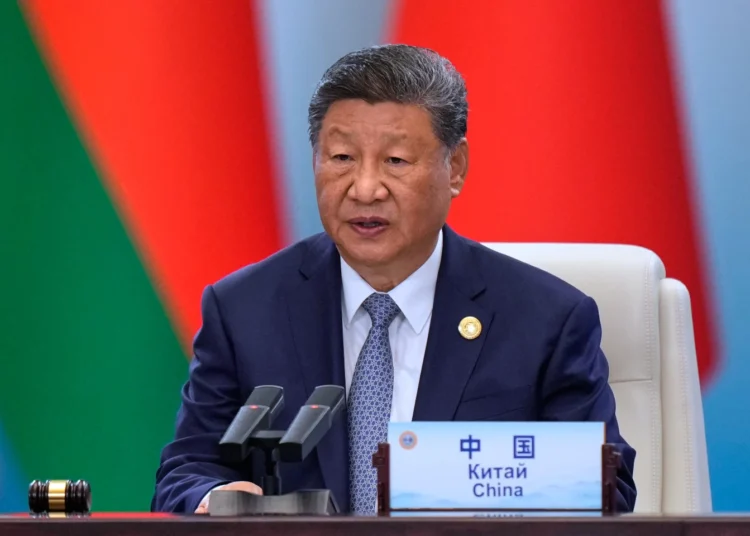
Chinese President Xi Jinping has renewed calls for the peaceful reunification of Taiwan with mainland China, describing the objective as an “unwavering historical mission” of the Chinese Communist Party.
Speaking at the Great Hall of the People in Beijing, Xi stated that the reunification of China was inevitable and urged people on both sides of the Taiwan Strait to work towards achieving it. “The complete reunification of the motherland must be realised, and it will certainly be realised,” he stressed.
Xi added that “the tide of history cannot be stopped,” presenting reunification as a shared national aspiration and an important step towards China’s broader goal of national rejuvenation.
The remarks were delivered during an event marking the 160th birthday of Sun Yat-sen, the revolutionary leader associated with the 1911 uprising that ended centuries of imperial rule and led to the establishment of the Republic of China.
Xi said that Sun had defended national unity and opposed efforts to divide the country, drawing a connection between his legacy and Beijing’s position on Taiwan.
China considers Taiwan part of its territory, although the island has its own democratically elected government and rejects Beijing’s sovereignty claims. The two sides have been governed separately since the end of the Chinese Civil War in 1949.
Beijing Reiterates Reunification Proposal
Xi reaffirmed Beijing’s commitment to what it describes as peaceful reunification under the framework of “one country, two systems.”
He said that China remained willing to engage in dialogue with Taiwan while maintaining the “one China principle,” under which Beijing regards both sides of the Taiwan Strait as belonging to a single country.
The Chinese President also called on people in Taiwan, mainland China and overseas Chinese communities to oppose what Beijing describes as separatist forces advocating Taiwan independence.
He urged them to support peaceful development across the Taiwan Strait, arguing that reunification represented the common aspiration of the Chinese people.
However, Beijing’s proposed “one country, two systems” framework has been rejected by Taiwan’s major political parties, which oppose placing the island under the Chinese Communist Party’s rule.
China has repeatedly said that it prefers peaceful reunification but has not ruled out the use of force to bring Taiwan under its control.
Taiwan Rejects Xi’s Remarks
Taiwan’s government dismissed the Chinese President’s renewed call for reunification, maintaining that its people would not accept Beijing’s proposed political arrangement.
The island’s Mainland Affairs Council said that neither the Taiwanese government nor its population could accept the “one country, two systems” model, arguing that it would ultimately place Taiwan under the authority of the Chinese Communist Party.
Council Spokesperson Liang Wen-chieh told reporters that Xi’s latest comments did not represent a significant departure from Beijing’s previous position. “As for the wording on Taiwan unification, it isn’t much different from the past,” Liang said.
Taiwan’s response reflects its longstanding rejection of Beijing’s claim to sovereignty over the island and its opposition to being governed under the Chinese political system.
The disagreement remains one of the most sensitive issues in relations between China and the United States, which maintains unofficial relations with Taiwan and provides the island with defensive support. Xi’s remarks come ahead of the Asia-Pacific Economic Cooperation (APEC) summit scheduled to take place in Shenzhen, China, where he is expected to meet US President Donald Trump.
Xi previously visited Washington in September, where he urged Trump to exercise “prudence” over Taiwan and called on the United States to oppose the island’s independence.
Taiwan Reports Chinese Military Activity
Xi’s speech coincided with renewed Chinese military activity around Taiwan.
Taiwan’s Defence Ministry said it had detected 29 Chinese military aircraft, including J-16 fighter jets and drones, conducting what it described as a joint combat readiness patrol around the island alongside Chinese warships.
The reported operation began on Thursday, adding to the military pressure Taiwan says it faces from Beijing.
China regularly deploys military aircraft and naval vessels around Taiwan, activities that Taipei views as attempts to increase pressure on the island.
Beijing maintains that its military activities are necessary to defend its sovereignty and territorial integrity, while Taiwan has continued strengthening its defence capabilities in response to the perceived threat.
Although Xi’s speech focused on political reunification rather than military action, the latest patrol underscores the security tensions surrounding the issue.
The latest developments also come ahead of important local elections in Taiwan scheduled for later in November, adding a domestic political dimension to the debate over the island’s relationship with mainland China.
Xi’s speech reinforces Beijing’s longstanding position that reunification is a central national objective. However, Taiwan’s rejection of the proposed political framework, continued military activity around the island and the strategic interests of the United States leave the dispute at the centre of regional security and diplomatic relations.
READ ALSO: Indonesia’s Vice President Resigns Amid Credentials Dispute