• About
  • Advertise
  • Privacy Policy
  • Contact
Sunday, September 13, 2026
  • Login
The Vaultz News
  • Top Stories
  • News
    • General News
    • Education
    • Health
    • Opinions
  • Economics
    • Economy
    • Finance
      • Banking
      • Insurance
      • Pension
    • Securities/Markets
  • Business
    • Agribusiness
    • Vaultz Business
    • Extractives/Energy
    • Real Estate
  • World
    • Africa
    • America
    • Europe
    • UK
    • USA
    • Asia
    • Around the Globe
  • Innovation
    • Technology
    • Wheels
  • Entertainment
  • 20MOBPL2DNew
  • Jobs & Scholarships
    • Job Vacancies
    • Scholarships
No Result
View All Result
The Vaultz News
  • Top Stories
  • News
    • General News
    • Education
    • Health
    • Opinions
  • Economics
    • Economy
    • Finance
      • Banking
      • Insurance
      • Pension
    • Securities/Markets
  • Business
    • Agribusiness
    • Vaultz Business
    • Extractives/Energy
    • Real Estate
  • World
    • Africa
    • America
    • Europe
    • UK
    • USA
    • Asia
    • Around the Globe
  • Innovation
    • Technology
    • Wheels
  • Entertainment
  • 20MOBPL2DNew
  • Jobs & Scholarships
    • Job Vacancies
    • Scholarships
No Result
View All Result
The Vaultz News
No Result
View All Result
in Economy

EIU Forecasts Cedi to End 2024, 2025 at GH¢16.07, GH¢17.23 to One Dollar

Maynard Championby Maynard Champion
December 24, 2024
Reading Time: 4 mins read
Add as Preferred on Google
avatars 000528790767 hr6kin t500x500 424x424 1

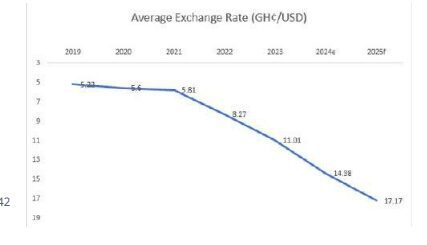
The Ghanaian cedi is projected to conclude 2024 at a rate of GH¢16.07 to one US dollar, with a slight depreciation to GH¢17.23 by the end of 2025.

This forecast, outlined in Deloitte’s report titled “Sneak Preview of 2025” and supported by insights from the Economist Intelligence Unit (EIU), sheds light on the cedi’s expected performance over the next two years.

According to the EIU, the expected depreciation of the cedi in 2024 is primarily attributed to reduced cocoa export earnings and an anticipated rise in Ghana’s import bill. These economic pressures are expected to weaken the cedi, particularly towards the latter part of 2024.

However, 2025 presents a more optimistic outlook, driven by factors such as enhanced investor confidence following a peaceful electoral process and the successful conclusion of the government’s debt restructuring negotiations.

ADVERTISEMENT

Additional support will come from periodic International Monetary Fund (IMF) disbursements and increased gold export receipts, which are expected to bolster Ghana’s international reserves and stabilize the currency.

At present, the cedi is trading at approximately GH¢16.10 to the dollar on the retail market, demonstrating the currency’s ongoing challenges in maintaining stability against external pressures.
Screenshot 2024 12 24 014638

Implications for Ghana’s Economy

A relatively stable exchange rate is crucial for restoring investor confidence in Ghana’s economy, as highlighted by Deloitte in its analysis. Stability in the cedi can significantly impact investment decisions, especially in sectors such as manufacturing, trade, and services, which rely heavily on currency predictability for planning and operations.

Nevertheless, risks to this stability remain. Deloitte notes that increased imports in the services sub-sector, including hydrocarbons and mining projects, could exert downward pressure on the currency.

Additionally, a more pronounced decline in cocoa exports could narrow Ghana’s trade surplus, negatively affecting the current account balance. The forecasted decline in the country’s current account balance—from an estimated $1.6 billion in 2024 to $700 million in 2025—underscores the economic vulnerabilities that could undermine cedi stability.

ADVERTISEMENT

Cocoa and gold, two of Ghana’s key export commodities, will play pivotal roles in determining the trajectory of the cedi over the forecast period.

A decrease in cocoa exports, whether due to global price fluctuations or production challenges, could limit foreign exchange inflows, exacerbating currency pressures. Conversely, higher gold export receipts, driven by favorable prices or increased production, are expected to support Ghana’s international reserves and stabilize the cedi in 2025.

Impact of IMF Disbursements and Debt Restructuring

The ongoing periodic disbursements from the IMF, coupled with successful debt restructuring negotiations, will be critical to Ghana’s economic recovery efforts. These measures not only enhance the country’s creditworthiness but also provide a cushion against external shocks, thereby contributing to a more stable currency environment.

ADVERTISEMENT

The peaceful conclusion of Ghana’s 2024 general elections is also projected to have a significant impact on investor sentiment. Historically, political stability has been a key factor in attracting foreign direct investment and maintaining confidence in the country’s financial markets.

Despite the positive projections for 2025, the road ahead is fraught with challenges. A significant rise in imports, particularly for hydrocarbons and mining projects, could increase demand for foreign exchange, putting pressure on the cedi. Additionally, global economic uncertainties and commodity price volatility could further complicate Ghana’s efforts to stabilize its currency.

To mitigate these risks, policymakers must prioritize measures to diversify the economy, reduce dependency on imports, and enhance value addition in key export sectors. For instance, boosting domestic cocoa processing capabilities could help Ghana retain more value from its cocoa exports, while investments in renewable energy could reduce reliance on imported hydrocarbons.

Meanwhile, the EIU’s forecast of a marginal depreciation of the cedi to GH¢17.23 by the end of 2025 provides a mixed outlook for Ghana’s economy. While the anticipated stability in 2025 is a welcome development, the risks associated with declining cocoa exports and rising import bills highlight the need for proactive economic management.

The coming years will test Ghana’s resilience and ability to leverage its strengths—such as gold exports and IMF support—while addressing its vulnerabilities.

READ ALSO: IPMAN Assures Nigerians of Adequate Festive Fuel Supply

ADVERTISEMENT

Sign Up to Our Newsletter

Fresh updates, Straight to your inbox

Tags: CediDepreciationEconomist Intelligence Unit (EIU)Sneak Preview of 2025
Please login to join discussion
Previous Post

IPMAN Assures Nigerians of Adequate Festive Fuel Supply 

Next Post

Horror in Haiti, Gang Executions Shake Cité Soleil

Related Posts

il tanker navigating a major Middle East shipping route as higher crude prices test Ghana’s inflation and external buffers.
Economy

Oil Shock Tests Ghana’s Disinflation and External Buffers

September 12, 2026
Ghana's President John-Mahama-IMF Chief Kristalina Georgieva
Economy

IMF Flags Concentrated Fiscal Risks Across Ghana’s Largest SOEs

September 11, 2026
Chief Executive Officer of the Ghana Gold Board (Goldbod), Sammy Gyamfi
Economy

GoldBod Profit-Jump Puts Focus on Long-Term Economic Value

September 11, 2026
A Ministry of Finance graphic projecting 30,000 direct and indirect jobs from the Accra-Kumasi Expressway project.
Economy

30,000 Accra-Kumasi Expressway Jobs Rest on Key Assumptions

September 11, 2026
ADVERTISEMENT

Sign Up to Our Newsletter

Fresh updates, Straight to your inbox

ADVERTISEMENT

Recent News

UK National Security Adviser Jonathan Powell

UK National Security Adviser Warns Europe of Real Hardship Amid Russia Pressure

September 13, 2026
Refined Gold

Ghana’s Estimated 3 trillion Ounces Gold Reserves Sets to be Mined Under New Terms

September 13, 2026
Dr. John Osae-Kwapong, Democracy and Development Fellow, CDD-Ghana, and Project Director, the Democracy Project

A Quiet Exit – Examining Our Civic Engagement Habits

September 12, 2026
President of Ghana, HE John Dramani Mahama

Mahama Rules Out Taxpayer Money for National Cathedral as Audit Reaches AG

September 12, 2026
il tanker navigating a major Middle East shipping route as higher crude prices test Ghana’s inflation and external buffers.

Oil Shock Tests Ghana’s Disinflation and External Buffers

September 12, 2026
ADVERTISEMENT
Next Post
Haitian gang

Horror in Haiti, Gang Executions Shake Cité Soleil

The Vaultz News

Copyright © 2025 The Vaultz News. All rights reserved.

Navigate Site

  • About
  • Advertise
  • Privacy Policy
  • Contact

Follow Us

Welcome Back!

Login to your account below

Forgotten Password?

Retrieve your password

Please enter your username or email address to reset your password.

Log In
No Result
View All Result
  • Top Stories
  • News
    • General News
    • Education
    • Health
    • Opinions
  • Economics
    • Economy
    • Finance
      • Banking
      • Insurance
      • Pension
    • Securities/Markets
  • Business
    • Agribusiness
    • Vaultz Business
    • Extractives/Energy
    • Real Estate
  • World
    • Africa
    • America
    • Europe
    • UK
    • USA
    • Asia
    • Around the Globe
  • Innovation
    • Technology
    • Wheels
  • Entertainment
  • 20MOBPL2D
  • Jobs & Scholarships
    • Job Vacancies
    • Scholarships

Copyright © 2025 The Vaultz News. All rights reserved.

This website uses cookies. By continuing to use this website you are giving consent to cookies being used. Visit our Privacy and Cookie Policy.