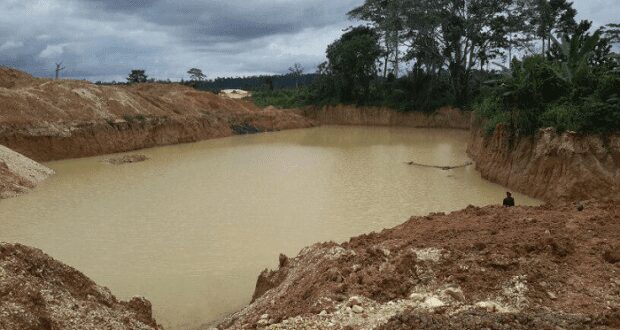
Director of Communications at the Ghana Water Company Limited (GWCL), Stanley Martey, has revealed that his outfit has been committed in its fight against the impact of illegal mining on the quality of water in the country.
Mr Martey indicated that currently there isn’t much improvement, although when there’s a “real fight”, some progress can be made. He explained that if government and other stakeholders are able to sustain the fight, then it means that there will also be quality in improvement of raw water.
“Anytime we get external people to support the fight against galamsey, it ceases for a while and we see improvement. But anytime we go to rest, then it happens again. The Ghana Water Company Limited for the past fifteen years has never relented in any way in fighting the menace. Unfortunately, we do not have the capacity to meet them boot-for-boot… So, we must all fight against the menace”
Stanley Martey
Mr Martey opined that it is the mandate of law enforcement agencies to ensure that illegal mining is addressed in the country. He noted that the GWCL and the Water Resources Commission, have on their part, resorted to educating the people and making sure they understand that apart from affecting the water bodies and its treatment, it is also affecting their domestic economy.
Mr Martey, however, assured the public that any water that flows through their taps meet the best of standard. He explained that before the water leaves the treatment plants, it means that it has “attained the Ghana Standards Authority’s drinking water standards and that of the WHO’s drinking water standards”.
“The Ghana Standards Authority’s standard is far higher than WHO and as a company, we ensure that we even do better than the Ghana Standard Authority’s standard for drinking water. So, the water that flows through our pipelines meet the best of standards.”
Stanley Martey
Challenges of treating water
The GWCL Communications Director highlighted that despite the fact that it is “seriously challenged” due to the pollution of the country’s water bodies, his outfit is committed to meeting the standards of GSA and WHO. That notwithstanding, he expressed that if at a point the company is unable to meet the standard, it means that the “water has reached an untreatable stage” and it must shut down its treatment plants.

“So, there’s been several occasions where we’ve had to shut down our treatment plants because we can’t treat the water to meet the standards of drinking.”
Stanley Martey
Elaborating on what qualifies water as reaching an “untreatable stage”, Mr Martey revealed that there are a lot of compounds in water and in the treatment process there is the need to get rid of all of them. He stated that in the process of getting rid of these compounds, his outfit sometimes loses a greater chunk of the water because of the dirt.
To improve the water quality, Mr Martey indicated that his team adds some chemicals which will coagulate all the dirt although “there are process losses” in the treatment of water. He noted that when the losses go beyond a specific limit, it means that it is not “feasible for us to waste our time and everything for us to treat the water”.
“Even with raw water that is clear, there could be some compounds we can’t see with the naked eye. All those things would have to be cleared before it is sent out for consumption… Now, if your process losses goes beyond fifty or sixty percent, then it is not economically prudent for you to treat the water. Because it means that you’ll be using a lot of chemicals and even we’ll be using energy to extract the water and you have to lose a chunk of the water.”
Stanley Martey
READ ALSO: Necessity Drove The Introduction Of Tree Planting Exercise- Samuel Jinapor