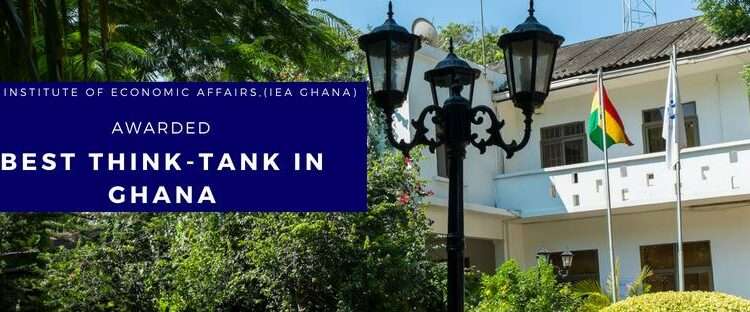
The Institute of Economic Affairs (IEA) has raised significant concerns about the frequency of economic crises and the recurring need for International Monetary Fund (IMF) bailouts in Ghana.
According to the IEA, these issues highlight serious policy failings that have increased the country’s vulnerability to economic shocks, ultimately stunting its growth and development.
The IEA’s assessment is particularly critical of Ghana’s economic trajectory since gaining independence. Despite decades of nation-building, the economy has not experienced the transformative changes necessary for sustainable growth. Ghana continues to rely heavily on the export of primary commodities while depending on a wide array of imports. This dependency has left the country exposed to global market fluctuations and external economic pressures.
The IEA pointed out that Ghana’s economic policies have largely adhered to the orthodox neoclassical model, which emphasizes free markets and a limited role for the state. While this model may be well-suited for mature economies, it has proven inadequate for a developing nation like Ghana. The IEA argues that the failures inherent in free-market policies have not been sufficiently addressed, leading to detrimental outcomes for the economy.
“Repeating the same policies will not yield different results,” the IEA emphasized, urging the need for a new approach. The think tank advocates for a shift toward transformative policies that can build a resilient and self-reliant economy. Such policies should prioritize the leveraging of Ghana’s internal resources and capacities, rather than relying on external aid and imports, to support broad-based economic transformation.
Macroeconomic Instability, A Persistent Challenge
The IEA also expressed deep concern about the persistent macroeconomic instability that has plagued Ghana’s economy for years. This instability is characterized by high inflation, exchange rate volatility, high interest rates, and unsustainable levels of debt. According to the IEA, these issues stem from both underlying structural weaknesses in the economy and weak macroeconomic fundamentals.
The think tank identified several factors contributing to this instability. Structural weaknesses continue to constrain production and supply, while expansionary fiscal and monetary policies exacerbate demand pressures. The resulting imbalances between supply and demand manifest in macroeconomic instability, which has become a recurring theme in Ghana’s economic narrative.
As the situation deteriorates and the country’s policy credibility erodes on the international stage, Ghana often finds itself turning to the IMF for financial bailouts. These bailouts come with programs designed to restore macroeconomic balance, but they often fail to address the fundamental structural weaknesses that underlie the crises. As a result, once the IMF program concludes, the cycle of fiscal profligacy and monetary expansion begins anew, leading to yet another episode of instability.
The IEA’s critique extends beyond diagnosing the problem; it also offers a prescription for the future. The think tank argues that without macroeconomic stability, sustained high growth will remain elusive. The economic hardship that instability imposes on Ghanaians further underscores the urgency of addressing these issues.
As Ghana approaches the December 2024 elections, the IEA has put together a set of key policy recommendations for the incoming government. These recommendations cover a broad spectrum of areas, including macroeconomic stability, economic growth and employment, infrastructure, energy security, agriculture and food security, and industrialization and economic transformation.
At the heart of the IEA’s recommendations is the call for Ghana to chart a new path. This path should focus on entrenching macroeconomic stability as a foundation for sustained growth. The IEA emphasizes that Ghana must break free from the cycle of crisis and bailout by implementing policies that address the root causes of its economic challenges.
The IEA’s analysis makes it clear that the frequency of economic crises and the reliance on IMF bailouts are symptomatic of deeper policy failings in Ghana. The country’s adherence to outdated economic models and failure to address structural weaknesses have left it vulnerable to shocks and hindered its development.
The IEA’s call for a new approach is a call for transformative change. By focusing on building a resilient, self-reliant economy, leveraging internal resources, and prioritizing macroeconomic stability, Ghana can break free from the cycle of instability and lay the groundwork for sustainable growth. As the country looks toward the future, these changes are not just necessary, but they are imperative.
READ ALSO: Enterprise Group Surges Ahead with Strong Financial Gains in 2023