Three Chinese astronauts have returned from their nation’s space station after more than a week’s delay because the return capsule they had planned to use was damaged, likely from being hit by space debris.
China’s Manned Space Agency disclosed that the team left their Shenzhou-20 spacecraft in orbit and came back using the recently arrived Shenzhou-21, which had ferried a three-person replacement crew to the station.
According to the space agency, the original return plan was scrapped because a window in the Shenzhou-20 capsule had tiny cracks, most likely caused by impact from space debris.
The astronauts had been on a six-month rotation and were originally scheduled to return November 5, 2025, four days after the new crew arrived.
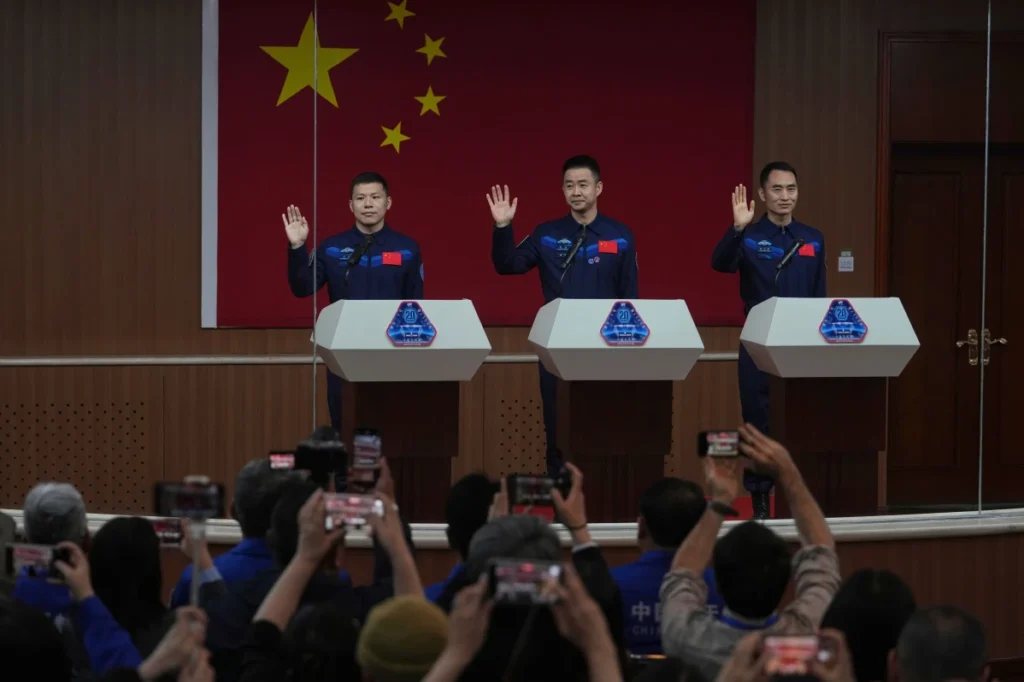
Their return was delayed for nine days, and their 204-day stay in space was the longest for any astronaut at China’s space station.
It wasn’t clear if the change in spacecraft would affect the timing of future missions to the Tiangong space station, where new crews typically swap in every six months. The space agency said that Shenzhou-22 would be launched but did not specify when.
The return capsule deployed a red and white striped parachute as it came down to a remote site in northern China’s Gobi Desert, about five and a half hours after leaving the space station.
The astronauts were carried out one by one about 30 minutes later and put into waiting chairs that were then loaded into individual orange trucks that took them away across the desert.
The temporarily stranded astronauts, who had traveled to the space station in April, conducted experiments with the new crew and were “in good condition, working and living normally,” the space agency said earlier this week.
Returning with the astronauts were four mice that also had a longer than planned stay after arriving on Shenzhou-21 about two weeks ago.
The Chinese Academy of Sciences announced that the mice were brought to study how weightlessness and confinement would affect them. The study will help in the development of technologies to breed and monitor small mammals in space.
Jiang Yue, at the academy’s space application engineering and technology center, said that the mice were monitored 24 hours in orbit to observe their activity.
The scientists found the mice adapted to the microgravity environment in a very short period of time, and that they could eat, drink and sleep on their own. The mice will be sent to a hospital for further study.
A Training Opportunity And A Real Test
Chen Dong, the Mission Commander, said that he felt at ease after their return, calling his latest space voyage both a training opportunity and a real test.
He said after emerging from the capsule that the path of human space exploration “is not smooth,” noting that it is filled with difficulties and challenges. “But that is exactly why we choose to walk this path,” he added.
China’s space program is a source of national pride. State broadcaster showed the astronauts’ return live. A Chinese national flag flapped in a stiff wind after being planted in the ground near where the capsule landed.
Besides building its own space station, China has explored Mars with a robotic rover and aims to land a person on the moon by 2030.
China developed the Tiangong space station after the country was excluded from the International Space Station over US national security concerns. China’s space program is controlled by its military.
The Tiangong, which means “Heavenly Palace,” hosted its first crew in 2021. It is smaller than the International Space Station, which has been operating for 25 years.
The International Space Station has also had delayed returns, notably that of two NASA astronauts whose one-week test flight of a new Boeing crew capsule in 2024 turned into nine months after problems cropped up with the capsule.