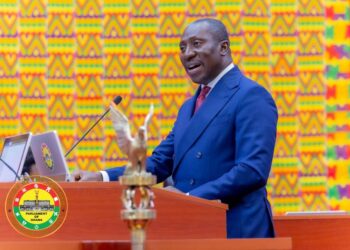

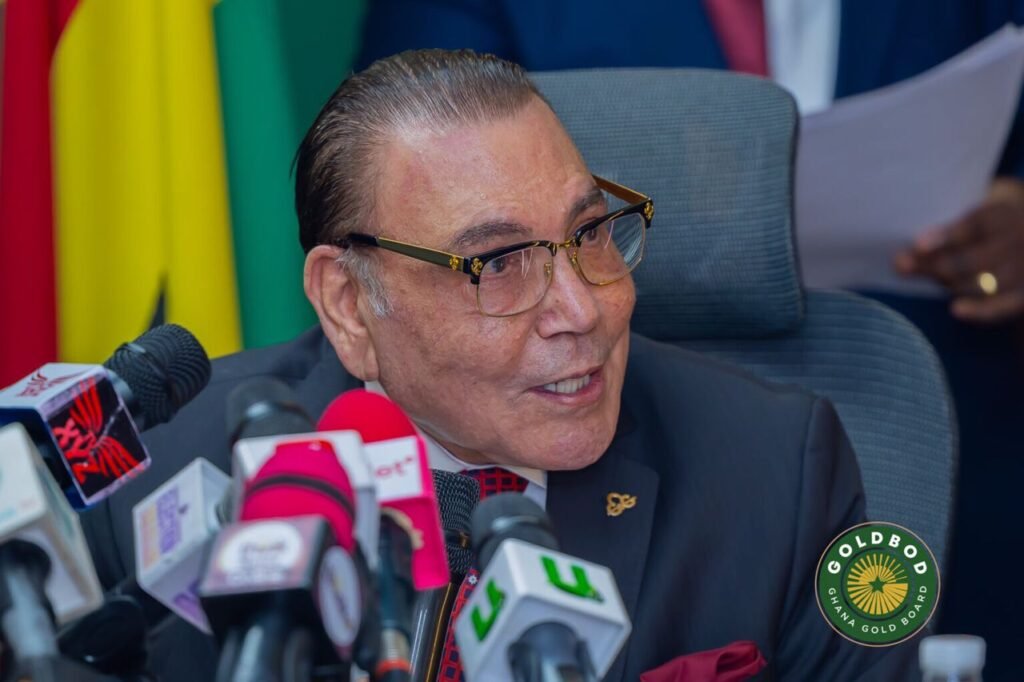
Finance Minister, Hon. Ato Forson, has emphasized that the establishment of the Ghana Gold Board (GoldBod) has fundamentally revolutionized the country’s extractive sector by shifting the focus from the export of raw minerals to aggressive value addition.
Hon. Ato Forson descried Gold Board as “revolutionary and visionary” institution which has successfully streamlined the gold industry, ensuring that the nation finally reclaims its sovereignty over its most precious resource.
This milestone marks the realization of a long-standing vision to integrate the entire gold value chain from the pits of artisanal miners to the high-precision floors of domestic refineries.
“GoldBod, I’m sure you can all see the benefits of Ghana Gold Board. It is revolutionary and it is visionary. It has changed the landscape of the gold industry in our country.”
Hon. Ato Forson
The finance minister highlighted that the GoldBod Act, passed in the first half of 2025, served as the legislative anchor for this new era of economic revitalization.
Since commencing its core operations in April and May 2025, GoldBod has aggressively mopped up gold from the Artisanal and Small-scale Mining (ASM) sector, providing a formal and transparent market that has already changed the global perception of Ghanaian gold.
By providing one tonne of gold per week to the Gold Coast Refinery with plans to scale up to two tonnes the government is effectively ending the historical reliance on foreign refineries.
This strategy not only supports the President’s vision but also powers the “24-Hour Economy” policy by creating direct employment for approximately 162 workers at the refinery alone.
Formalizing the ASM Sector and Curbing Illicit Flows

A primary benefit of the GoldBod initiative is the comprehensive formalization of the Artisanal and Small-scale Mining (ASM) sector.
By acting as the sole authorized buyer of ASM gold, GoldBod has dismantled exploitative informal networks and “brought the forest into our country” by ensuring that foreign exchange earnings are repatriated through the formal banking system.
This centralized aggregation strategy has drastically reduced the prevalence of gold smuggling, which previously deprived the state of billions in revenue.
The board’s ability to purchase an average of 2.5 tonnes of gold per week provides a ready market for local miners, incentivizing legal trade and enhancing the “traceability and international acceptability” of Ghana’s gold.
Strategic Macroeconomic Stability and Currency Strength
The activities of GoldBod are serving as a critical pillar for Ghana’s macroeconomic stability. Through the “Gold-for-Reserves” program, the board is facilitating the accumulation of gold reserves at the Bank of Ghana, which provides a robust buffer for the Ghana Cedi.
Finance Minister Ato Forson noted that the board’s operations have already begun to “change the landscape” of the foreign exchange market, reducing the perennial pressure on the local currency.
By retaining refining charges in-country costs that were previously paid to refineries in Dubai and Switzerland Ghana is significantly improving its balance of payments and ensuring that the “benefits of the gold industry are touted all over the world as a novelty” for their efficiency and impact.
Industrialization and Job Creation through Value Addition

Beyond the fiscal gains, the partnership between GoldBod and the Gold Coast Refinery signals a massive leap toward full-scale industrialization.
With the refinery now set to “refine up to two tonnes of gold per week,” the domestic industry is being positioned to produce high-purity gold that meets international standards.
This initiative has already created over 160 direct jobs, with hundreds more expected in the downstream jewelry and fabrication sectors.
The Minister emphasized that it is the government’s firm policy to ensure that “in the shortest possible time, we will not be exporting raw gold outside this country.”
By adding value locally, Ghana is not only creating wealth but also building the technical expertise required to make the nation the “gold refinery hub of West Africa.”