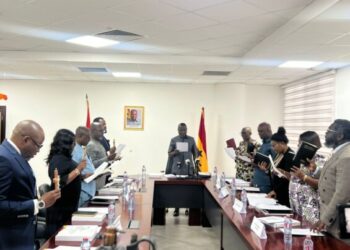
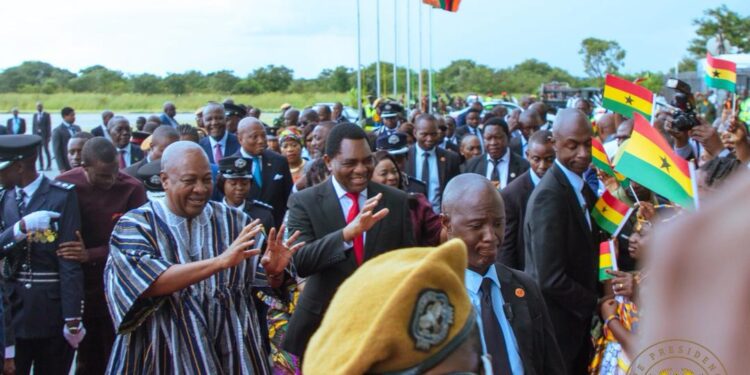
Ghana’s President HE John Dramani Mahama has used an interaction with Ghanaian nationals living in Zambia to outline and defend his government’s reset agenda, describing it as a necessary response to deep economic and governance challenges inherited after the 2024 elections.
The engagement formed part of his three-day state visit to Zambia and followed a long-standing tradition of Ghanaian leaders meeting citizens abroad during official trips. Addressing the gathering, President Mahama expressed gratitude to members of the Ghanaian community for the warm reception accorded him on arrival.
“I want to thank you for the warm welcome, especially for the welcome party that met us at the airport. Your enthusiasm was very infectious, and my arrival was being telecast live, and so your families back home saw you at the airport waving and cheering, and so I’ve got a few comments about Ghanaians at the airport and how enthusiastic you were when we arrived here”.
Ghana’s President HE John Dramani Mahama
The President also thanked Zambian President Hakainde Hichilema for the invitation to undertake the state visit, highlighting the historic bonds between Ghana and Zambia. He recalled Ghana’s role in Africa’s liberation struggle, describing the country as a hub for anti colonial movements.
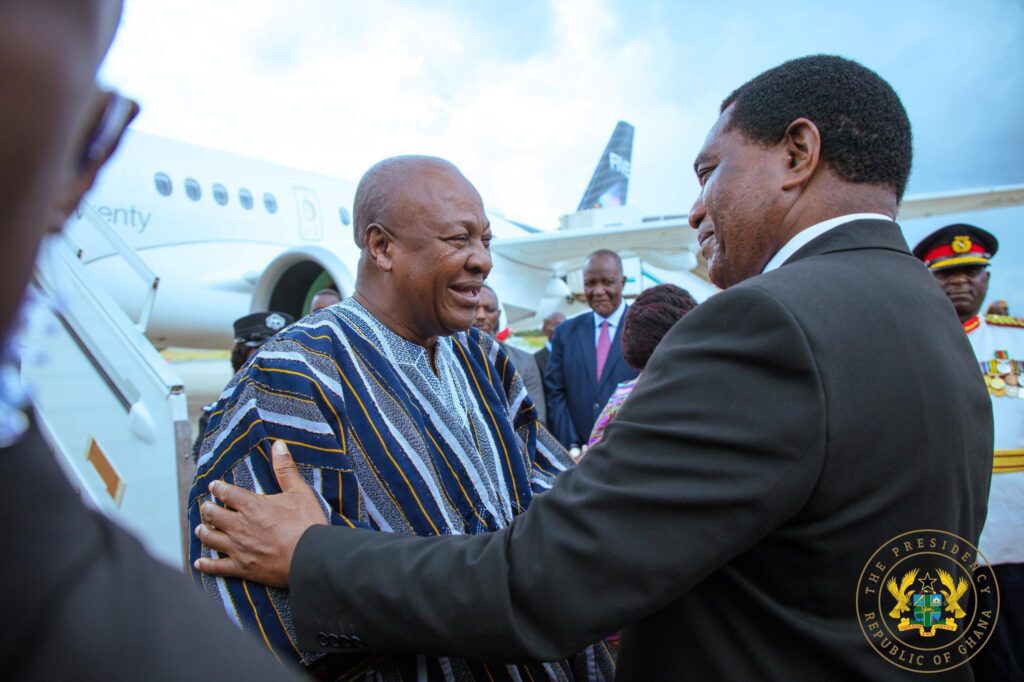
He referenced the vision of Ghana’s first President, Dr Kwame Nkrumah, who maintained that Ghana’s independence would be incomplete unless it was linked to the total liberation of the African continent, a principle that shaped Ghana’s foreign policy in the early years.
President Mahama explained that meetings with citizens abroad have remained a key feature of his travels, even though access to information has changed significantly over time.
He said the practice originated when Ghanaians living outside the country had limited ways of staying informed about events at home, relying on newspapers brought by travelers, letters from relatives, or outdated copies available at embassies.
While technology has made information instantly accessible, he argued that direct engagement remains valuable for understanding the lived experiences of citizens abroad and explaining government policies.
2024 High Stake Election
Turning to domestic politics, President Mahama reflected on the 2024 general elections, which he described as a high stakes contest that tested Ghana’s democratic maturity. He said the period was marked by anxiety and tension, but it also represented a defining moment for the country.
According to him, the election was an opportunity to demonstrate that democracy can still work in delivering progress and accountability. He noted that before the election, public confidence in democratic governance had been eroding.

Opinion surveys, he said, pointed to growing frustration over corruption, limited opportunities for young people, and perceptions that democracy was failing to improve lives.
He added that the situation was compounded by democratic backsliding across West Africa, where several countries experienced military coups, and by the fact that some Ghanaian youth were beginning to express admiration for military rule.
President Mahama said these developments made the 2024 election a make or break moment. In his view, whoever won had a responsibility to take difficult decisions to restore trust in democratic governance and prevent Ghana from sliding into unconstitutional rule.
“So what I’m doing is not for myself, it’s for our country, that we don’t also fall into the same trap where we return to unconstitutional governance. I’m doing it for all of us.
“I’m doing it for the political elites, and so there are some severe decisions that one has to take, not because I enjoy taking them but to reignite the trust of our people in our democracy”.
Ghana’s President HE John Dramani Mahama
He expressed appreciation to Ghanaians for the overwhelming mandate given to his government, noting that the two thirds majority secured in Parliament was unprecedented in the Fourth Republic.
According to him, such support places a heavy responsibility on the administration, as it reflects high public expectations. He said the mandate provides the political backing needed to undertake far reaching reforms and create new opportunities, especially for young people.
A Troubled Country and its Revival
President Mahama described the condition of the country inherited by his administration as deeply troubling. He said the economy was in crisis, governance systems were weakened, and key sectors such as education, health care, and agriculture were struggling.
He highlighted the severity of the debt situation, noting that Ghana had defaulted on its obligations, with the debt-to-GDP ratio approaching 100 percent, making it difficult to access international credit.

It was against this backdrop, he said, that his campaign centered on a reset agenda. He likened the situation to a frozen computer that cannot function no matter how much effort is applied until it is reset. In the same way, he argued, Ghana required a comprehensive reset across all sectors to restore effective governance and economic stability.
President Mahama emphasized that the reset agenda is not limited to one sector but cuts across governance, economic management, and public service delivery. He acknowledged that implementing the agenda would require tough and sometimes unpopular decisions, but said these were necessary to rebuild confidence and set the country on a sustainable path.
He concluded by assuring Ghanaians in Zambia that their concerns and contributions remain important to national development. He encouraged them to stay engaged with developments at home and to see themselves as partners in Ghana’s effort to rebuild institutions, strengthen democracy, and restore economic stability through the reset agenda.
READ ALSO: Ghana Inflation Plunges to 3.8% Low